



Hommage | Témoignages
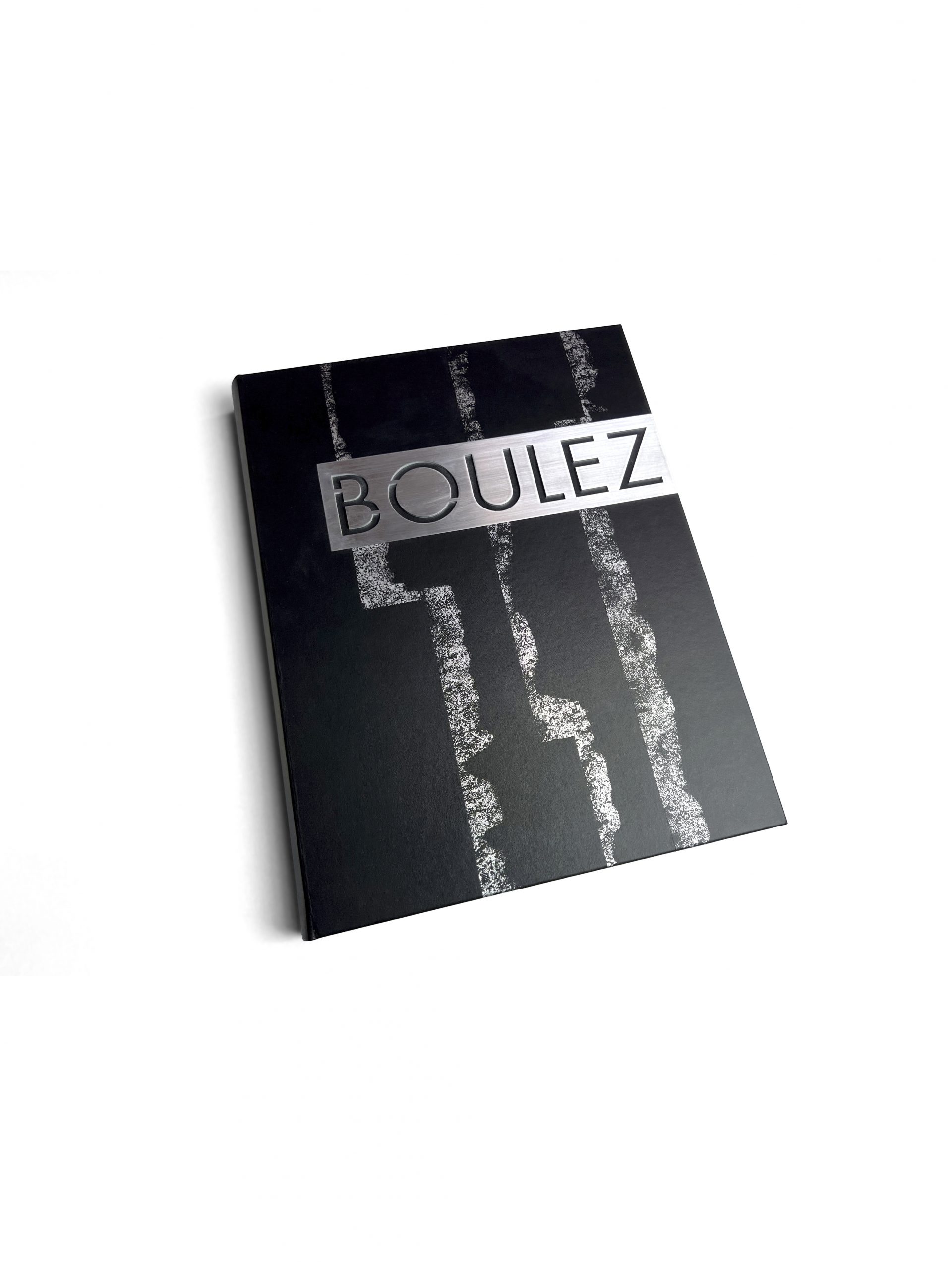
The book contains original contributions by 22 major figures from the worlds of music, architecture, literature and research: Marie-Hélène Arbour, Michel Archimbaud, Daniel Barenboim, Jean-Pierre Changeux, Sophie Cherrier, Angela Ida de Benedictis, Giuseppe di Giugno, Michel Fano, Ralph Fassey, Pascal Gallois, Marie-François George, Andrew Gerszo, Susanna Mälkki, Philippe Manoury, Brigitte Marger, Alessandro Melchiorre, Emmanuelle Ophèle, Renzo Piano, Alain Planès, Jean-Guihen Queyras, Tamara Stefanovich and Suzanne Stephens, all of whom signed their contributions in pencil.
These texts accompany an exceptional set of 70 previously unpublished photographs by Ralph Fassey, who worked alongside Pierre Boulez for nearly thirty years. The photographs presented here are drawn from his archive of more than 3,000 images, offering an intimate and multifaceted portrait of a man who profoundly shaped his era and the history of music.
The volume also includes two exceptional documents: the first is a previously unpublished reproduction of Boulez’s last handwritten notes, in which he sketches his current projects and reflections on the future; the second presents four autograph electronic diagrams drawn by Giuseppe Di Giugno in 1979 for the design of the 4X machine.
Composer Luciano Berio, invited by Pierre Boulez in 1974 to head the electroacoustic section of Ircam, oversaw a project for the real-time synthesis and transformation of complex sounds. The following year, Giuseppe Di Giugno and Ircam researchers developed several successive versions of digital processors: the first prototype, 4A, followed by 4B and 4C, culminating in 1981 in the highly powerful 4X system.
This “4X musical workstation” allowed musicians to analyze, synthesize and digitally manipulate sound, creating new sonorities and transforming in real time the sound produced by traditional instruments. Pierre Boulez was the first to use the 4X, for his work Répons in 1981: “Twenty-four instrumentalists occupy a central stage around which the audience is seated; this central orchestra undergoes no sound transformation from the electroacoustic and computer system. The audience itself is surrounded by six soloists and six loudspeakers that reproduce their sound, processed in real time. The sounds produced by the soloists are processed in real time by the 4X and fed back through loudspeakers also placed behind the audience” (Notice de la station 4X de l’Ircam used in this concert, now preserved at the Musée de la Musique — Cité de la musique, Philharmonie de Paris, shelf mark E.996.29.1, online).
All copies of the book are bound identically by Luigi Castiglione, art bookbinder.