

Sérotonine
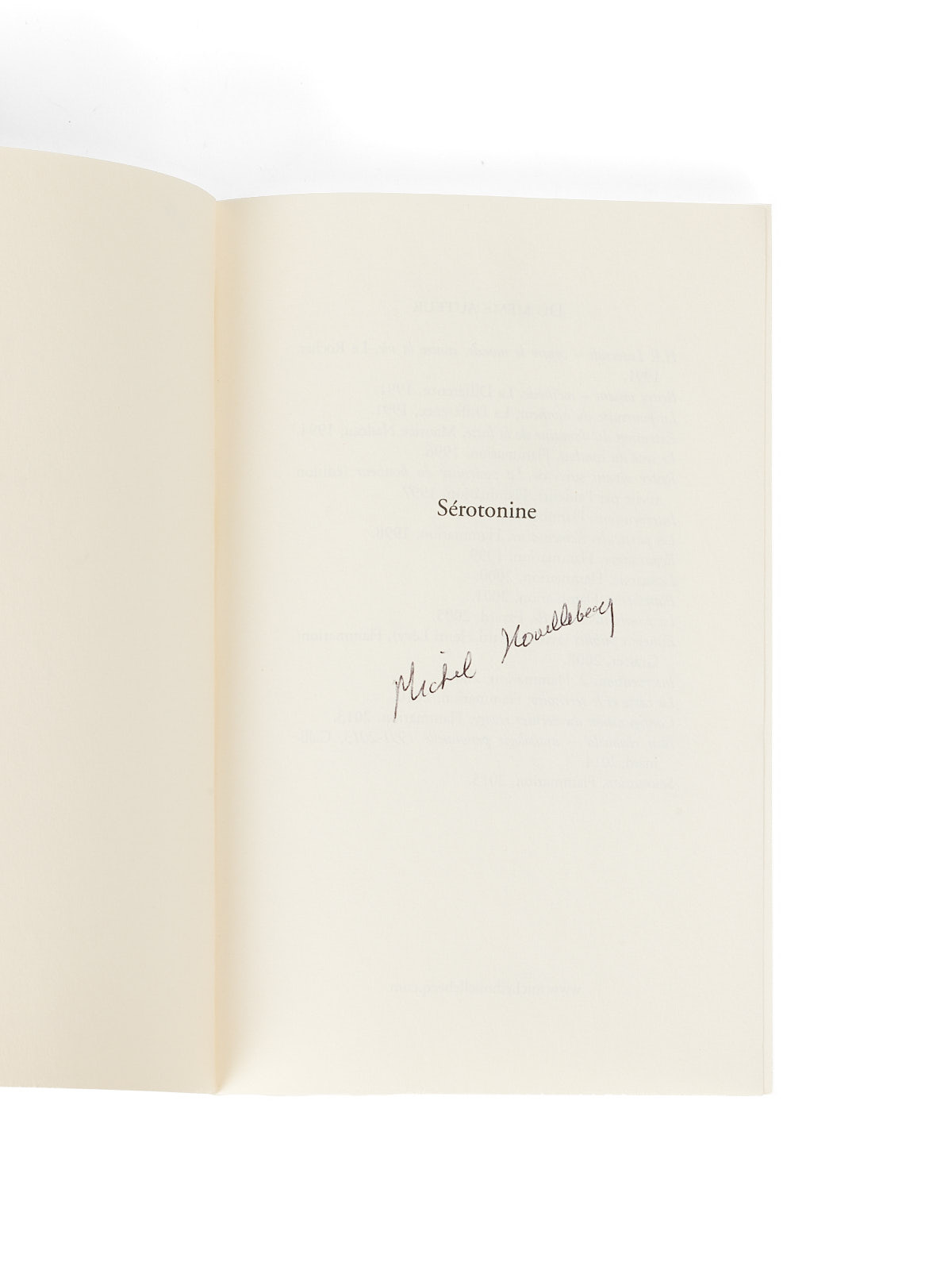
Signed by the author.
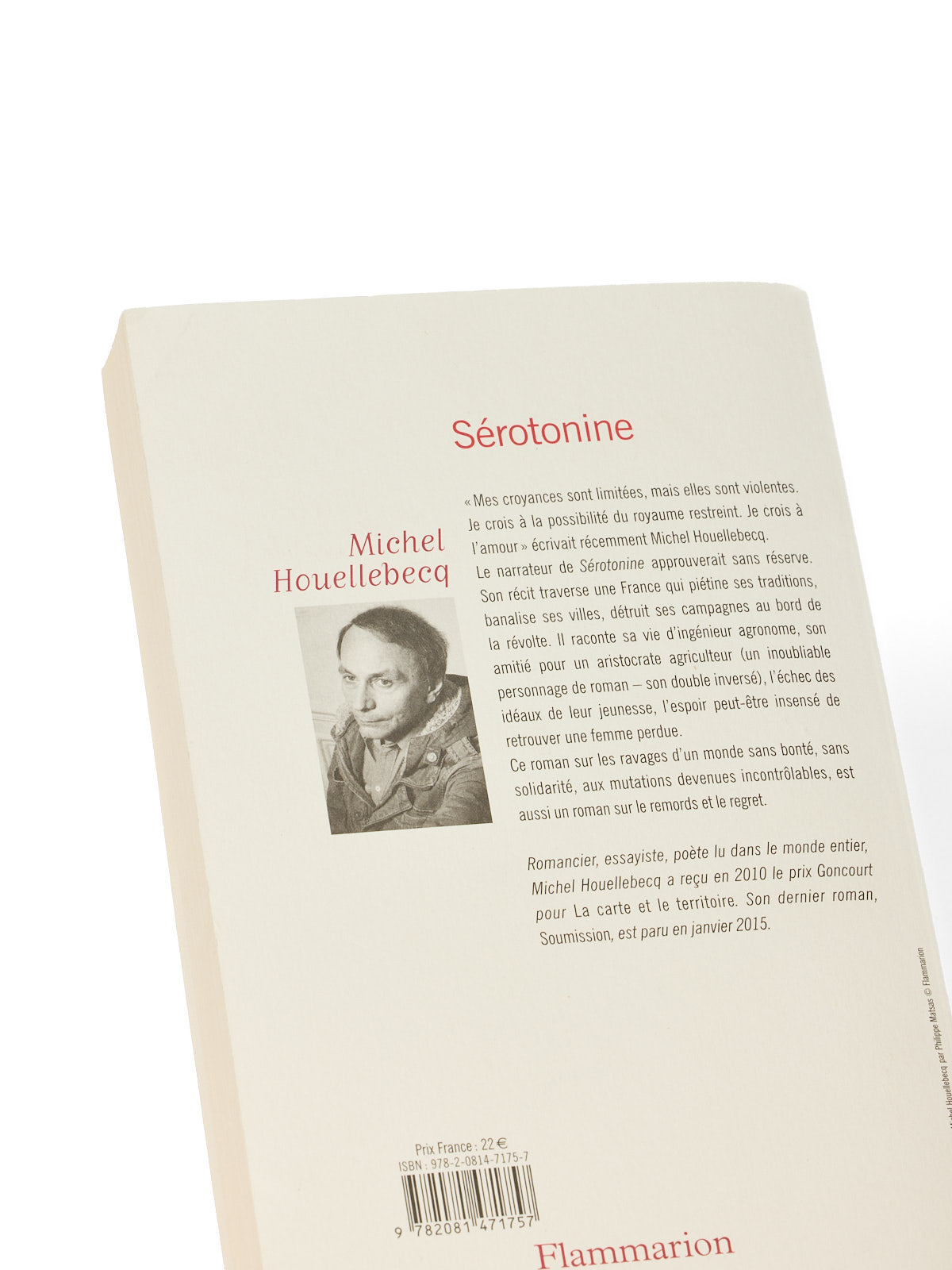
Sérotonine is a treatise on decline, addressing the decline of the West, the European Union, France, and God. The hero — or anti-hero —, Florent-Claude Labrouste, is a forty-six-year-old agricultural engineer employed at the Ministry of Agriculture, in a relationship with a twenty-six-year-old Japanese woman, who is dying “of grief” and survives thanks to a drug, Captorix, which stimulates the production of serotonin, a “hormone linked to self-esteem,” which the author defines from the incipit: “It is a small white, oval, scored tablet.” Florent-Claude Labrouste decides to disappear. First in a Mercure hotel near the Place d’Italie, then in Basse-Normandie, “an abandoned territory, populated by suicidal farmers condemned by Brussels’ European policy.”
Houellebecq, the novelist of contemporary man’s solitude, hammers the same nail with obstinate persistence, even at the cost of oversimplification, admitting as much himself: “yes, I’m simplifying, but one must simplify or nothing gets done.” He thus reveals his own method: “Had we been in a romantic comedy, I would have done this […]. Had we been in a porn film, what followed would have been even more predictable […]. We were in reality, and so I went home.” An implacable, disenchanted machine.