

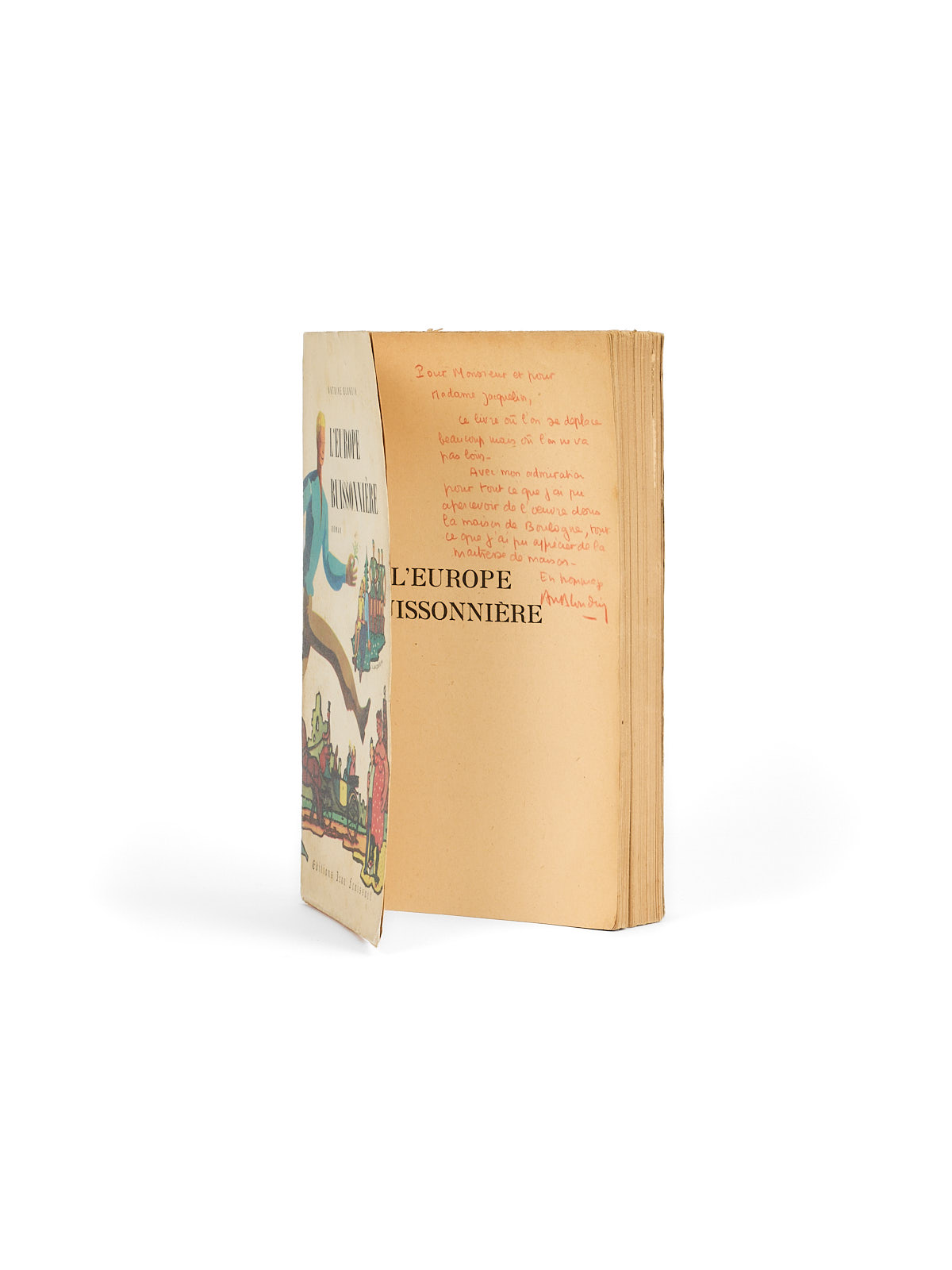
L’Europe buissonnière
Presentation copy inscribed by Blondin to Monsieur and Madame Jacquelin:
“Pour Monsieur et pour Madame Jacquelin, ce livre où l'on se déplace beaucoup mais où l'on ne va pas loin. Avec mon admiration pour tout ce que j'ai pu apercevoir de l'œuvre dans la maison de Boulogne, tout ce que j'ai pu apprécier de la maîtresse de maison. En hommage. Antoine Blondin.”
Antoine Blondin, the only child of bohemian parents, achieved fame with the publication of his very first book, L’Europe buissonnière. The novel — arguably the most irreverent book ever written about the Second World War — caused a stir for its lighthearted treatment of the German occupation. It follows Muguet and some twenty other characters wandering across Europe, their only conquest being that of women: a story imbued with a lightness of spirit, somewhere between the naivety of Candide and the freedom of Don Quixote, who lets himself be led wherever his mount chooses to go.
Marked by an anticommunism as blunt as it was courageous for its time, Blondin delights in irreverent puns and iconoclastic wordplay: “Il souffrait en outre d’une affection commune à la plupart des chefs de cette époque-là : il avait le mal du Péguy”; “- Rylka, tu es enceinte ? – Je ne sais pas, répondit-elle. Je suis tellement désordonnée.”
The novel was awarded the prix des Deux Magots in January 1950 — “a striking coup: that this author’s first literary distinction should be a café’s prize is anything but trivial, given how much of his life he would go on to spend in them,” notes Étienne de Montety, the prize’s current president, wryly. The prize, created in 1933 in reaction to the Prix Goncourt, later honored Raymond Queneau, Pauline Réage, Paul Morand, Sébastien Japrisot and Christian Bobin.
Ten years later, Blondin would receive the prix Interallié for his novel Un singe en hiver.
A fine copy with a delightful provenance: that of Jean Jacquelin, designer and creator of the illustrated wrapper covering the book.