

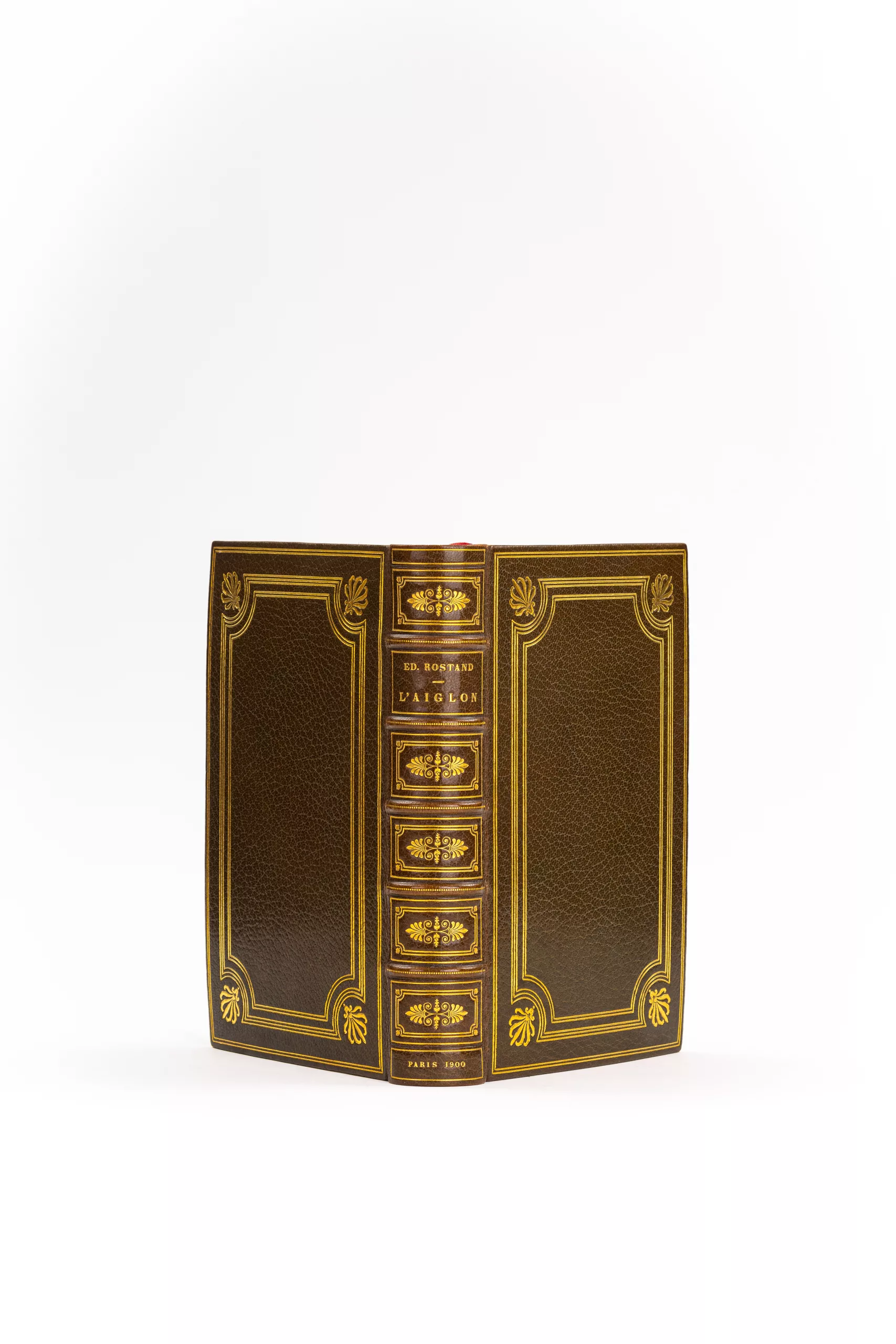
L’Aiglon. Drame en six actes, en vers.
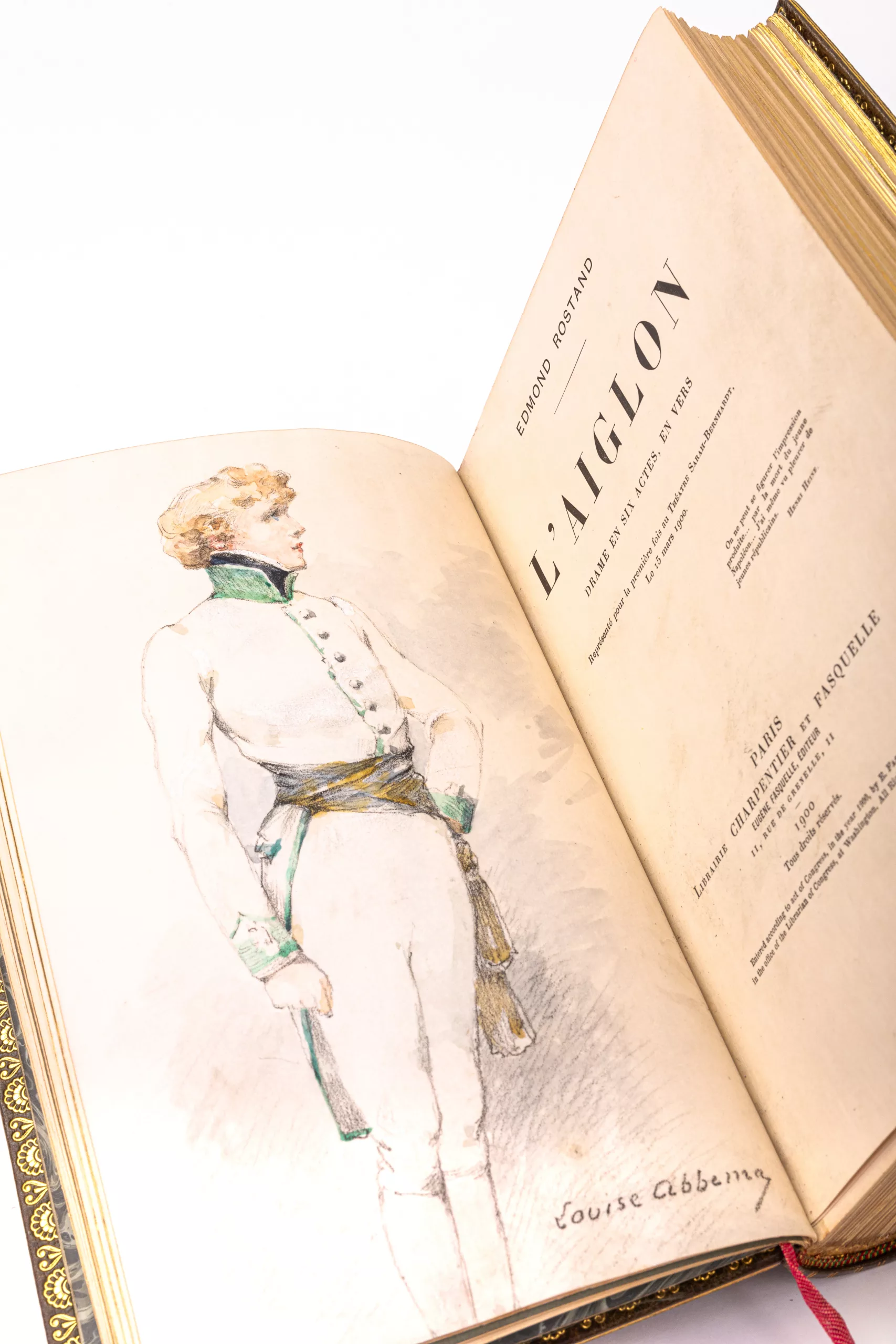
– an original watercolor by Louise Abbéma, for the frontispiece, depicting Sarah Bernhardt in the role of the Aiglon;
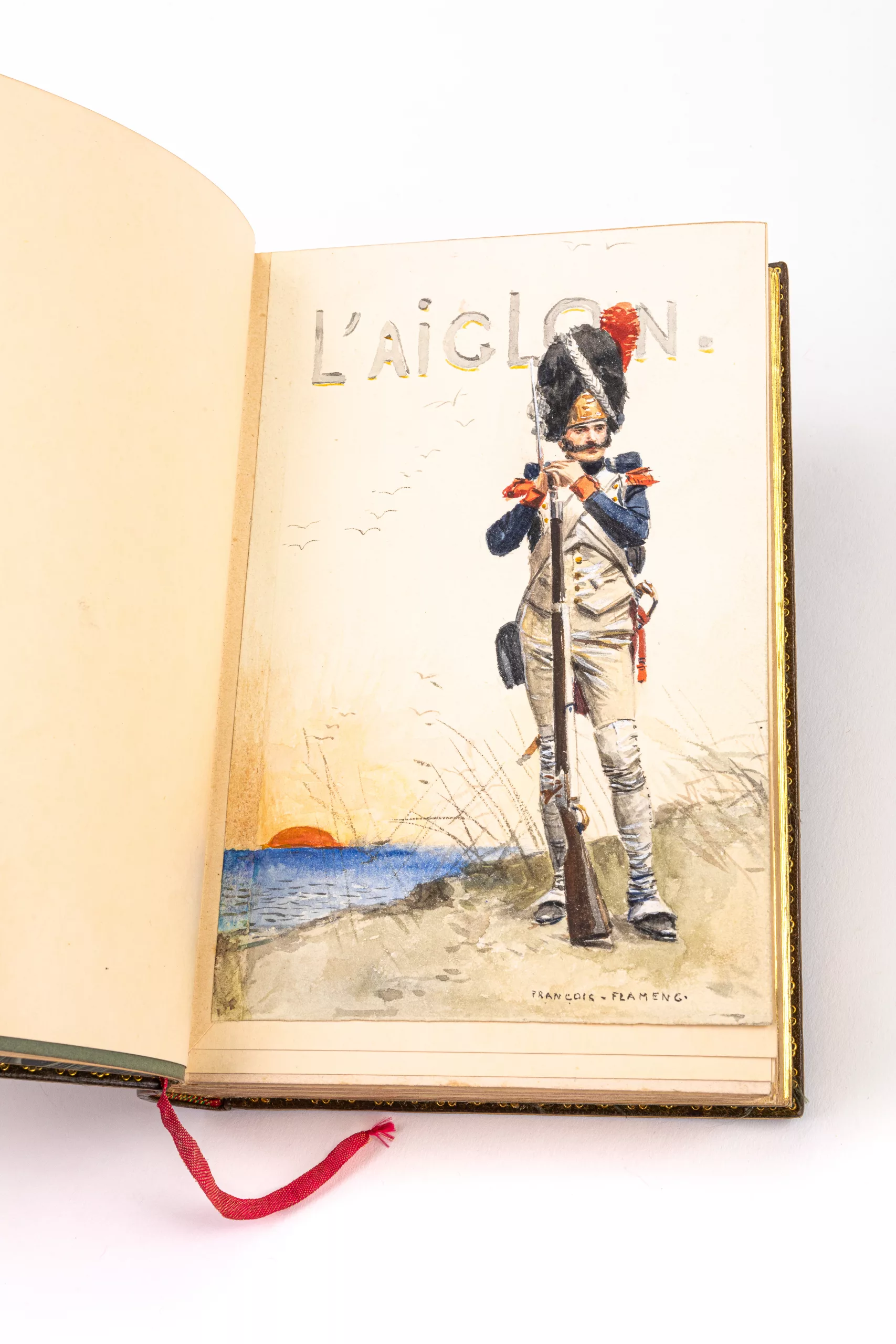
– an original watercolor by François Flameng, for the character of Flambeau;
– two early etched portraits of the Duke of Reichstadt.
The work is further enriched with two historical documents of importance:
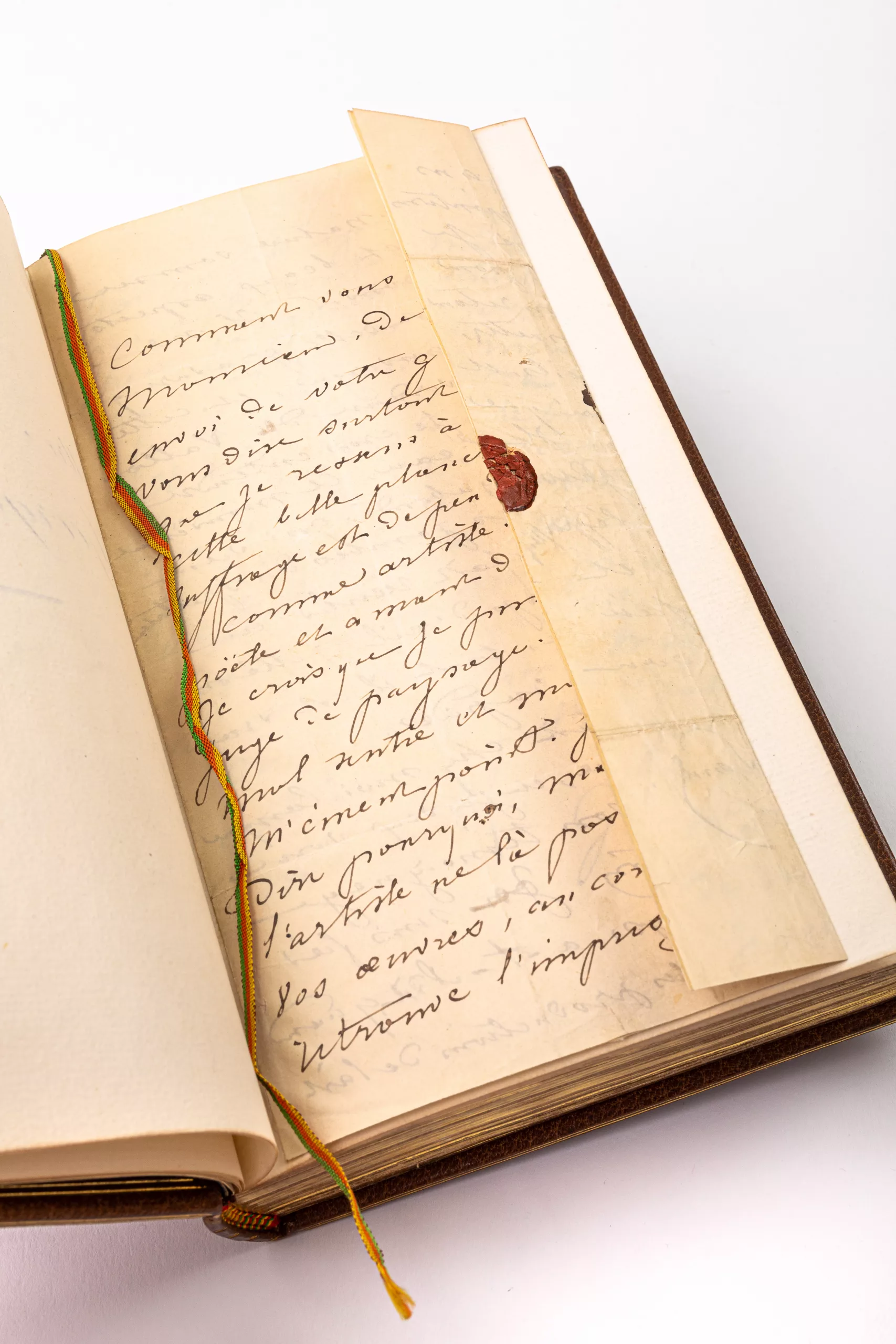
– the letter of Emperor Francis II of Austria to Napoleon, in which the Austrian sovereign agrees to be godfather to the Aiglon, King of Rome. Dated 22 May 1811, from Vienna, it informs Emperor Napoleon I, “mon frère et cher Beau-fils,” of the “fonction de parrain, à juste titre chère à mon cœur, à laquelle votre Majesté Impériale m'appelle, [qui] m'offre une occasion de lui prouver ma considération particulière. Je charge mon ambassadeur près de votre Majesté de porter au Roi de Rome la Grande croix de mon ordre de Saint-Étienne. Je désire qu'un jour cette décoration lui rappelle le lien qui va s'établir entre lui et son grand-père (…) [signée :] le bon Frère et Beau-père, François.”
– an autograph school exercise by the Aiglon, a lesson entitled “Du Participe présent”: “Le Participe présent se termine toujours en ant. Aimant, ayant, étant, suivant. Il est invariable dans sa terminaison, de sorte qu'il s'applique indifféremment aux trois personnes, de quelque genre et de quelque nombre qu'elles soient. Exemples : j'ai trouvé vos frères arrivant dans la campagne. J'ai trouvé vos frères vos sœur descendant de voiture. Il a rejeté les anglais marchant à l'avant. On l'appelle participe présent parce qu'il indique une action, etc.” The young man's handwriting is highly careful for this exercise, with a few light cancellations and overwritings, mostly corrections to the autograph text. Note two words in pencil in the margin, where the Aiglon hesitates over the spelling of a word: “tiran - tyran.” A charming detail.
The copy is further inscribed to Arthur Meyer, with a long dedication in verse by Edmond Rostand, enriched with a large original pen drawing, in the same ink, depicting the young Aiglon standing full-length in his study at Schönbrunn.
The Bibliothèque nationale de France has held, since the nineteenth century, a series of documents on Napoleon I’s son, from his birth at the Tuileries to his death in Vienna in 1832. He was born on 20 March 1811, when one hundred and one cannon shots announced to Parisians the long-awaited birth of the Emperor’s son. Constitutionally granted the title of “Prince Impérial,” he also received that of “King of Rome”; his baptism was celebrated on 9 June at Notre-Dame Cathedral in Paris. The defeat at Waterloo forced Napoleon I to abdicate in his favor, but Fouché’s provisional government acted as though nothing had happened, and the chambers refused to proclaim the child who, since 1814, had been in exile at the Austrian court. He remains, in history, the one who “reigned” for twenty days, from 22 June to 7 July 1815.
In Vienna, he received a thorough religious, philosophical and military education, under the affectionate care of his grandfather, Emperor Francis II (defeated at Austerlitz and Wagram), who, to seal peace and the Treaty of Schönbrunn, had given Napoleon his elder daughter, Marie-Louise of Austria, who became Napoleon’s second wife. After Napoleon’s abdication in 1815, Francis II gave him the title of Duke of Reichstadt. He was raised by his mother and his aunt, Archduchess Sophie, under the guardianship of Count Dietrichstein, whose substantial correspondence the BnF acquired in 2015. The Prince Impérial died on 22 July 1832, only twenty-one years old, at the Palace of Schönbrunn. The diagnosis was of fulminant tuberculosis, though the theory of poisoning has never been ruled out. Without marriage or descendants, his death nonetheless put an end to the fascination and apprehension of Europe’s great courts regarding a possible return to power of Napoleon I’s only legitimate descendant.
The copy is further inscribed to Arthur Meyer, with a long dedication in verse by Edmond Rostand, enriched with a large original pen drawing, in the same ink, depicting the young Aiglon standing full-length in his study at Schönbrunn. In military dress, he speaks these words: “Voici donc les soldats de Napoléon II ! / Pareil au prisonnier rêveur qui se ferait / Toute une frémissante et profonde forêt / Avec l’arbre en copeaux d’un jardin de poupée, / Rien qu’avec ces soldats je me fais l’Épopée !” This echoes the famous “military tactics” scene, in which Prokesch teaches him the rudiments of strategy: “Je vous soumets un plan. Faites-m’en la critique / Attends ! Prends-moi d’abord – là, dans ce coin, tu vois ? / – La grande boîte où sont tous mes soldats de bois ! / Ma démonstration, je vais bien mieux la faire / Avec notre petit échiquier militaire.”
Rostand’s play premiered on 15 March 1900 — Paul Morand, in 1900, evokes the fevered excitement of all Paris that evening — at the Théâtre Sarah-Bernhardt, with Sarah Bernhardt (dressed as a man) in the role of the Aiglon, and Lucien Guitry, then Coquelin aîné, in the role of a grognard of Napoleon’s Guard who makes his way into Schönbrunn to see the Aiglon, not in the livery of a Viennese footman but in the uniform of the Empire. The play gave Rostand the occasion for several famous lines, such as “des petits, des obscurs, des sans-grades” (Act II, scene 9).
From the library of Arthur Meyer (sale, Mes livres, mes dessins, mes autographes, Paris, Drouot, 1921).