

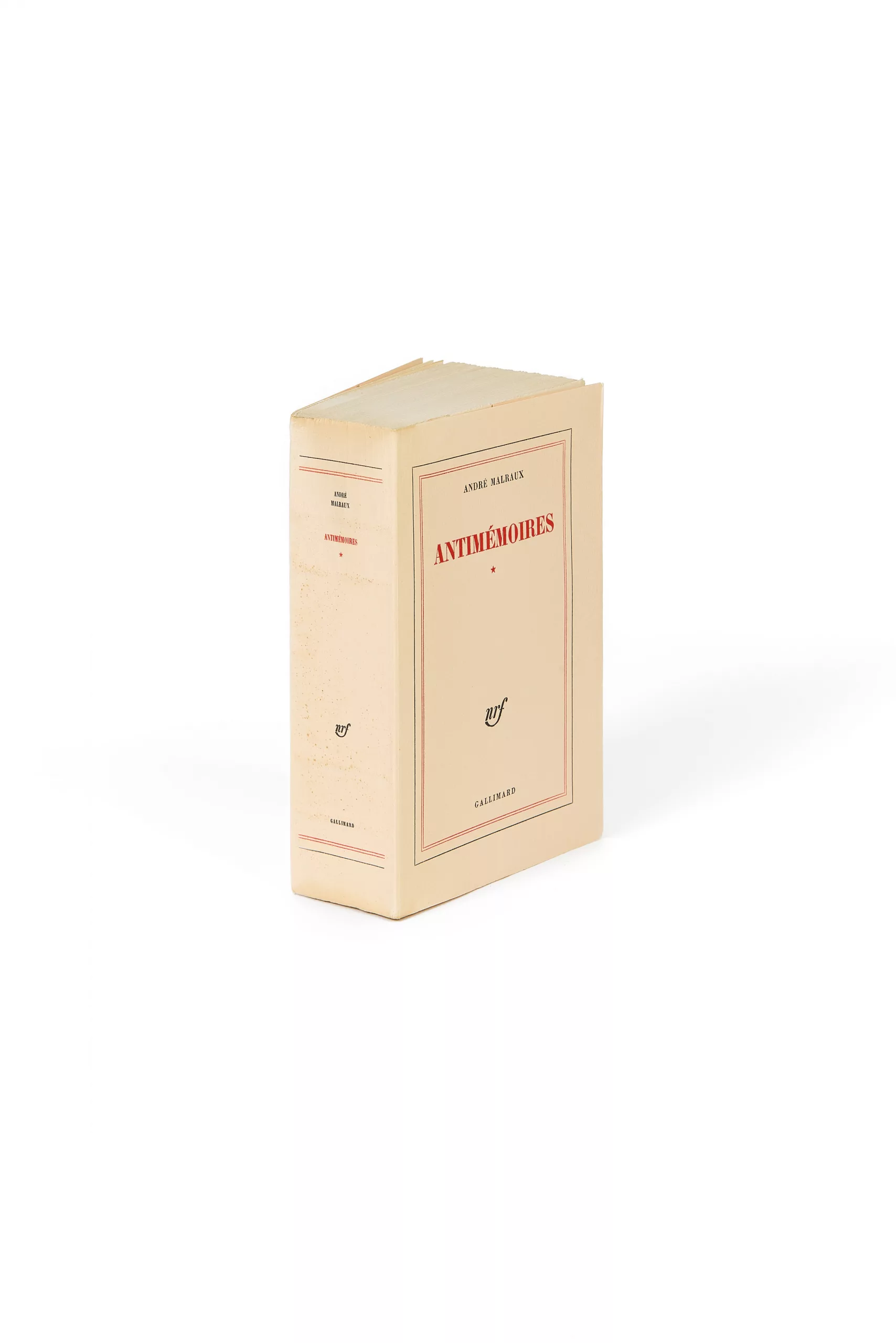
Antimémoires
One of the first 80 copies on vélin de Hollande (no. 43).
The copy is enriched with the Christmas card Malraux reserved for the end of that year, 1967, reproducing an illustration from 1667, with an autograph note.
“Why remember?”, Malraux asks at the opening of his Antimémoires, recalling the chaplain of the plateau des Glières, for whom “there are no grown-ups.”
First published in 1967, these memoirs that claim not to be memoirs form the first part of Le Miroir des limbes. Jean Schlumberger admired the “secret architecture” of the Antimémoires; on 9 October 1967 he wrote to Malraux with striking precision, in what remains one of the finest analyses of the book: “…you are a man in whose feelings death has wrought harsh ravages; […] Behind your eloquence there is that silent note which I value more than eloquence itself” — that famous eloquence which Malraux found so hard to shed, and which drew some criticism. And yet, as Schlumberger sensed: “The whole ending of your book did not merely interest me: it moved me.”