

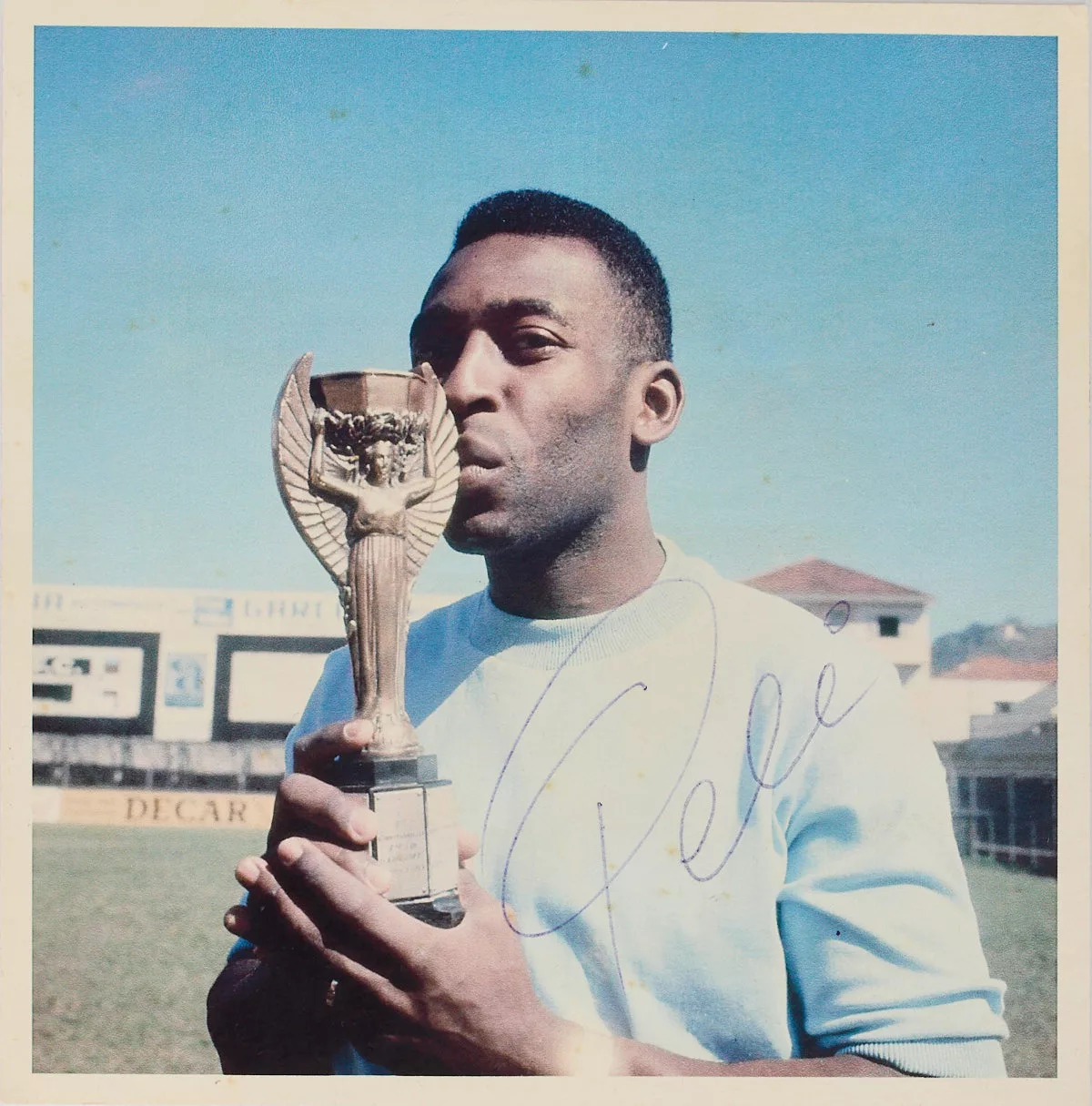
Photographie en couleurs du joueur avec la Coupe Jules Rimet
In many respects, this World Cup was a series of firsts. For the first time, player substitutions were permitted during World Cup matches, with two substitutions allowed per team per game; it also saw the first use of yellow and red cards to signal warnings and expulsions respectively, and it was the first World Cup to be televised in color. Also for the first time, in order to accommodate European broadcast schedules, several matches — including the opening match, the quarterfinals and the final — were played at noon, an unpopular decision with many players and coaches given the intense heat in Mexico at that hour.
This edition also marked the return of Africa, with the participation of Morocco, the second African nation to reach the final phase after Egypt in 1934, and the unprecedented presence of Israel, representing the Asian continent. Brazilian coach Mário Zagallo became the first footballer to be crowned world champion both as a player (1958, 1962) and as a coach (1970) — a feat since matched by Franz Beckenbauer and Didier Deschamps. Finally, Pelé ended his World Cup career here as the first player to have won three World Cups.
With this third victory (following those of 1958 and 1962), Brazil earned the right to keep the Jules Rimet Cup permanently, the trophy with which Pelé poses here. It has since disappeared: it was stolen in 1983 in Rio de Janeiro and has never been recovered.