

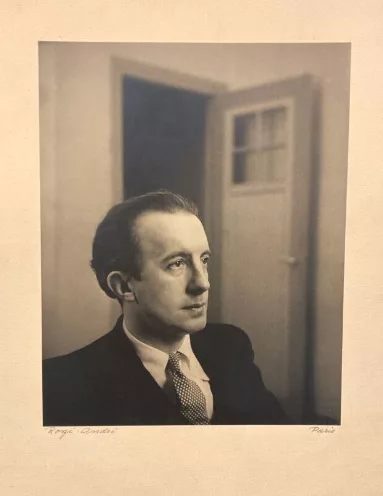
Rosa Klein was for a time married to André Kertész, who introduced her to photography in the 1920s. Amid the intellectual ferment of Paris, she formed close ties with avant-garde artists, notably the Surrealists, of whom she produced numerous portraits, following Kertész’s advice: “Never photograph something for which you feel little enthusiasm, but only what interests you passionately.” She favored — an innovation at the time — photographing her sitters within their own surroundings, and some critics have detected a Cubist influence in her portraits, for instance when she builds a geometric composition through the play of light and shadow, as here, in this portrait using the elements of the room in which Éluard is seated.
In 1941, during the Second World War, Rogi André was forced to flee to the free zone and take refuge in Touraine because of her Jewish origins, before returning to Paris, where she went into hiding with the help of the gallery owner Jeanne Bucher.
She died on April 11, 1970, in Paris, in poverty, and all her modest possessions were sold at the Hôtel Drouot. Part of her archives, notably her prints, were nevertheless saved from dispersal through the efforts of Jean-Claude Lemagny, curator in charge of contemporary photography at the Département des Estampes et de la Photographie of the Bibliothèque nationale de France, who acquired them for the BnF collection, which holds a print of this photograph (shelfmark 40299995), unsigned; a later print, from 1982, is held by the Centre Pompidou (AM1983-429).
Another print of this image is also known, unsigned by the photographer but presented, with a dedication, by Paul Éluard to Max-Pol Fouchet.
These are the only three known prints. Our print, produced by the artist in 1944, is the only one that is signed, here twice: on the photograph itself, and on the mount.