

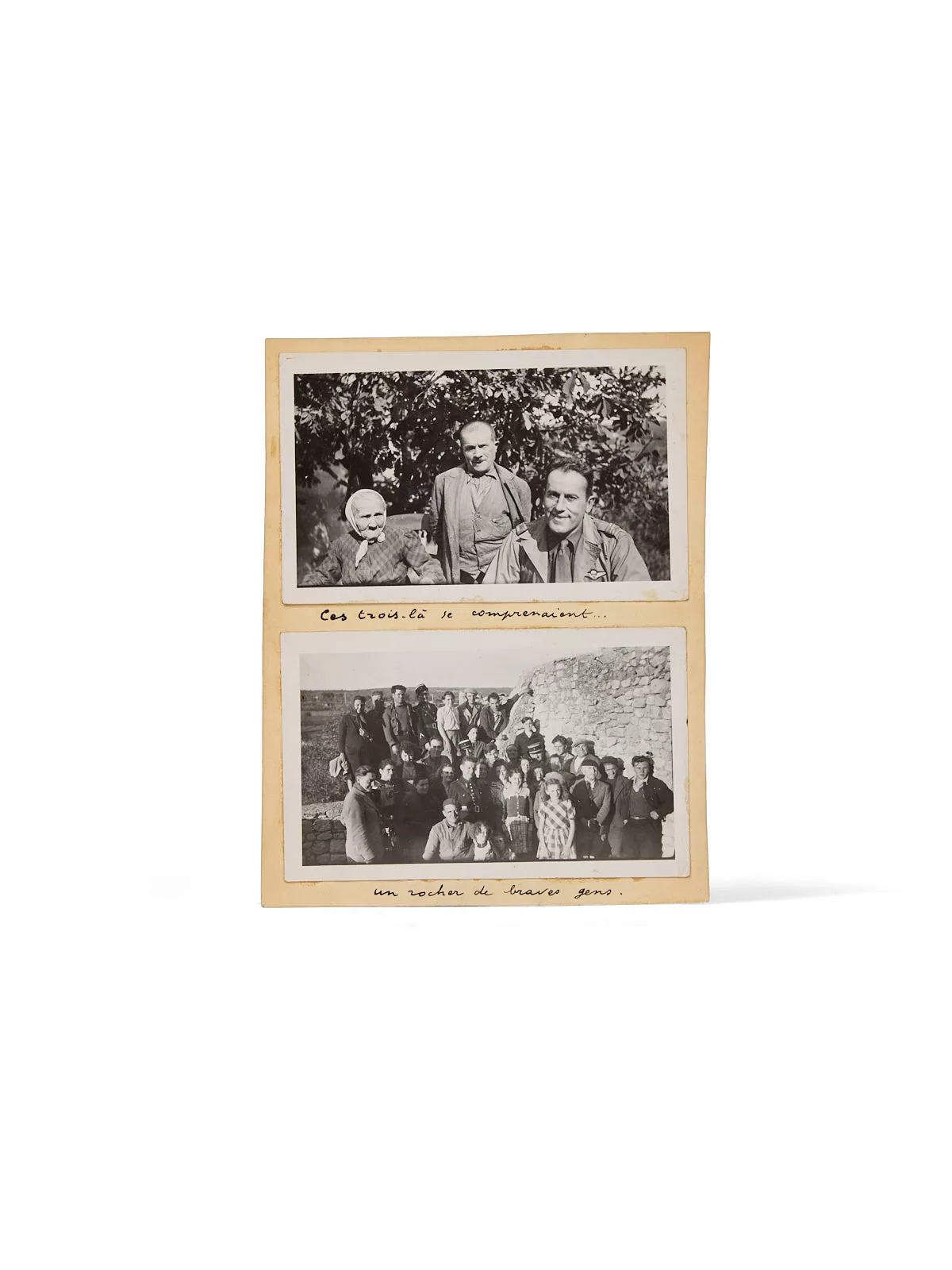
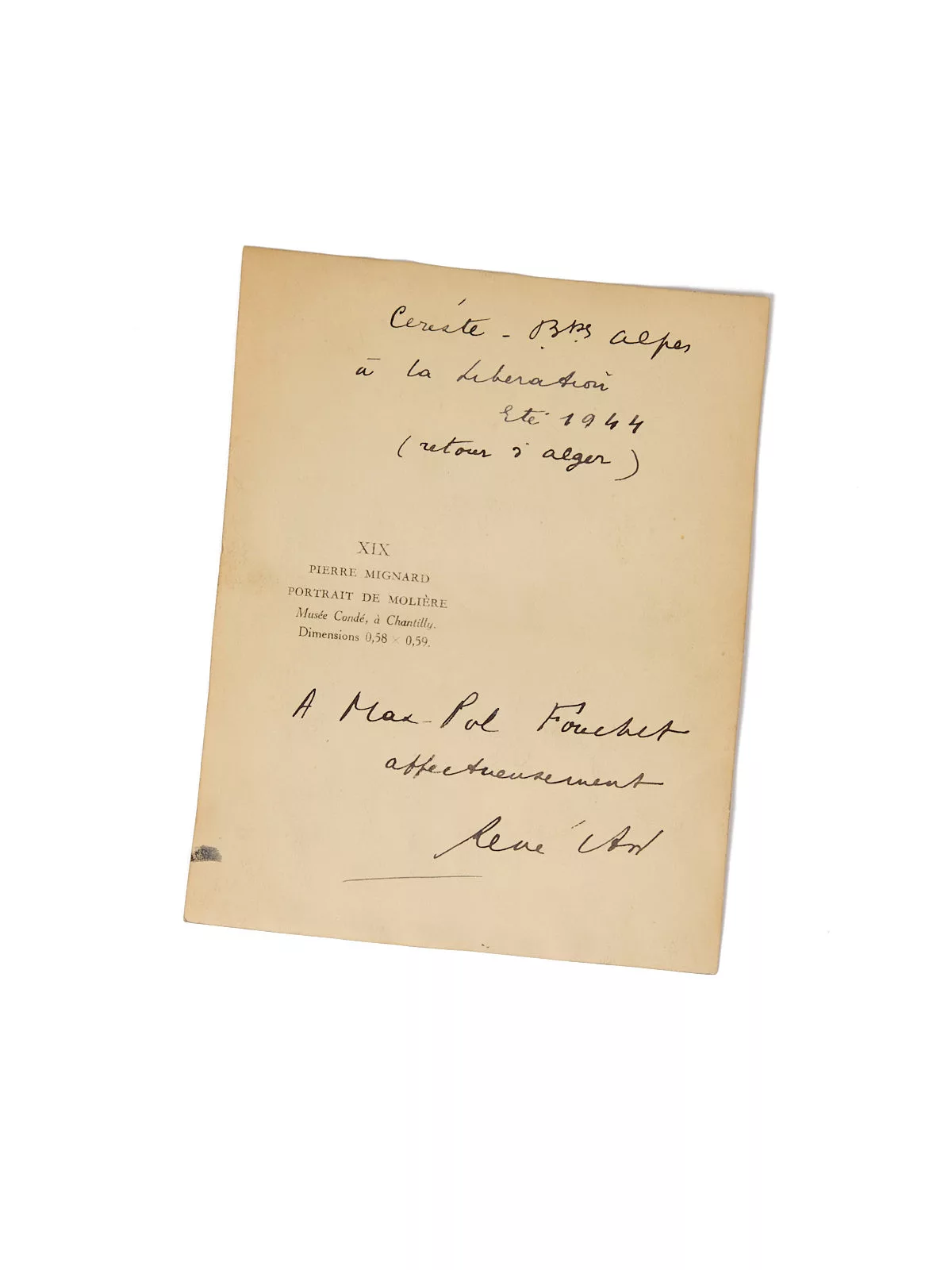
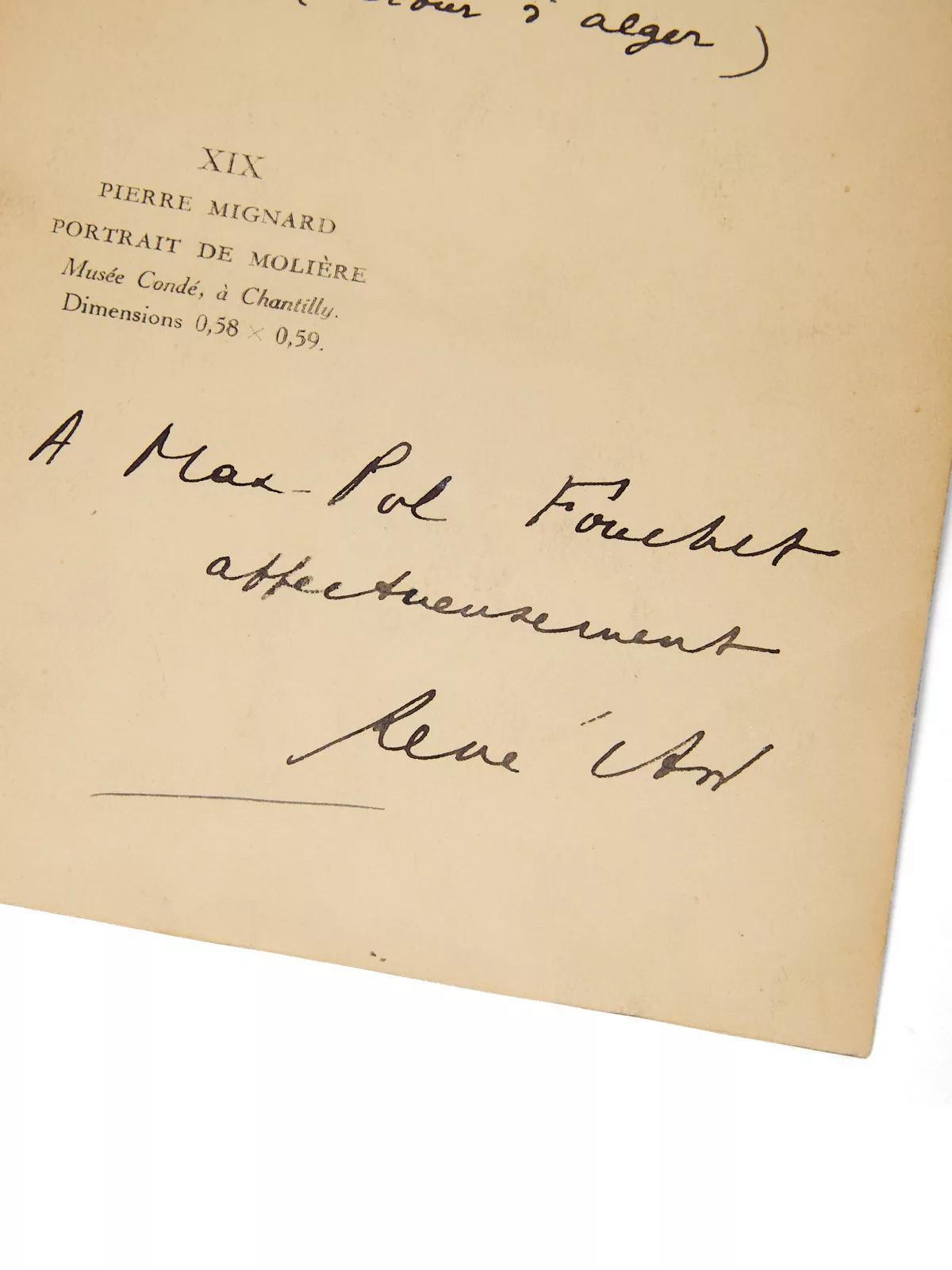
Signed presentation inscription on the verso: “À Max-Pol Fouchet, affectueusement, René Char,” with the autograph note “Céreste, basse Alpes, à la Libération, Été 1944 (retour d'Alger).”
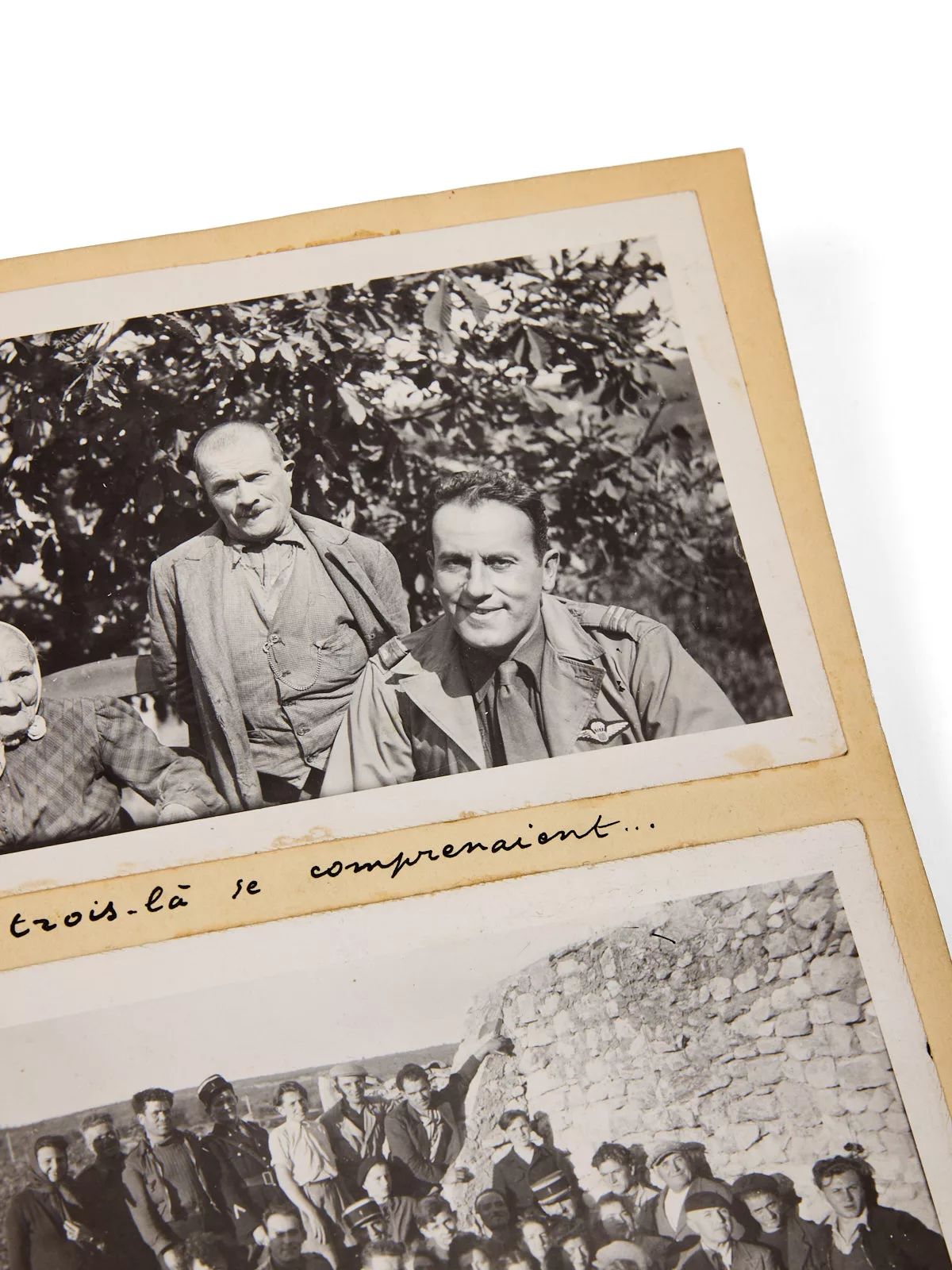
The first photograph shows René Char wearing an American M-41 Field Jacket bearing captain’s stripes and an R.A.F. parachutist’s cloth badge, together with the Ginoux family — the village roadmender and his mother, of whom Char later recalled, “fearing a search, [I] once asked her to hide codes and other important documents under her petticoats” (René Char, Bibliothèque nationale, p. 76). The poet captioned the print in his own hand: “ces trois-là se comprenaient…” The second photograph, taken the same day, also at Céreste, shows him in the same uniform among a group of villagers and a few gendarmes, with another caption in his hand: “un rocher de braves gens.” The young girl in a checked dress standing in the front row is Mireille Sidoine, the eleven-year-old daughter of Marcelle Sidoine-Pons, the “renarde” of poem 222 of the Feuillets d’Hypnos.
These photographs were taken by Irisson, Char’s photographer friend, with a view to making a documentary film on the Sap and the Céreste maquis — a project that never came to fruition.
Char gave these prints to the man who had probably “resisted through Letters” most effectively while abroad: Max-Pol Fouchet, whom he had met the previous summer in Algiers. These photographs were probably given by René Char to Max-Pol Fouchet together with a large portrait inscribed to the “Sourcier de Fontaine,” at the time when Fouchet was preparing publication of the first extracts from the Feuillets d’Hypnos, which would appear in the journal Fontaine in October 1945.
An identical print was given to Adrienne Monnier in 1949 (Collection Pierre Leroy, 2002, no. 171), and another appears in Char’s own lettered copy A of the Feuillets d’Hypnos, later in the Maus and then Zara collections. It was first reproduced in the text of the lecture given by Gilbert Lély on René Char in 1946, in Paris.
Other later prints are known, Irisson having made several more from 1945 onward, in larger formats (100 x 170 and 120 x 180 mm).
Char, BnF, no. 100, reproduced.