

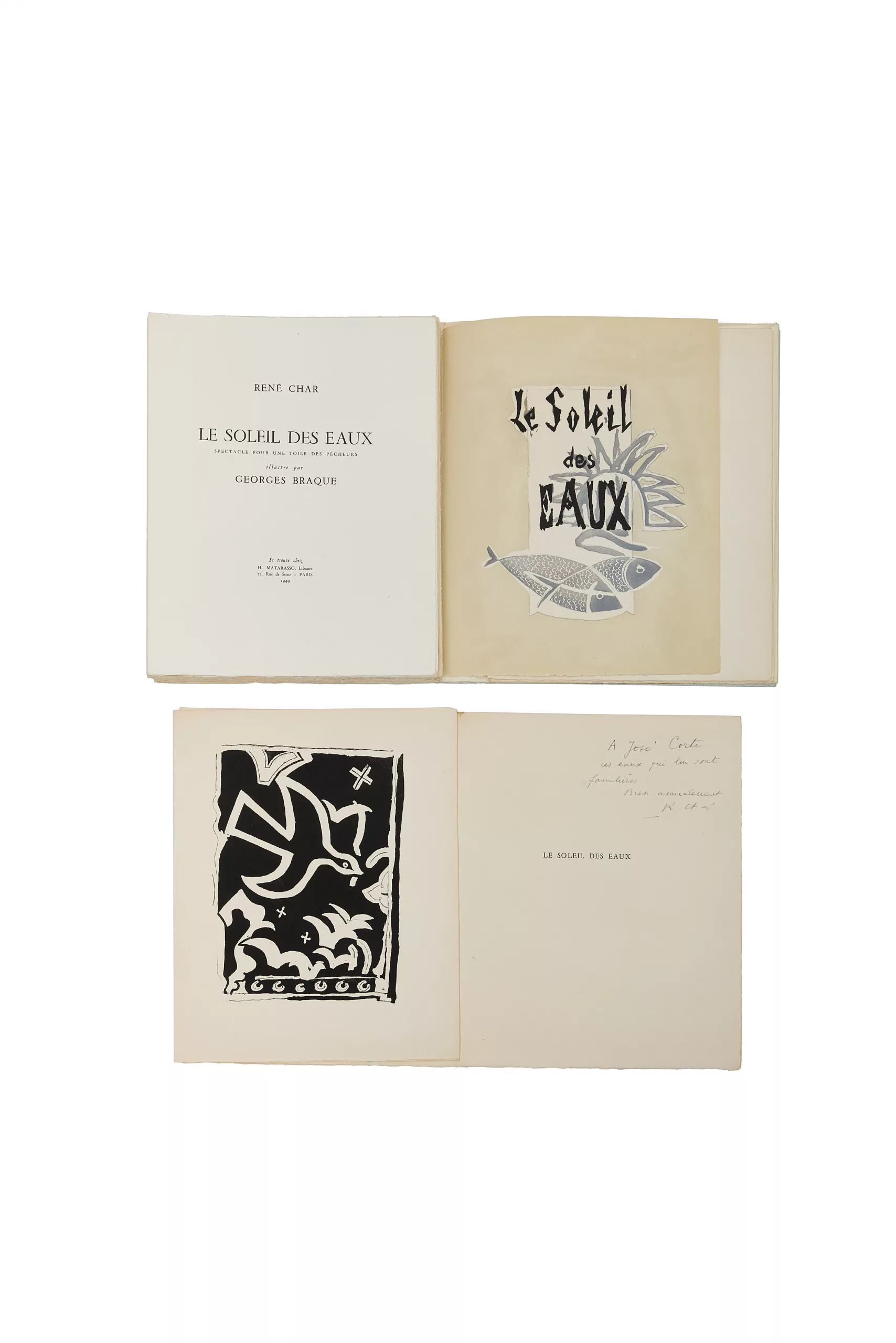
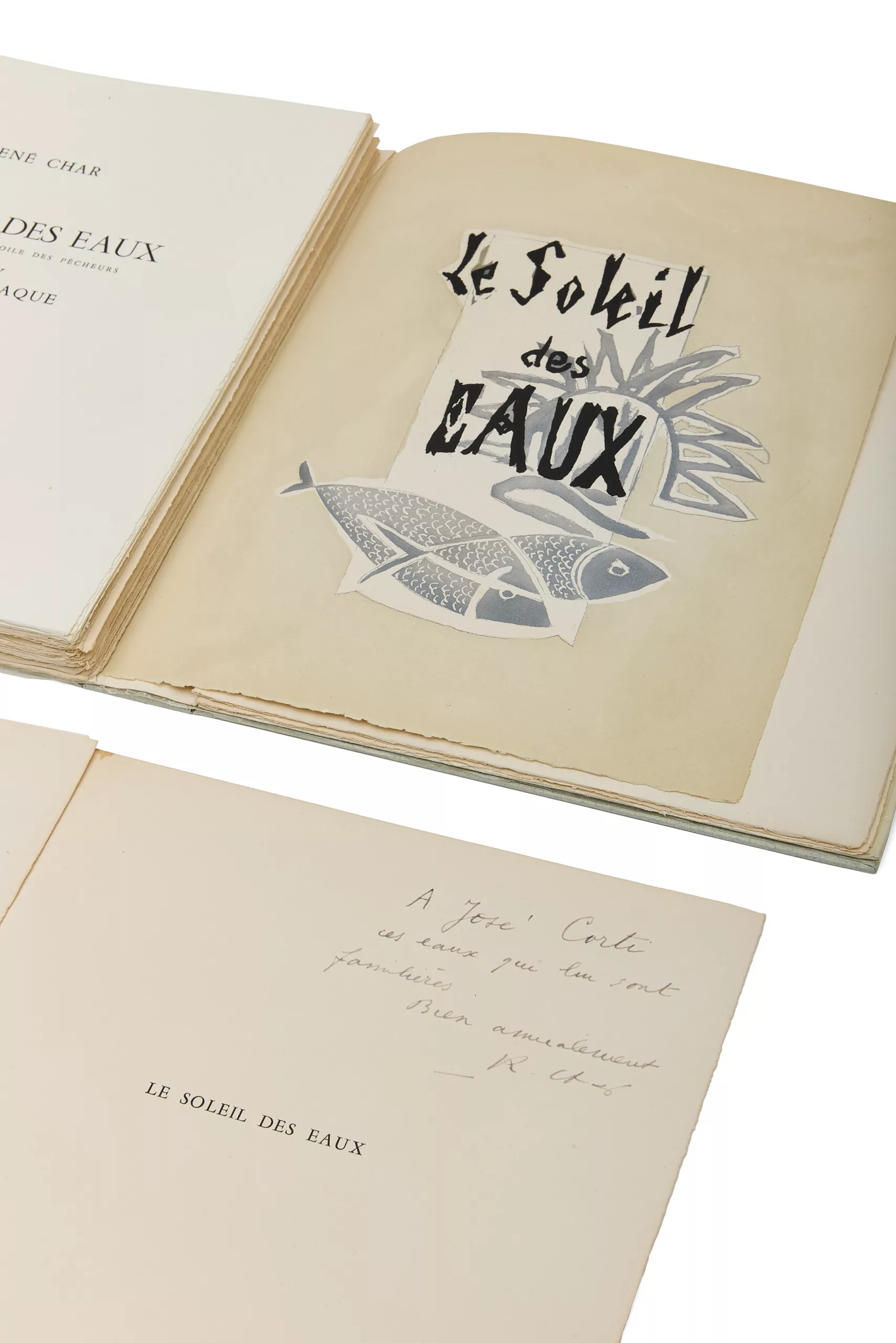
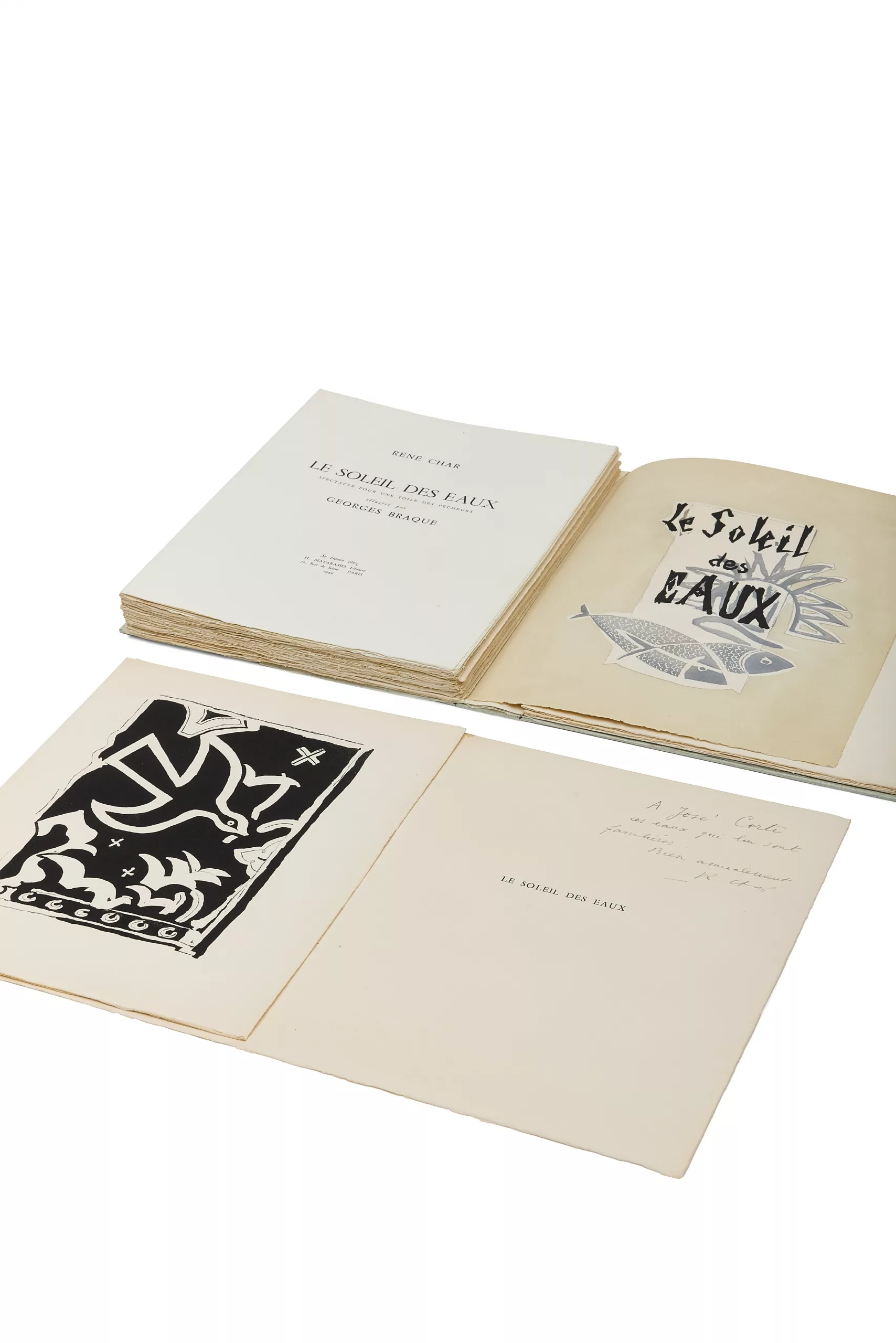
Le Soleil des eaux
Limited to 200 copies, this one of 170 copies on vélin pur fil du Marais (no. 137), signed by the artist and the author.
Presentation copy inscribed by Char to José Corti: “À José Corti. Ces eaux qui lui sont familières. Bien amicalement. R. Char.”
It was with Le Soleil des eaux that the important collaboration between René Char and Georges Braque began. The book appeared shortly after the two men met at an exhibition of contemporary paintings and sculptures organized by Christian and Yvonne Zervos at the Palais des Papes in Avignon. It is one of the rare texts by Char conceived for staging — cinematic rather than theatrical, since most of the scenes unfold in natural settings, for the project was in fact originally intended as a film.
René Char wrote the screenplay between August and October 1946. It tells the story of a community of fishermen in Provence, in the Comtat Venaissin, at the turn of the century. The building of a paper mill on the banks of the Crillone, the river running through the small village of Saint-Laurent, provokes a revolt among the trout and eel fishermen, whose river is polluted by the factory’s chlorine discharge. How could rural happiness be reconciled with destructive technology? The film was to be shot in L’Isle-sur-la-Sorgue, where most of the extras were to be recruited. Char described it as “a film whose ambition is to make one forget that it is a film, that is to say something more than food for the eyes: a proof for the heart,” a project he wished to share with Jean Vilar, whom he had considered for one of the roles. Having no experience as a director, Char turned successively to four different filmmakers, but faced with difficult conditions — including the great strike of 1947 — the financial backers withdrew, and only a few scenes were ever shot. Char then turned to the stage: the work was first performed in 1948 by Radiodiffusion française, with music by Pierre Boulez and direction by Alain Trutat.
Char’s meeting with Braque the following year gave shape to the project of an illustrated edition. It was for this book that Braque introduced his celebrated motif of the open bird, which he executed on three plates in black and on the color frontispiece plate.
Char’s few texts intended for the stage were later collected under the title Trois coups sous les arbres.
A fine copy, with the subscription form laid in.
P. A. Benoit, Bibliographie des œuvres de René Char, 33.