

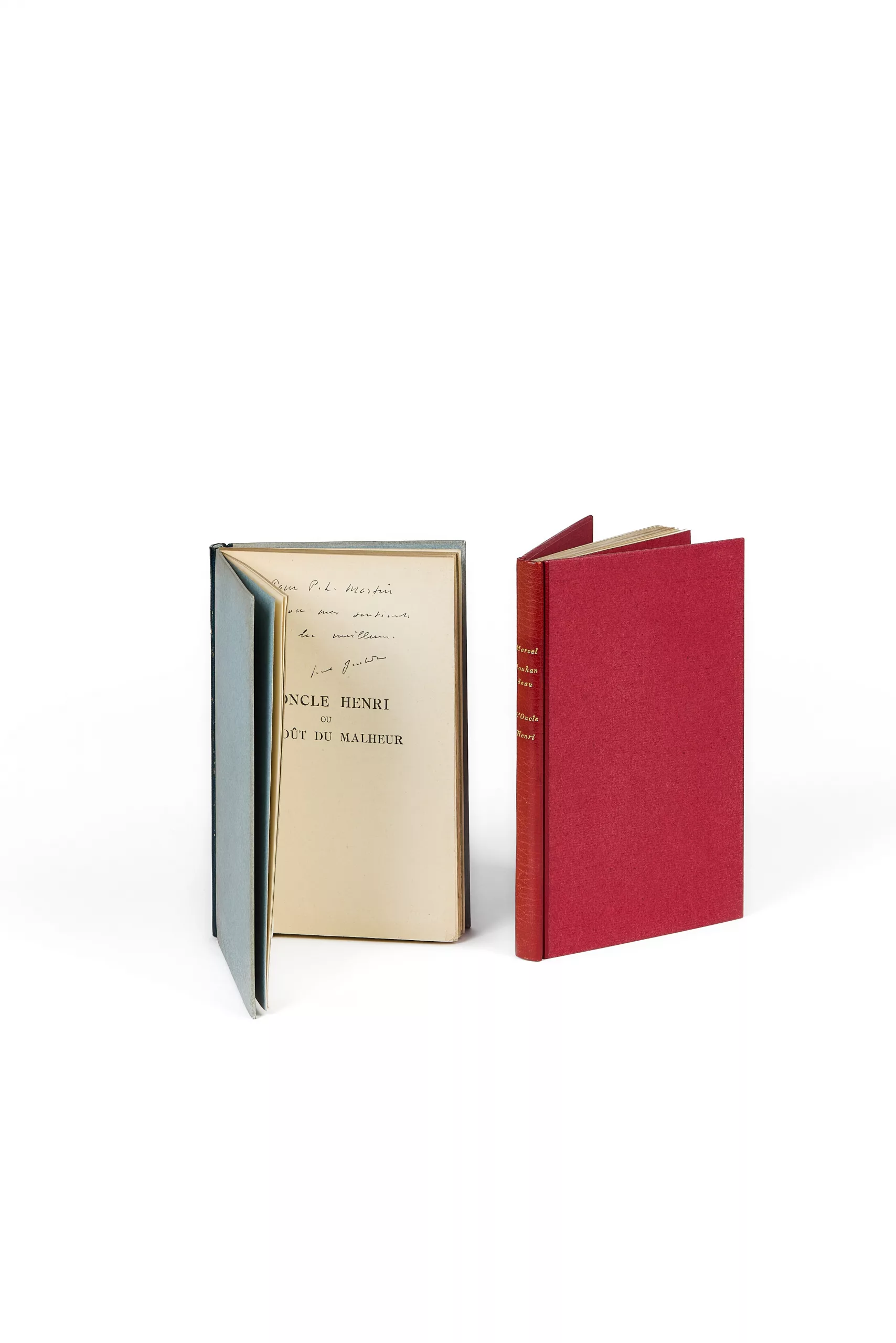
L’Oncle Henri, ou le goût du malheur
Copies on châtaignier paper.
Presentation inscription signed on each volume:
“Pour P.L. Martin avec mes sentiments les meilleurs, Marcel Jouhandeau.”
“Pour Paul Bonet avec mes sentiments les meilleurs, Marcel Jouhandeau, 7 juillet 1959.”
Guéret is still ashamed of its disgraceful son, Marcel Jouhandeau. This small town in the Creuse harbors an undisguised resentment toward the acid-penned novelist who caricatured Guéret without restraint or, as he called it in his writings (La Jeunesse de Théophile, Les Pincengrain, Tite-le-Long), Chaminadour-la-Bienheureuse. His hometown therefore makes little effort to honor the memory of the novelist — an antisemite in his darker moments — whose scant affection for his town is reflected in the portrait of Oncle Henri. His descriptions of Henri’s living quarters combine epic sweep with realist precision, pushing the depiction of material and moral wretchedness to extremes rarely achieved in so spare a style: “…for a bed, two trestles, a plank and a straw mattress on which, without a sheet, lay a naked man wrapped in a brown blanket (…) not an ornament, not an object, not a single image on which the eye might fasten as on a buoy of hope, or which might recall a moment of happiness: no, nothing but nothingness, emptiness. For furniture, only a wooden chair and a rickety table whose drawer had vanished; a little cold meat and bread lay directly on the paper, the remains of the evening meal, and an opened liter of red wine; not a glass in sight. Two steps from me, a half-open crate crammed pell-mell with a few rags. Never had I seen misery so closely, never had I come upon a man so utterly abandoned by Earth and Heaven and even by himself (…).”
Fine copies: a reunion of those presented to the two most skilled binders of their day, Pierre-Lucien Martin and Paul Bonet.
From the library of Jean-Charles Lissarague (with bookplate).