

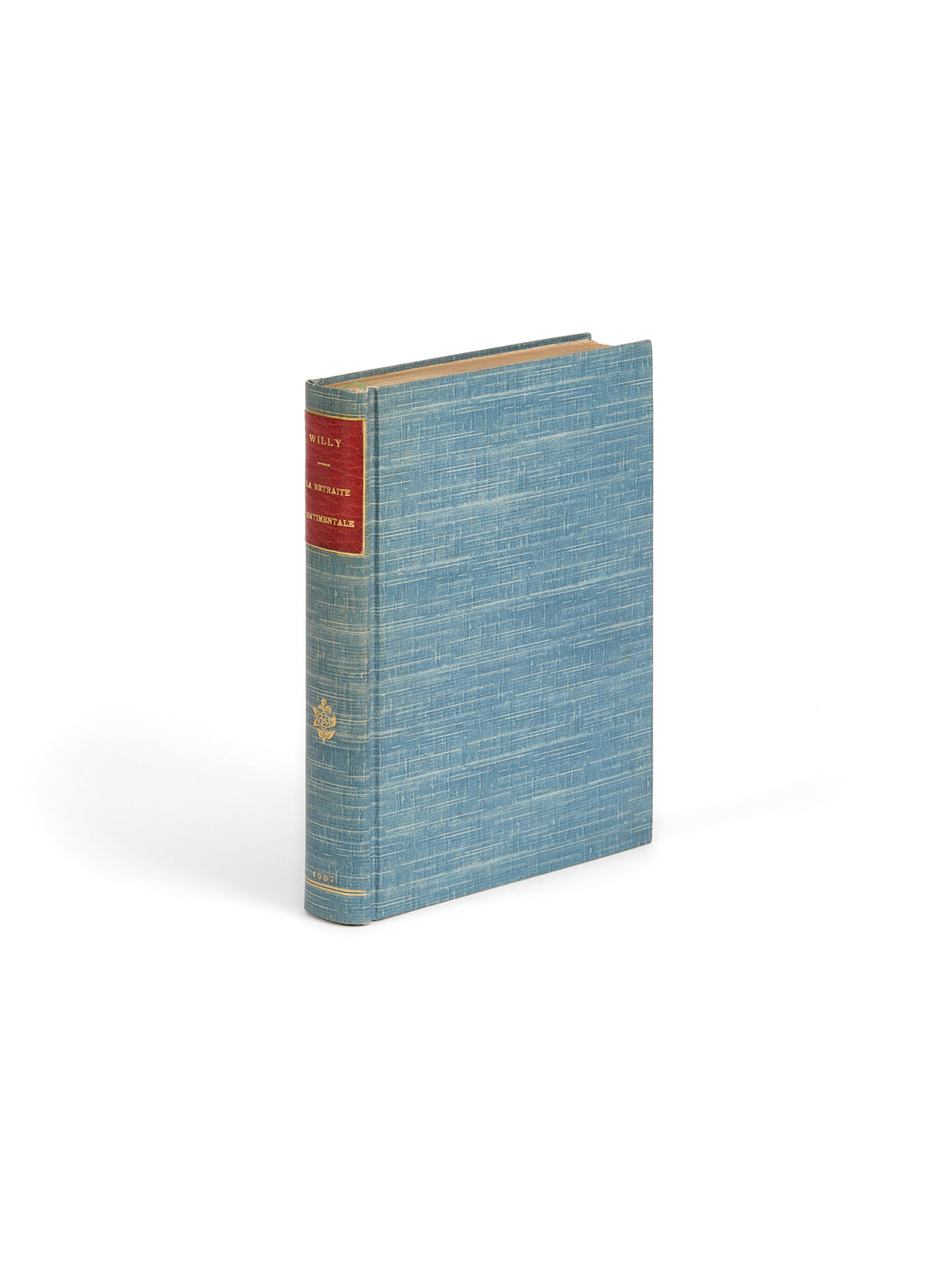

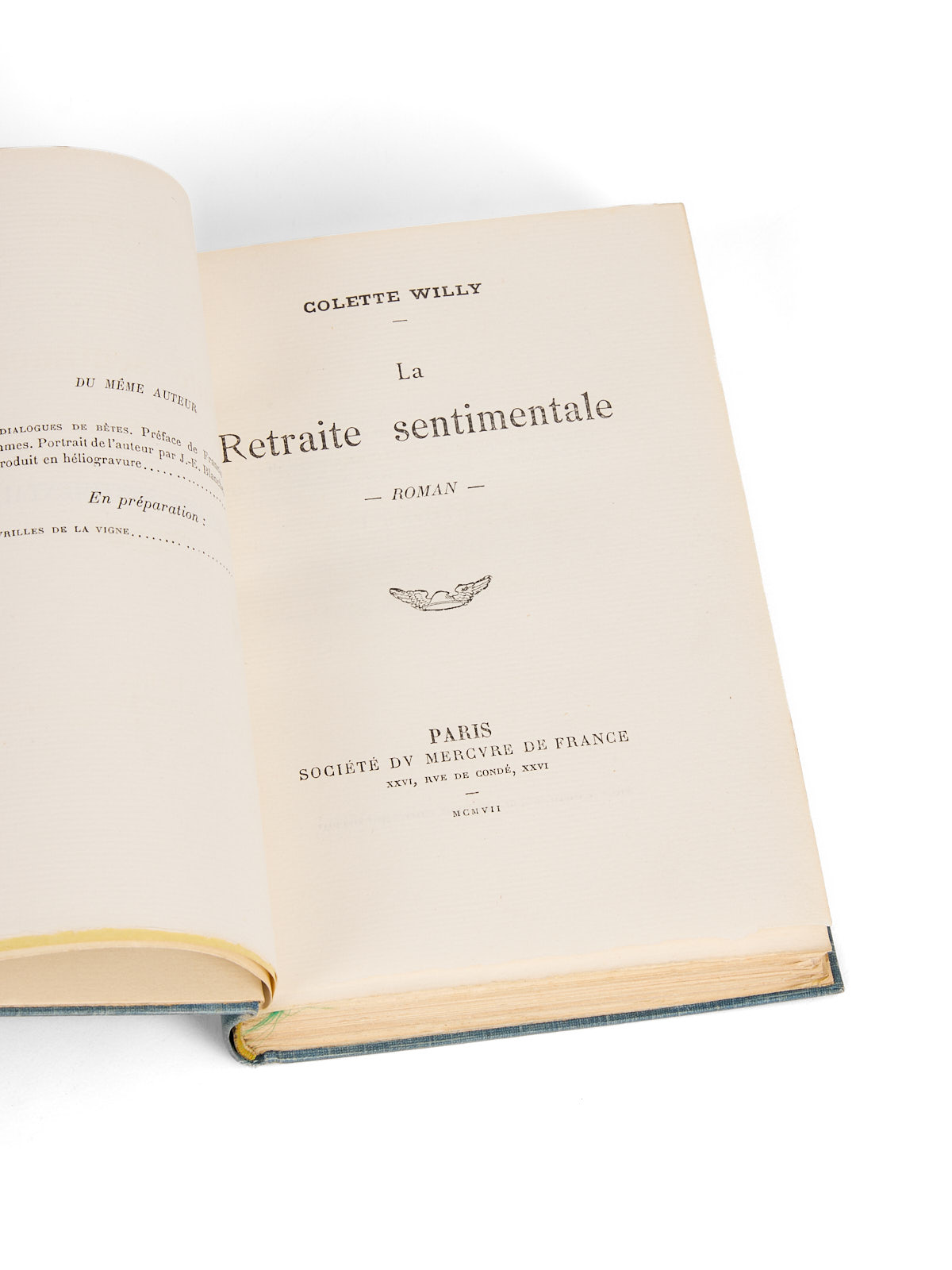
La Retraite sentimentale
One of 29 copies on Hollande paper (no. 19) — the only paper issue after 5 copies on Japanese paper.
“Many of Colette’s masterpieces owe a debt to the places that inspired them. Thus Rozven and Brittany gave rise to Le Blé en herbe, and La Treille muscate and Provence to La Naissance du jour. La Retraite sentimentale seems illuminated by the beauty and poetry of Les Monts-Bouccons, a property near Besançon that Willy had given to Colette in 1901 and which the couple kept until 1905 […] It truly closes the Claudine cycle. Annie, the heroine of Claudine s’en va, and Claudine take refuge at Casamène — a fictional transposition of Les Monts-Bouccons — while Renaud, one of the models for Willy, gradually fades and dies in Paris” (notice from the Amis de Colette website on La Retraite sentimentale).
Colette had married Henry Gauthiers-Villars, known as Willy, in 1893, before divorcing her domineering Pygmalion in 1906 and publishing, the following year, this first novel — graver and deeper than her previous ones — signed under her own name alone. Octave Mirbeau praised “the last thirty pages, as beautiful as Ecclesiastes.” This book is the last to feature Claudine and marks the transition between Colette’s early period and her later work, letting her heroine return to her childhood home of Montigny-en-Fresnois — a fictional double of Saint-Sauveur-en-Puisaye — surrounded by her animals and discovering, in her rediscovered gardens, new reasons to hope: “What bitterness at first, — but what peace afterward! — to discover, — on a day when spring still trembles with cold, unease and hope, — that nothing has changed, neither the smell of the earth, nor the shiver of the stream, nor the rosebud shape of the chestnut tree’s buds… To bend, astonished, over the small filigreed cup of the wild anemones, toward the countless carpet of violets, — are they mauve, are they blue? — to caress with one’s gaze the unforgotten shape of the mountains, to drink in a hesitant sigh the tangy wine of a new sun, — to live again! to live again! with a little shame, then with more confidence, to find one’s strength again, to find again the very presence of the absent one in everything that is intact, inevitable, unforeseen and serene in the passing of the hours, in the setting of the seasons…”
A fine copy.