

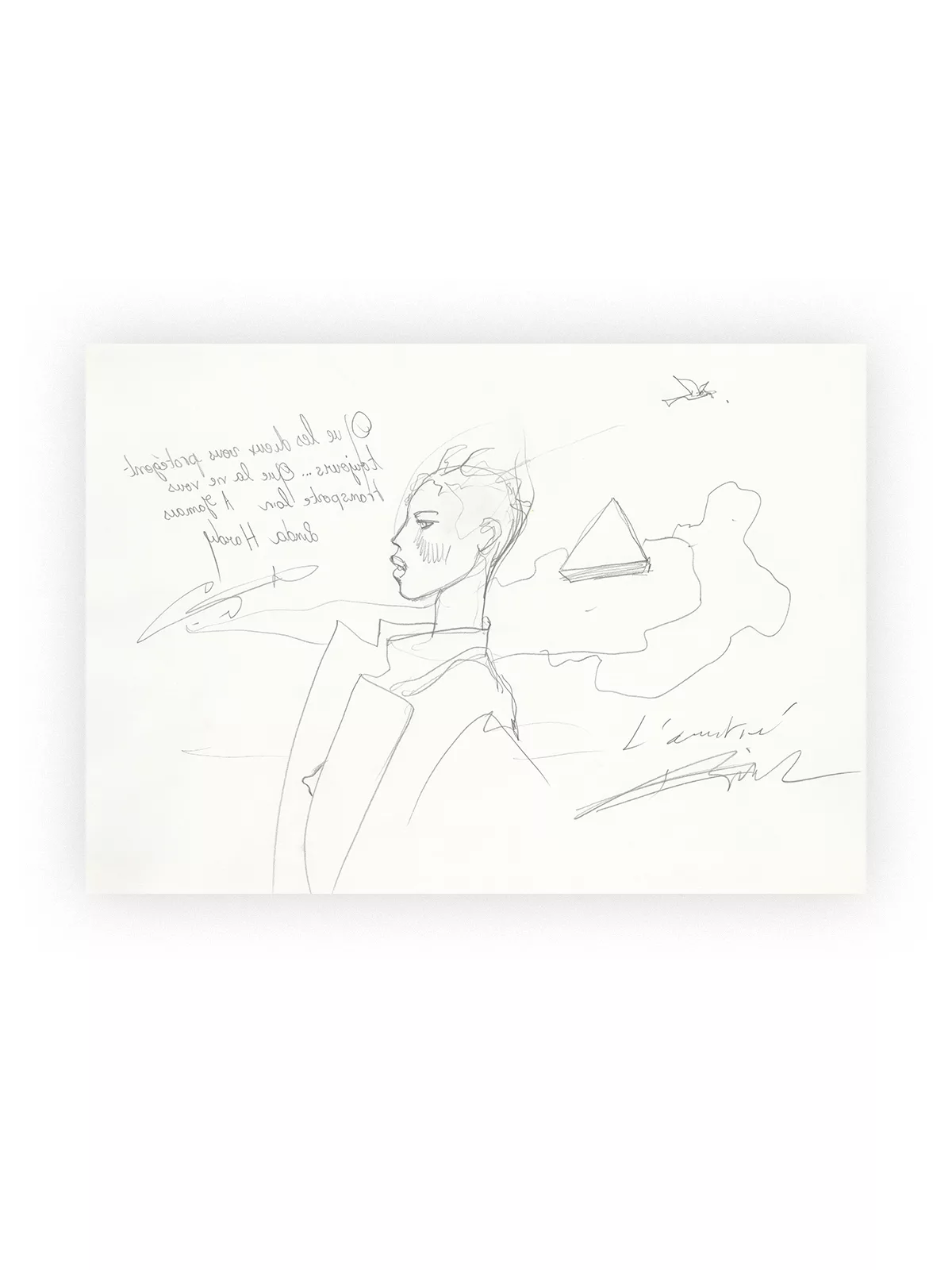
« L’Amitié »
Linda Hardy added these lines: “Que les dieux vous protègent toujours… que la vie vous transporte loin… À jamais,” written in mirror-script — an echo of the powers possessed by the character created by Bilal that she was to portray in the film adaptation.
La Foire aux immortels and La Femme piège, the first two volumes of the Nikopol trilogy, are regarded as one of the science-fiction comics “most original works that revolutionized the conventions of the genre” (Moliterni & Mellot, Les Aventures de la BD, coll. “Découvertes Gallimard,” 1996).
“From the very first volume, the break with the linear narratives at which Pierre Christin excelled is complete. Through a metaphorical rebellion embodied by the dissident god Horus and the rebel Alcide Nikopol, multiple plotlines overlap, leaving each reader to find their own meaning. Bilal no longer draws for the story, but for a set of ideas made material by the image, in albums that place a questioning of the contemporary world — totalitarianism, fanaticism, the role of the media, global warming — into perspective” (Vincent Bernière, La Bédéthèque idéale).
In 2004, Enki Bilal decided to adapt the two volumes for the cinema: Immortel (ad vitam). He transposed his story, originally set in Paris, to a futuristic and blighted New York, populated by ordinary humans, genetically modified humans and mutants. The city lives under dictatorship and, like Metropolis, is divided into three stratified zones. The action takes place in 2095, when a mysterious pyramid appears floating above a Central Park declared a “forbidden zone.”
The role of Jill Bioskop [bioskop meaning “cinema” in Serbo-Croatian, Bilal’s native language], the blue-haired — and blue-teared — mutant, was played by Linda Hardy in her first film role, a true double of the character created in 1989. It was Bilal’s third film, after Bunker Palace Hôtel (1989) and Tykho Moon (1996).
Accompanied by the album La Femme piège in first edition: the emblematic album in which the character of Jill Bioskop takes center stage.