

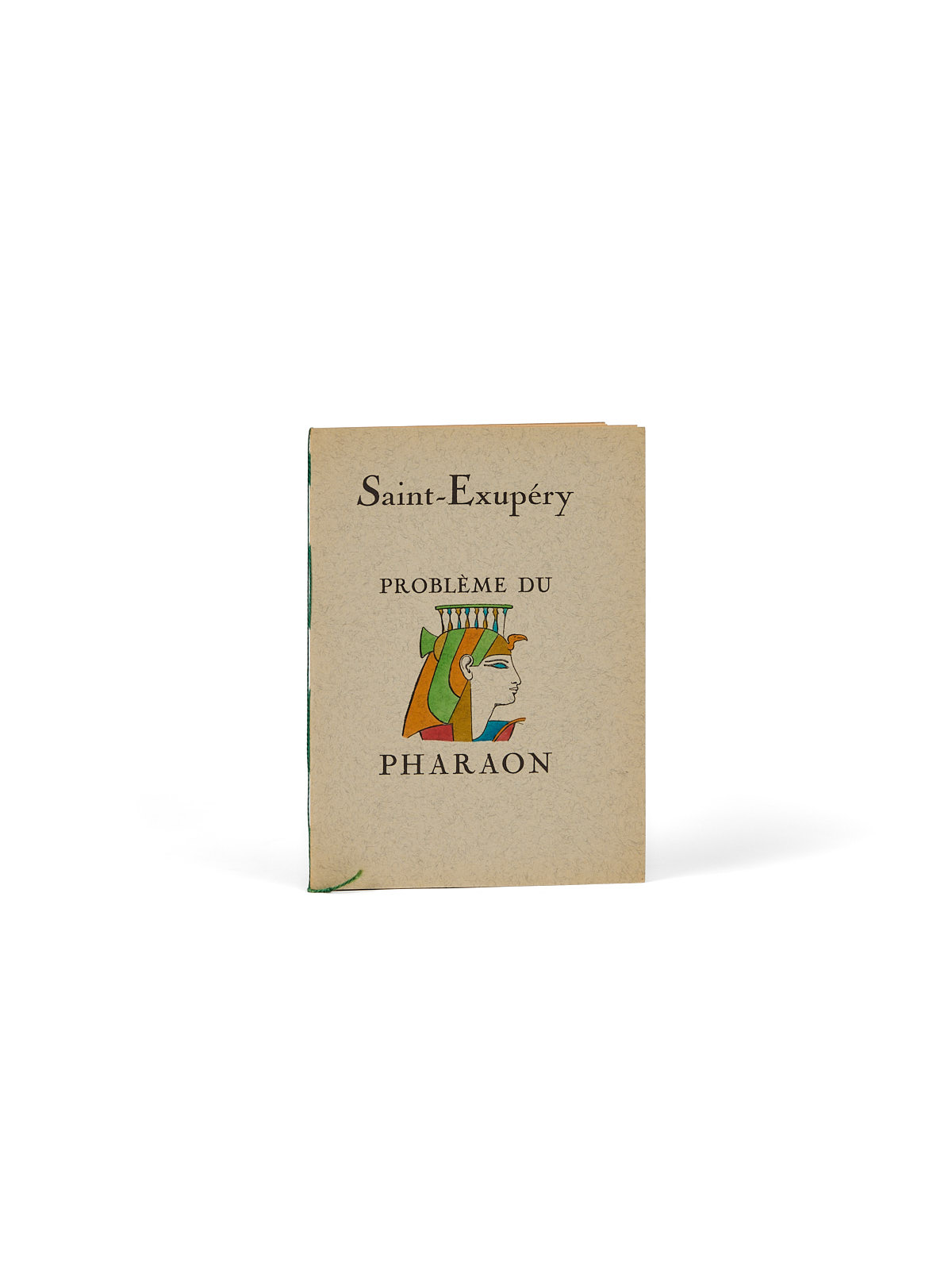
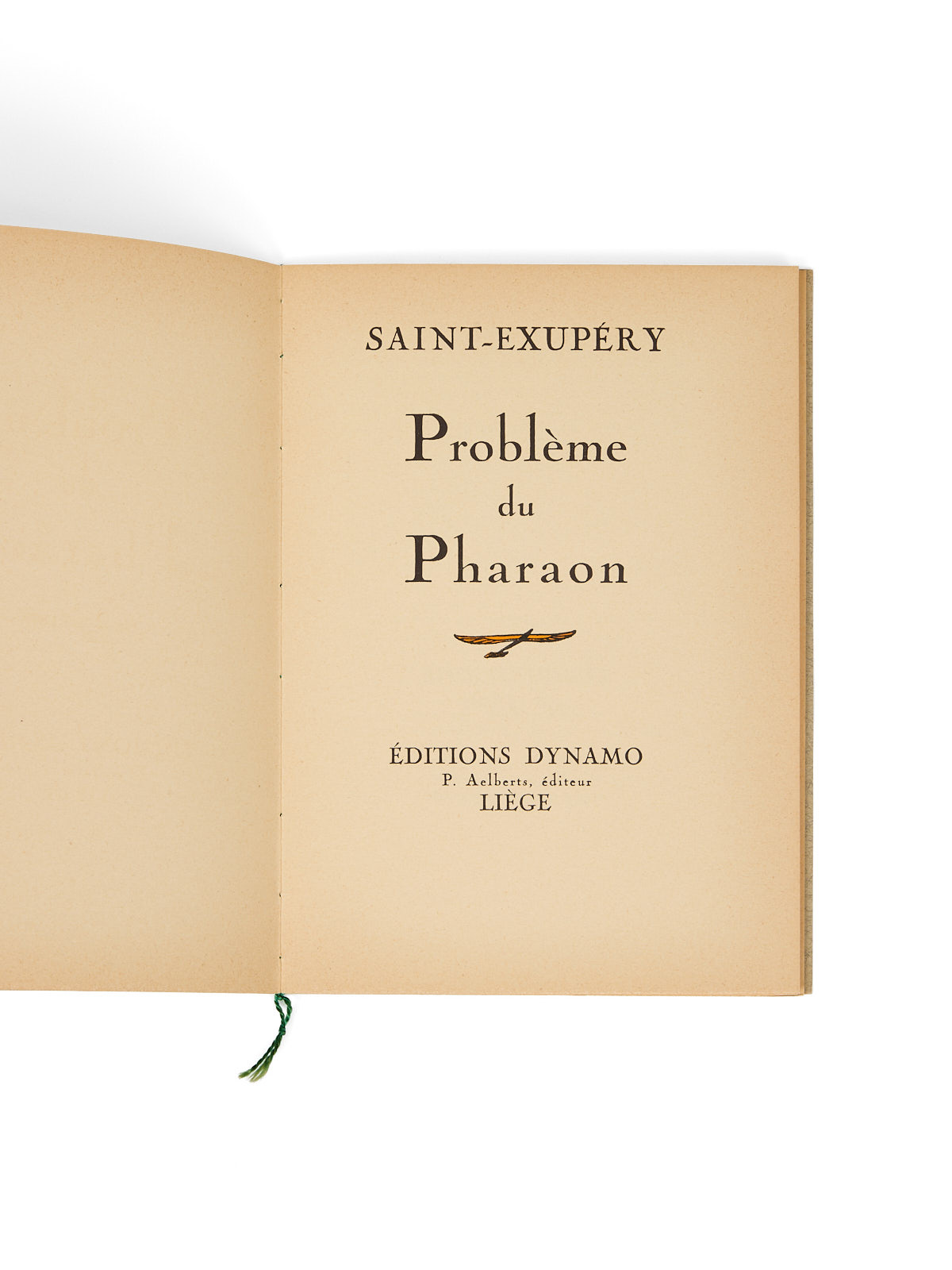
Problème du Pharaon
One of 10 copies on chamois vellum, numbered and initialed by the publisher, this copy no. 6, after a single copy on Japanese paper.
“Further proof of his fondness for mathematics, which he saw as a mental exercise, Antoine de Saint-Exupéry is the author of a Problème du Pharaon. He worked out the terms of this problem in 1935, following a trip to Egypt. The pages devoted to it were published in 1957 by Éditions Dynamo in a small booklet printed in a few dozen copies, now very rare” (in Le Problème du Pharaon, Antoinedesaintexupery.com, online).
Although the idea came to him as early as 1935, it seems that the problem was only actually put to Saint-Exupéry much later, in the officers’ mess at Borgo or Villacidro, in July 1944, shortly before his disappearance.
The problem runs as follows: Egyptologists discover, on the Giza plateau, some ten kilometers from Cairo, a number N of cube-shaped stones. Each pile contains exactly 348,960,150 cubes, intended for the construction of a rectangular parallelepiped stele, a site of sacrifice in honor of the god Ra, whose height was to equal the diagonal of its base. For mystical reasons, the number N was prime. What are the dimensions of the stele?
On the Sardinia base, he set another problem to Colonel Max Gelée, which was likewise written down (now preserved at the Musée de l’École de l’air in Salon-de-Provence, reproduced in Icare, no. 96, p. 85): the “parallelepiped problem: a rectangular parallelepiped whose height equals the diagonal of the rectangular base is made up exactly of cubic dice 1 cm on a side. The area of the base rectangle equals the product of 311,850 and an unknown prime number. Calculate the height of the parallelepiped. If Colonel Gelée, a former student of the École Polytechnique, solves my problem in less than three days and three sleepless nights, I undertake to give him a Parker 51 pen as a gift. If he fails to solve it in three days, he will give me six packs of Philip Morris. Villacidro, 15 July 1944. Antoine de Saint-Exupéry.”
Ladies and gentlemen, put your minds to these two problems.
It should be recalled that Saint-Exupéry had studied in the advanced preparatory mathematics classes, had been admitted to sit the entrance examination for the Naval academy (despite a mark of 7 out of 20 in French!) but had failed the oral.
From the library of Pierre Puech (Paris, Alde, II, 2010, no. 370).