

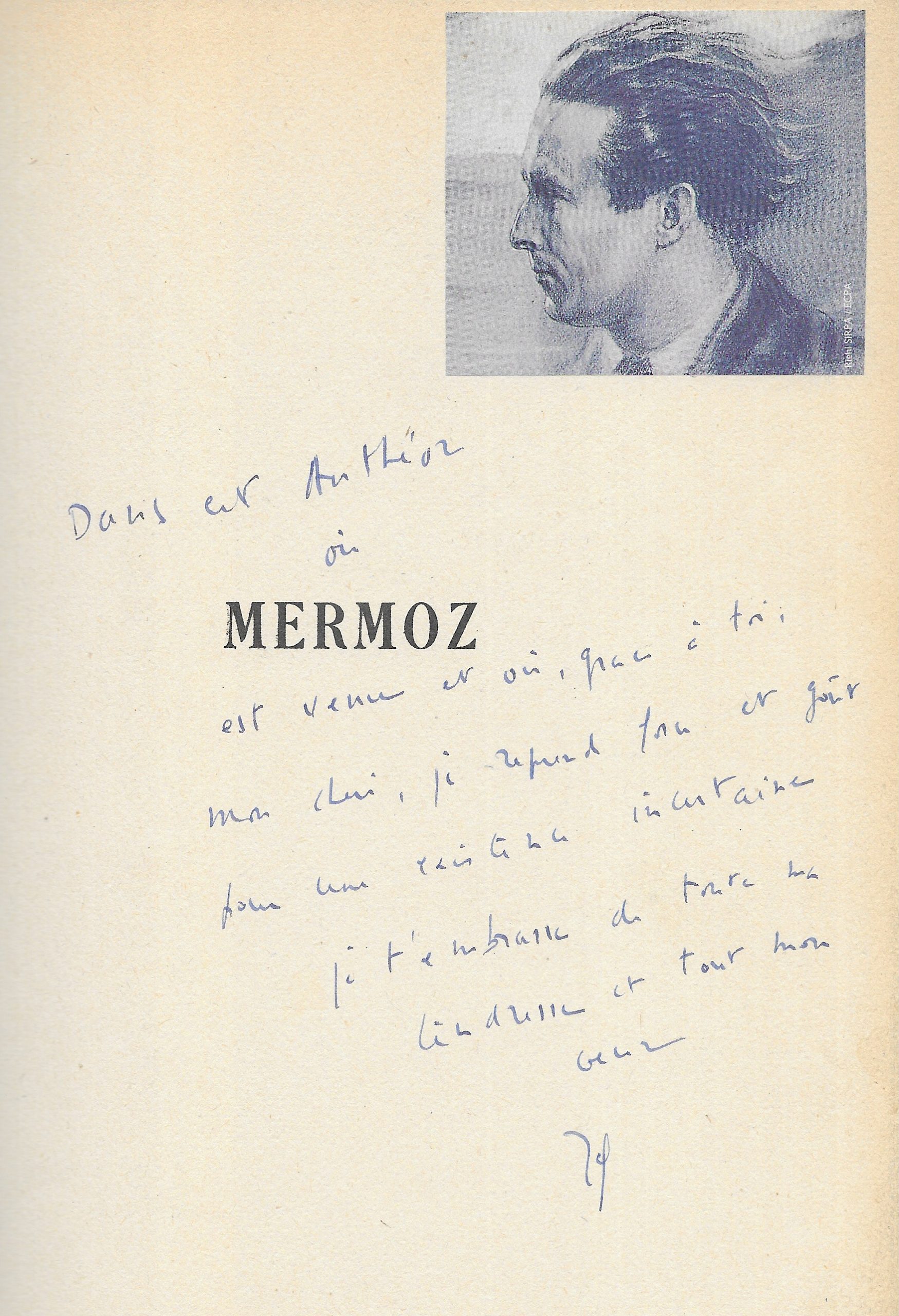
Mermoz
A precious and moving copy uniting Joseph Kessel, Jean Mermoz and Maurice Druon.
Signed presentation inscription: “Dans cet Anthéor où Mermoz est venu et où, grâce à toi, mon chéri, je reprends force et goût pour une existence incertaine. Je t’embrasse de toute ma tendresse et tout mon cœur. Jef.”
“No news of Mermoz and his four companions. It is hoped that their silence is due only to engine failure,” Le Figaro announced on its front page on 8 December 1936. Since the previous day, nothing had been heard from La Croix-du-Sud, flying the Dakar–Natal route under the command of Jean Mermoz. At 10:43 a.m.: “The rear right engine must be stopped.” This was the seaplane’s last message. Lost off the coast of Dakar, La Croix-du-Sud (whose name was later given to Gallimard’s South American literature series founded by Roger Caillois) and its pilot met a singular fate: Jean Mermoz was the most celebrated and beloved pilot of an era when aviation still offered adventures of epic proportions, admired throughout the world.
Kessel had met Mermoz some years earlier, and, despite his grief, felt compelled to write, only months after his friend’s death, of what the newspapers could never capture: a deep and intimate friendship, a fellow adventurer, and the fears, regrets and character of the great pilot — “a glorious archangel, a profound neurasthenic, a resigned mystic, a dazzling pagan, in love with life yet inclined toward death, child and sage: all of this was true of Mermoz, but each element taken alone would be false, for they were fused into an extraordinary unity.”
Kessel offers this profound and heartfelt tribute here to a man he had recently grown close to: his nephew, Maurice Druon. It was at Anthéor, mentioned in the inscription, that the two men forged an especially close bond: their shared wartime experiences, Maurice’s deep admiration for his elder, and Kessel’s close attention to the young novelist’s early writing made these studious weeks spent “among men” a constant delight. Kessel, whose books appeared on the Otto List, was forbidden from publishing or practicing journalism under the Occupation. An “uncertain existence” weighed heavily on him, made bearable — and more — by his nephew’s presence, as the inscription movingly reveals.
After the Germans entered Dunkirk on 4 June 1940, Kessel filed his last article for Paris-Soir before having to flee. In early November he settled into a house at Anthéor, near Agay and not far from Fréjus, staying with Germaine Sablon, who accompanied him, at the home of her mother, Jeanne. They were joined a few weeks later by Maurice Druon. It was there, at Anthéor, that Druon wrote his first play, Mégarée, while Kessel completed his first novel devoted to the Resistance, Les Maudru. The two men remained inseparable from then on: during the summer of 1941 a deep complicity and warm affection united uncle and nephew, and it was on Kessel’s advice that Druon began his first novel, La Dernière Brigade, inspired by the heroic stand of the Saumur cadets against the German crossing of the Loire. A year later, Druon, Kessel and Sablon left the Mediterranean coast together for London, where their shared destiny would produce Le Chant des partisans and L’Armée des ombres.
A magnificent copy of superb provenance.
From the library of Maurice Druon (signed presentation inscription).