

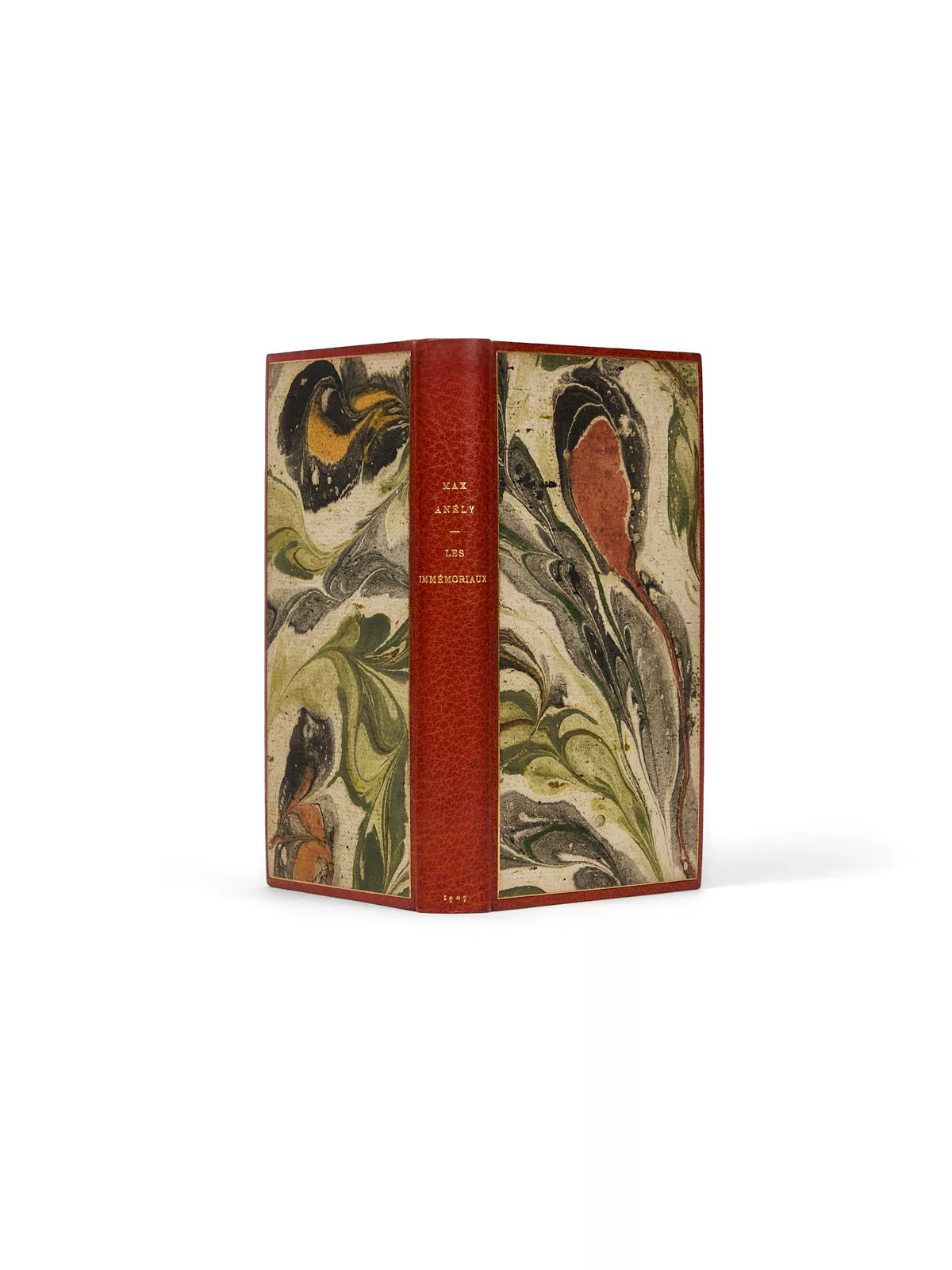
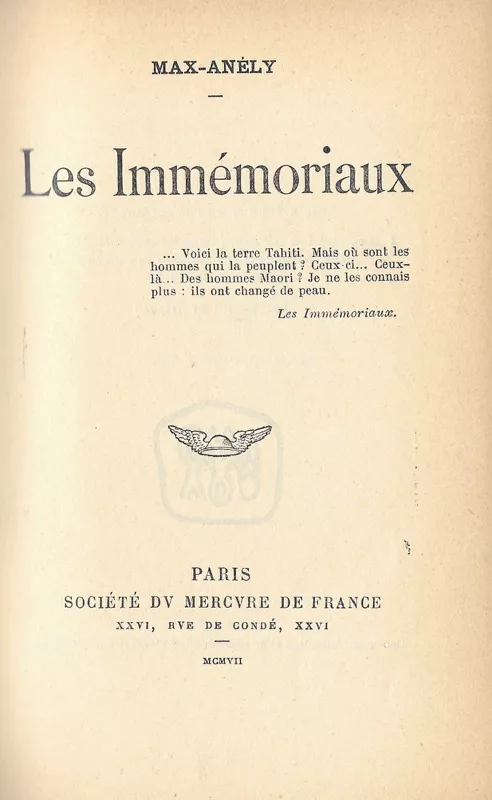
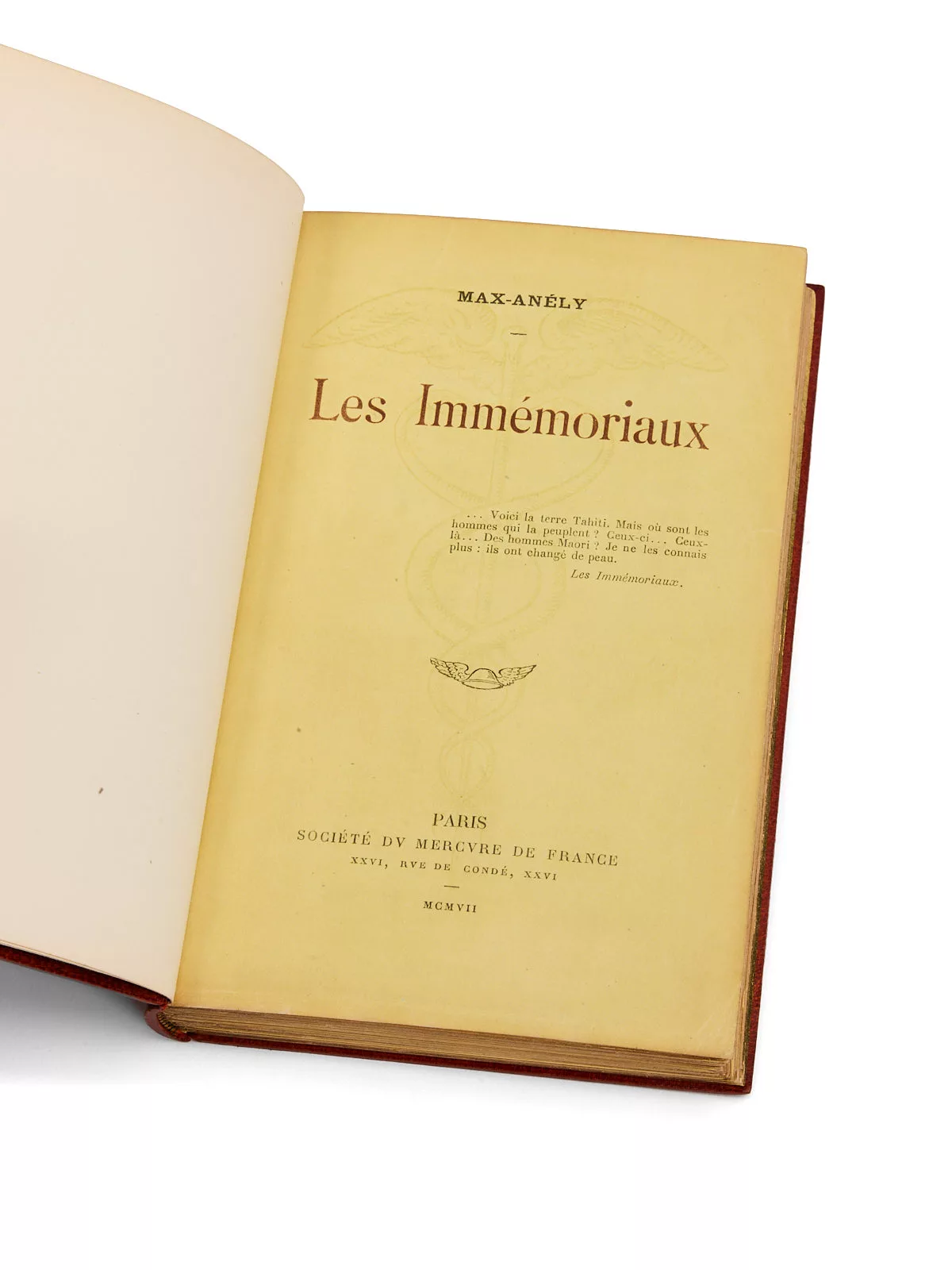
Les Immémoriaux
Signed presentation inscription: “À madame Rachilde, en tout admiratif hommage, ces histoires d'une race libre & inconventionnelle - autrefois. Max-Anély.”
A precious copy, presented and inscribed to Rachilde, wife of Alfred Valette, director of the Mercure de France, the house that published Segalen’s Les Immémoriaux. This first printing bears, beneath the limitation statement, the “Maori vignette” characteristic of copies from the first thousand. Many authors published by the Mercure de France and by La Revue blanche had a personal mark (monogram or device) stamped on the limitation of the standard printings of their first editions.
When Victor Segalen published Les Immémoriaux under the pseudonym Max-Anély, only a few initiates — Huysmans, Gourmont, Loti — knew the identity of the author behind several essays that had appeared in the Mercure de France: “Les Synesthésies et l’École symboliste,” “Gauguin dans son dernier décor,” “Le double Rimbaud.”
Born in Brest, Segalen entered the naval medical school in Bordeaux before embarking in 1903 as a ship’s doctor aboard the Durance, which called at Tahiti for two years. The project of Les Immémoriaux was born there, as Segalen gathered the last recollections of Paul Gauguin, who had just died, discovering his paintings, his writings and the objects he left behind. Back in Brest in 1905, Segalen composed his book, devoted to Maori culture, already celebrated by Gauguin in the pages of Noa-Noa.
In August 1903, three months after the painter’s death, Segalen, from his home port of Hiva-Oa in the district of Atuona, discovered the Maori people and their culture. A letter he wrote some years later to a friend testifies to the importance of this discovery: “I told you I had been happy in the tropics; it is fiercely true. For two years in Polynesia, I slept badly, from joy. I had awakenings that brought tears of intoxication as the day rose. […] I discovered Nietzsche. I had found my work; I was free, convalescent, fresh and sensually well trained. […] The whole island came to me, like a woman.” (letter to Henry Manceron, 24 December 1911).
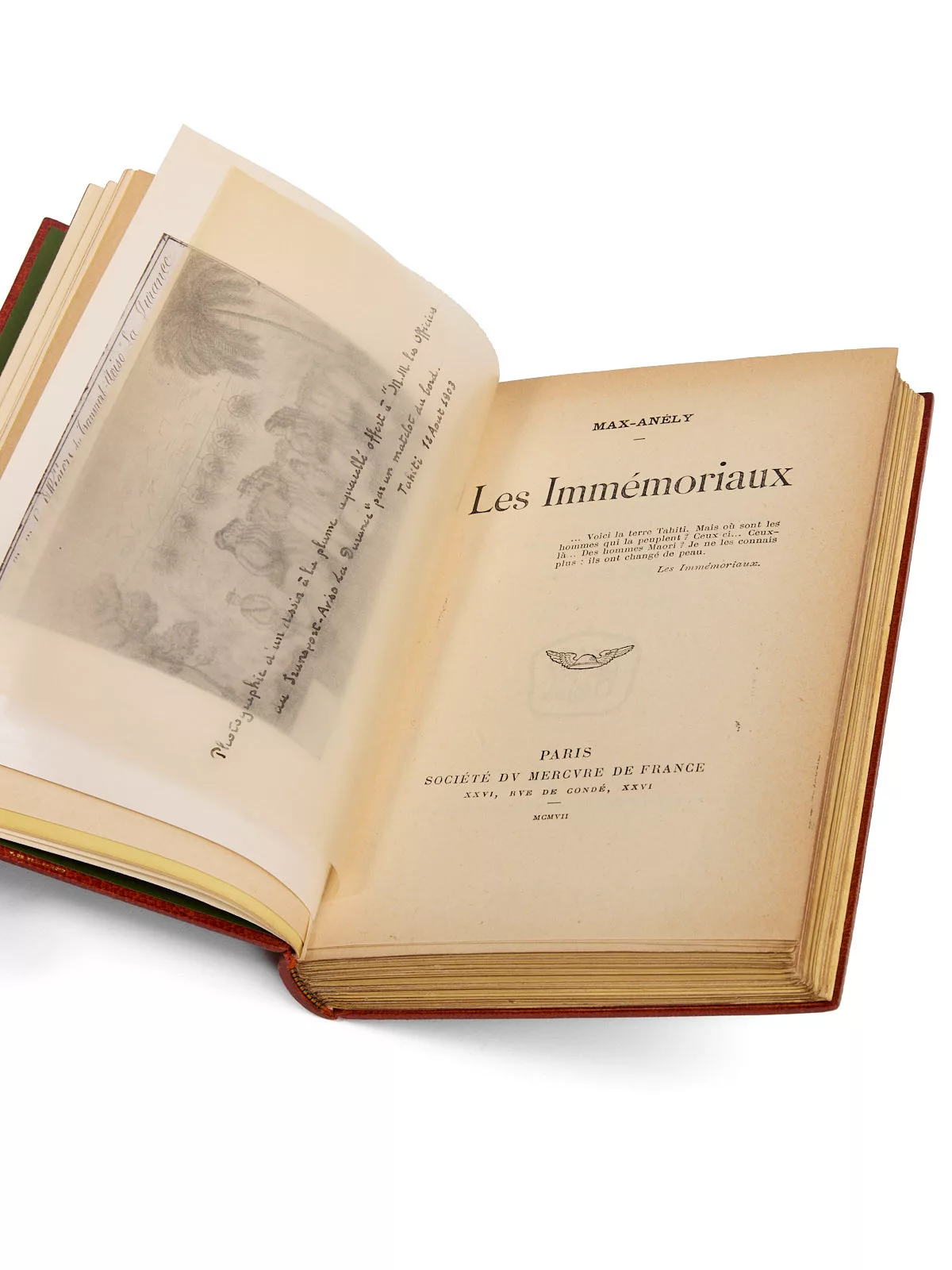
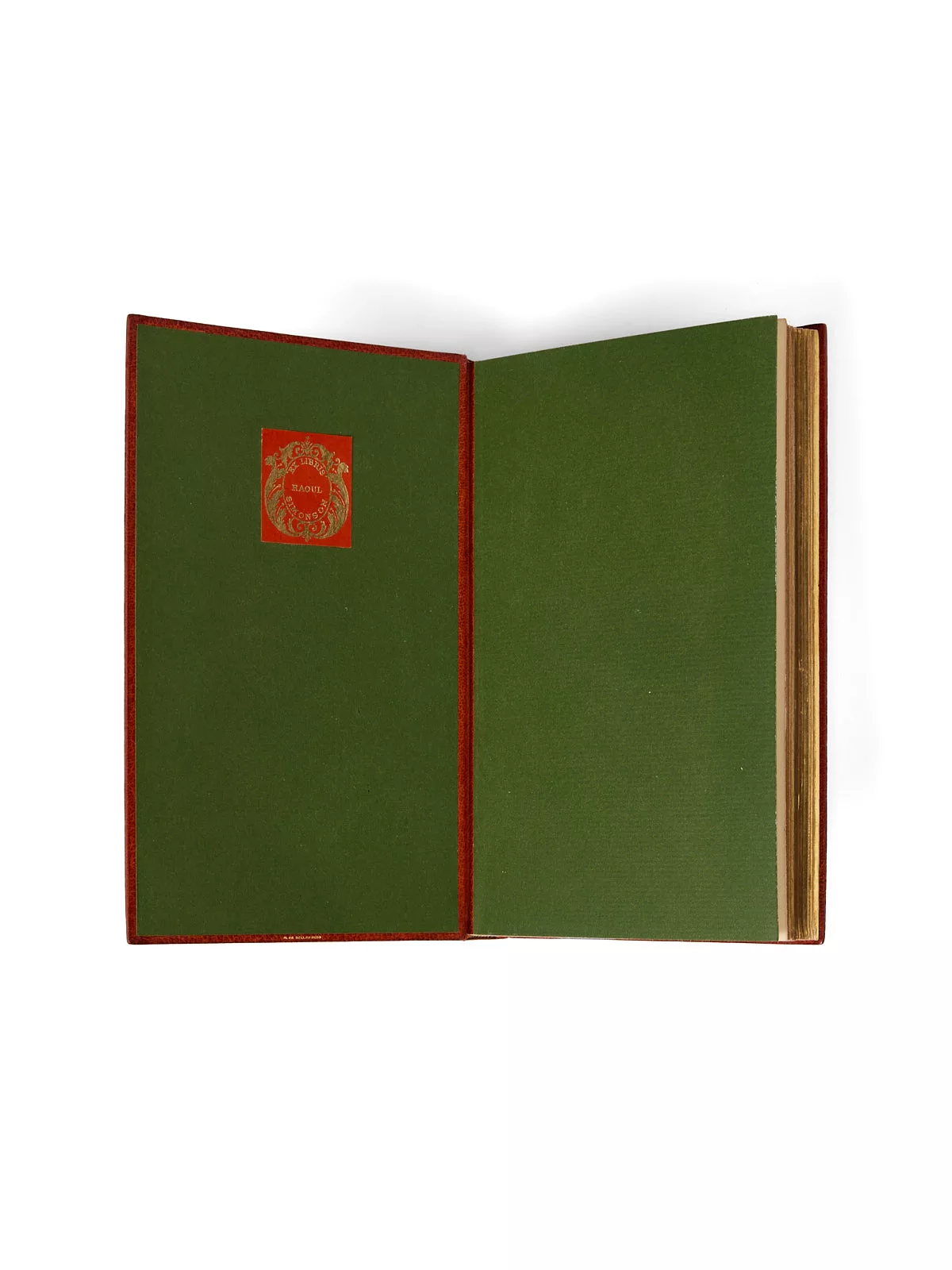
The person who commissioned this binding by Micheline de Bellefroid, probably the bibliophile Raoul Simonson, had two documents added at the front of the copy: a photographic reproduction and its manuscript caption in Segalen’s hand, on onionskin paper: “Photographie d’un dessin à la plume aquarellé, offert à MM. les Officiers du Transport-Aviso ‘La Durance’ par un matelot du bord. Tahiti 12 août 1903.” The date is significant, since it was on that same 12 August that Segalen discovered a crucial Maori object, the tao mata, a cylindrical object woven from coconut fiber and extended by knotted cords used to count successive generations. “This encounter is fundamental. In a single place are joined the discovery of the genealogies and the shadow of Paul Gauguin, embodied in a Marquesan, Tioka, the painter’s friend. Segalen brought back a crate containing Gauguin’s last belongings and a tao mata […]. Les Immémoriaux would be written out of this double inheritance” (Étienne Germe, Segalen, l’écriture, le nom, Presses universitaires de Vincennes, 2001).
A choice copy, in perfect condition.
Provenance: Raoul Simonson (Sotheby’s, 2013, lot 643); Jacques Attali (Alde, 2018, lot 90).