

Flagrant délit Rimbaud devant la conjuration de l’imposture et du truquage.
One of the first 100 copies on Holland laid paper (no. 36), signed by the author.
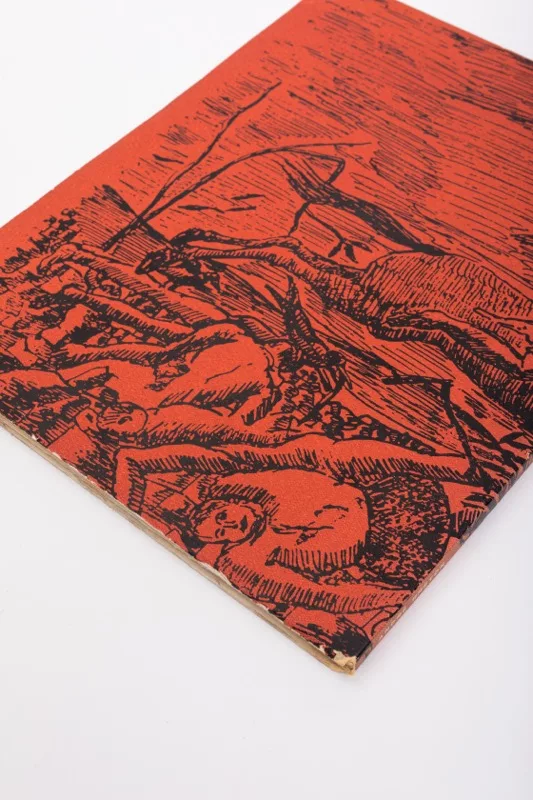
Illustrated cover reproducing La Guerre, the only lithograph by the Douanier Rousseau.
On 19 May 1949, Maurice Nadeau, together with Pascal Pia, published in Combat extracts from an unpublished Rimbaud text he had discovered at the bookshop of Adrienne Monnier; at the instigation of Pia and Maurice Saillet, the Mercure de France then published the full text.
André Breton and Jean Paulhan immediately delivered an uncompromising verdict: it was a forgery. On the very day of the Combat publication, Breton wrote to the newspaper: “Gentlemen, there is not a true Rimbaud scholar whose emotion, on discovering this morning’s literary page of Combat, must not almost at once have given way to unease, and shortly afterward to indignation. I deplore, once again, that the person responsible for this page could fall into such crude traps. One would indeed have to have understood nothing whatsoever of Rimbaud to dare maintain that the ‘few sentences’ quoted are by him. The extreme mediocrity of the writing, which fails to conceal a laborious exercise in pastiche, immediately casts the gravest doubt on the authenticity of such a document.”
On 26 May, Combat published a “Word to André Breton” from Nadeau, who declared himself “still convinced of the authenticity of the text,” but the Mercure soon announced that “the profits from the edition of this pastiche will go to the Rimbaud museum.”
“At the outset, the point is not to understand but to love”: with this argument of unmatched elegance, Flagrant délit appeared four days after this reversal, exposing the deception. Had the deceived adopted this point of view, they might not have been deceived at all. The text was later reprinted in the collected edition La Clef des champs, but unfortunately without the three appended pieces, each of which vindicates Breton’s perspicacity.
A perfect choice by André Breton: a composition by the Douanier Rousseau (a lithograph published in L’Ymagier in January 1895) illustrates the cover.