

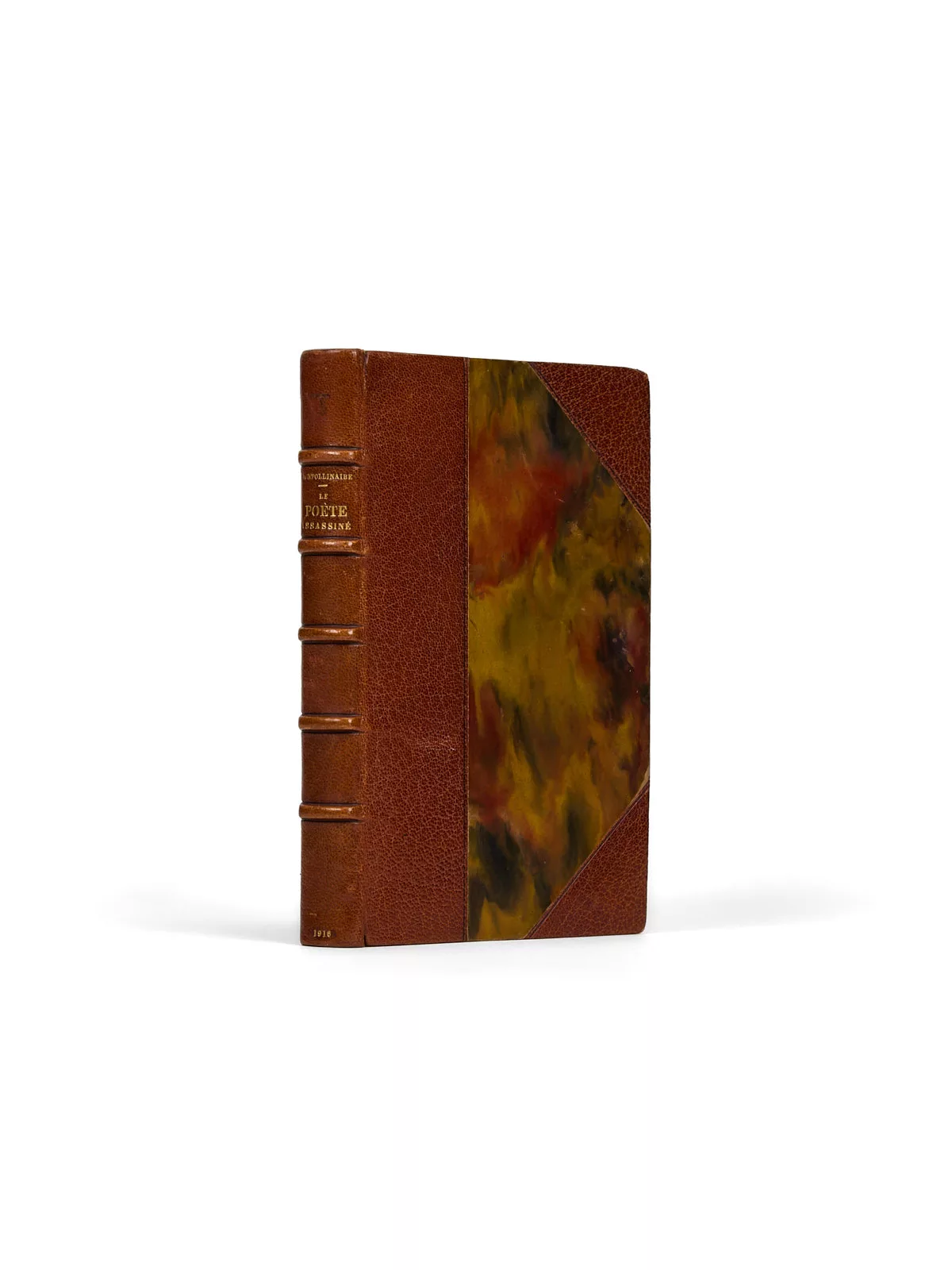
Le Poète assassiné
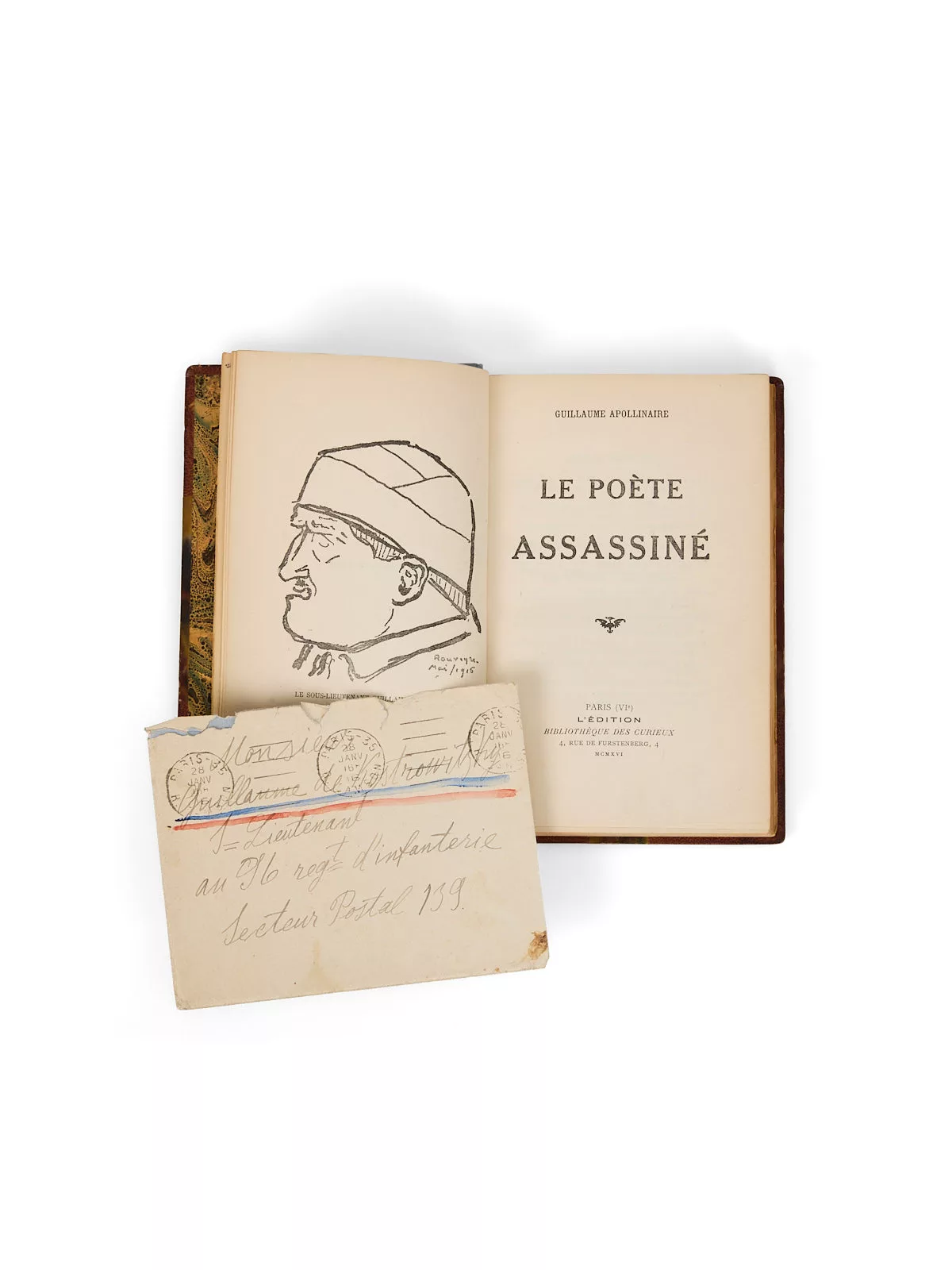
Accompanied by: mailing envelope addressed to Apollinaire (145 x 110 mm, postmark “Paris, 28 janvier [19]16,” with his name underlined twice in red and blue, forming with the space between the lines the French flag: it is addressed to “Guillaume de Kostrowitsky / S=Lieutenant au 96 regt d'infanterie / Secteur Postal 139.”
The envelope is printed with the letterhead of “Hotel de Castille 37 rue Cambon à Paris”: at this time, two figures close to Apollinaire were staying there, Natalia Goncharova and Mikhail Larionov, for whom the poet had written, in 1914, the preface to the catalogue for the opening of the Paul Guillaume gallery, which exhibited the two artists’ work. In March, he wrote to Max Jacob about them: “MM. GONTCHAROVALARIONOF [sic] are, I believe, still at the Hôtel de Castille, rue Cambon; I sent them a poem they wanted to publish in Paris […] but I fear they will publish it in Russia without publishing it here […] if you had time you might go and copy it out, which would please me” (letter to Max Jacob, 14 March 1916, R.B.L. collection, May 22, 2019, no. 9).
A second lieutenant of infantry since 18 November 1915, Apollinaire returned to Paris in early January, after his break with Louise de Coligny-Châtillon, to whom he wrote for the last time on 18 January 1916. His regiment went into rest in January, giving Apollinaire some leisure to write and complete the stories for a future collection, his second after L’Hérésiarque et Cie (published in 1910). It would be a set of texts written between 1900 and 1913, which he was, as the manuscripts show, substantially reworking.
He withdrew five tales and added one final one, “Le Cas du brigadier masqué c’est-à-dire le poète ressuscité.” In early February, he was able to write to his publisher P.-V. Stock that he had “the intention of bringing out a volume of stories if I find a publisher. I will call it Le Poète assassiné […],” for which he wished to contact the Briffaut brothers, founders of the Bibliothèque des Curieux publishing house. Apollinaire entrusted them with the publication of his collection in October. He returned to the front in early March, after a final leave in Oran with Madelaine Pagès, before moving up the line with his unit a few kilometers from Berry-au-Bac. Wounded on 17 March by a shell fragment that struck his right temple, he was transferred to the Italian hospital on the Quai d’Orsay, where he underwent trepanation on 9 May. On 17 June Apollinaire was awarded the Croix de guerre.
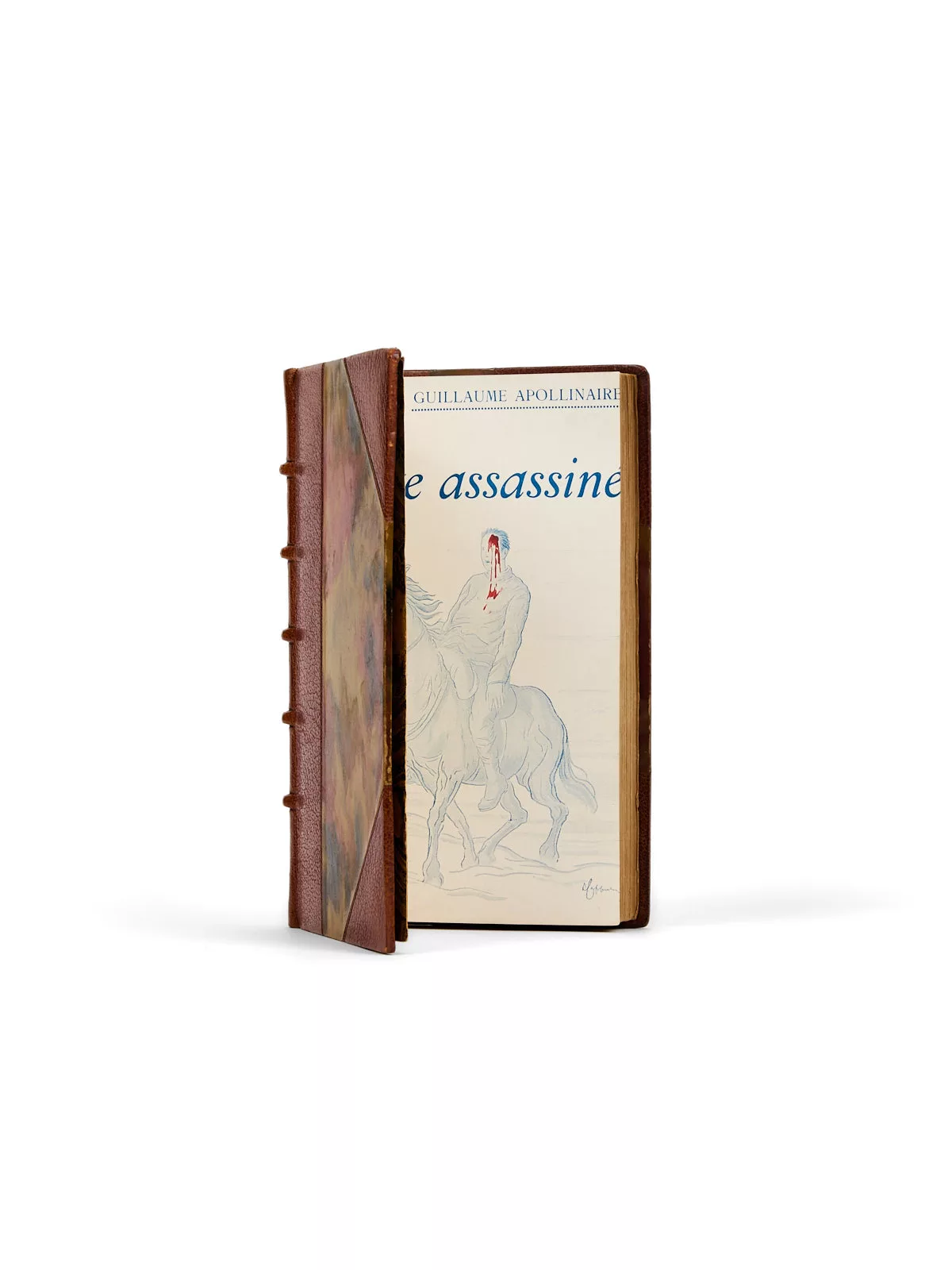
The collection appeared in bookshops in November, with a frontispiece portrait of “Sous-Lieutenant Guillaume Apollinaire” by André Rouveyre, matching the color cover illustration by Leonetto Cappiello showing a mounted soldier with blood on his forehead. On 9 November 1918, almost exactly two years after this book’s publication, the poet died of Spanish influenza in a Paris nearly liberated.
A good copy, without foxing.
Modest binding; wrappers slightly trimmed at the margin.