

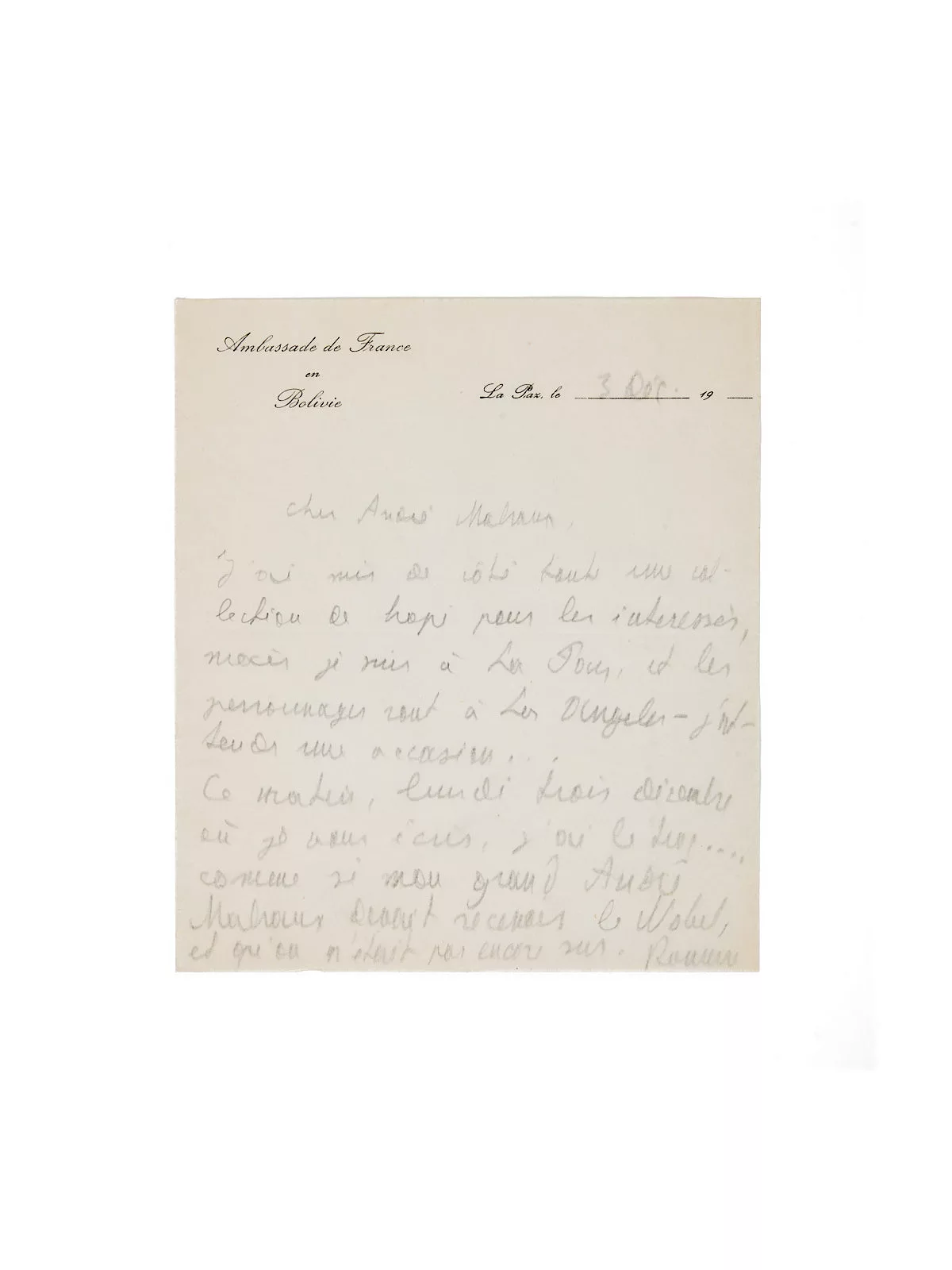
Lettre à André Malraux
An exceptional letter to André Malraux: written on 3 December, just hours before the announcement of the Prix Goncourt.
“Cher André Malraux, J’ai mis de votre côté toute une collection de Hopi pour les intéressés, mais je suis à La Paz, et les personnages sont à Los Angeles – j’attends une occasion… Ce matin, lundi trois décembre où je vous écris, j’ai le trac… comme si mon grand André Malraux devait recevoir le Nobel, et qu’on n’était pas encore sûr. Romain.”
It was the Agence France Presse correspondent in La Paz who informed Gary of the Goncourt jury’s decision to award him the 1956 prize, by eight votes against one for Michel Butor’s L’Emploi du temps and one for Angélina Bardin’s Une fille des champs. “I am torn between the joy of being awarded the Prix Goncourt and the sadness of seeing that the ideal of freedom and human dignity that I defend in my book has never been more threatened,” were Gary’s first words on hearing the news, adding: “Only one thing would give me as much personal joy as receiving the Prix Goncourt: that the Nobel Prize be awarded to André Malraux.”
Malraux had already appeared on the Swedish shortlist the previous year, alongside Henri Bosco and Albert Camus among others. He appeared again the following year, with Pagnol and Saint-John Perse. But it was the Spanish writer Juan Jiménez who was chosen; Camus would succeed him in 1957. Camus did not forget Malraux in his acceptance speech: “I want to say that, had I taken part in the vote, I would have chosen André Malraux, for whom I have great admiration and friendship, and who was the master of my youth.” Despite this, Malraux was never honored, having ultimately received 32 Nobel nominations in total.
Gary returned to Paris on 10 December, six days after being awarded the Prix Goncourt, following a thirty-two-hour flight by Caravelle. The Quai d’Orsay granted him an exceptional three-week leave, during which he undertook a continuous round of interviews and obligations attendant on receiving the prize.
The first novel to openly take the protection of nature as its central subject, Les Racines du ciel is also — once again — a novel of resistance: “resistance to everything that oppresses man, wherever and however it occurs.” This is why Romain Gary wrote, in December 1956, after the entry of Russian tanks into Budapest: “The Hungarian elephants must be saved. One day they will resume their triumphant march” (Larat, Romain Gary, Une trajectoire dans le siècle, II, p. 48).