

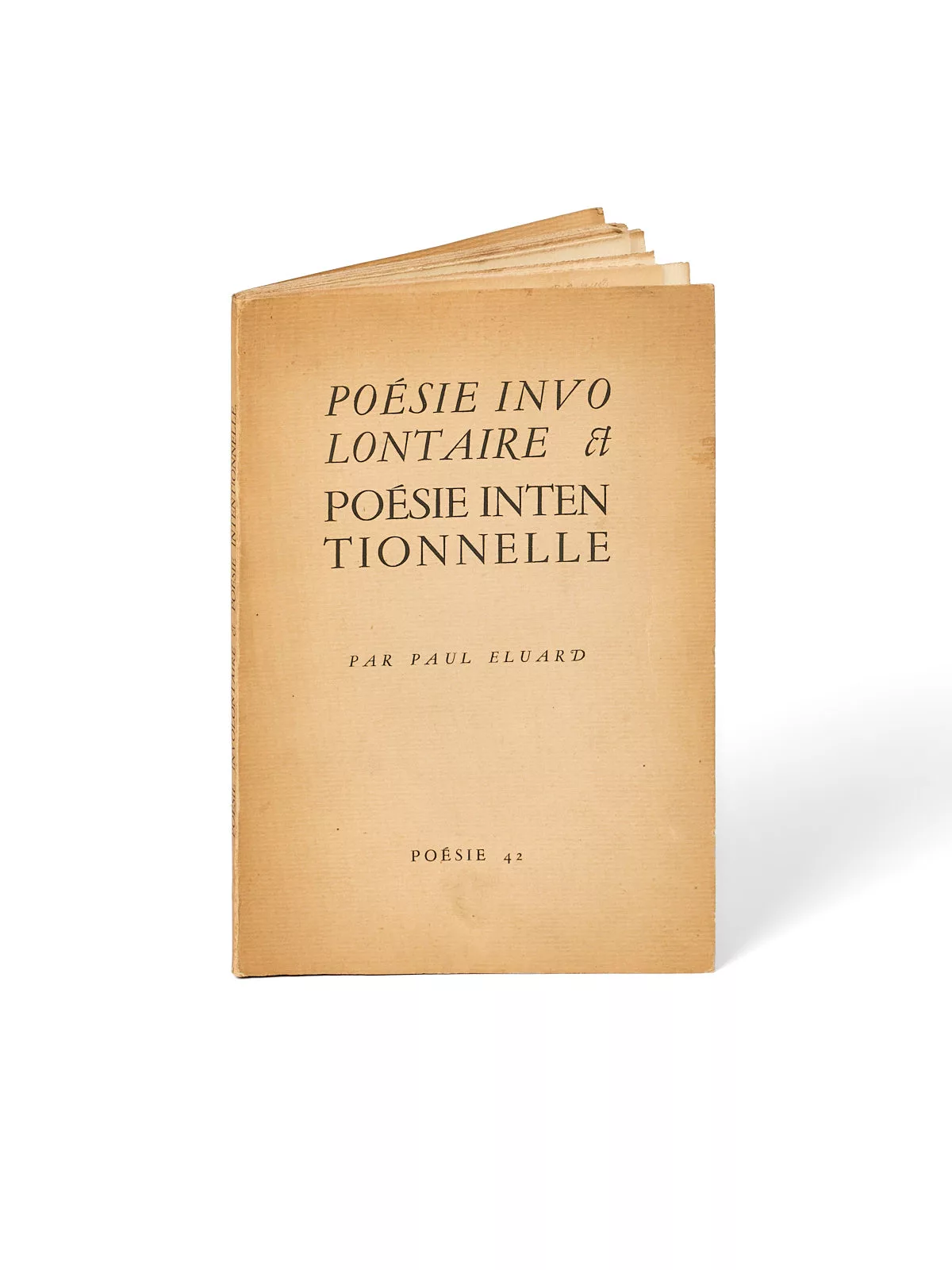
Poésie involontaire et Poésie intentionnelle
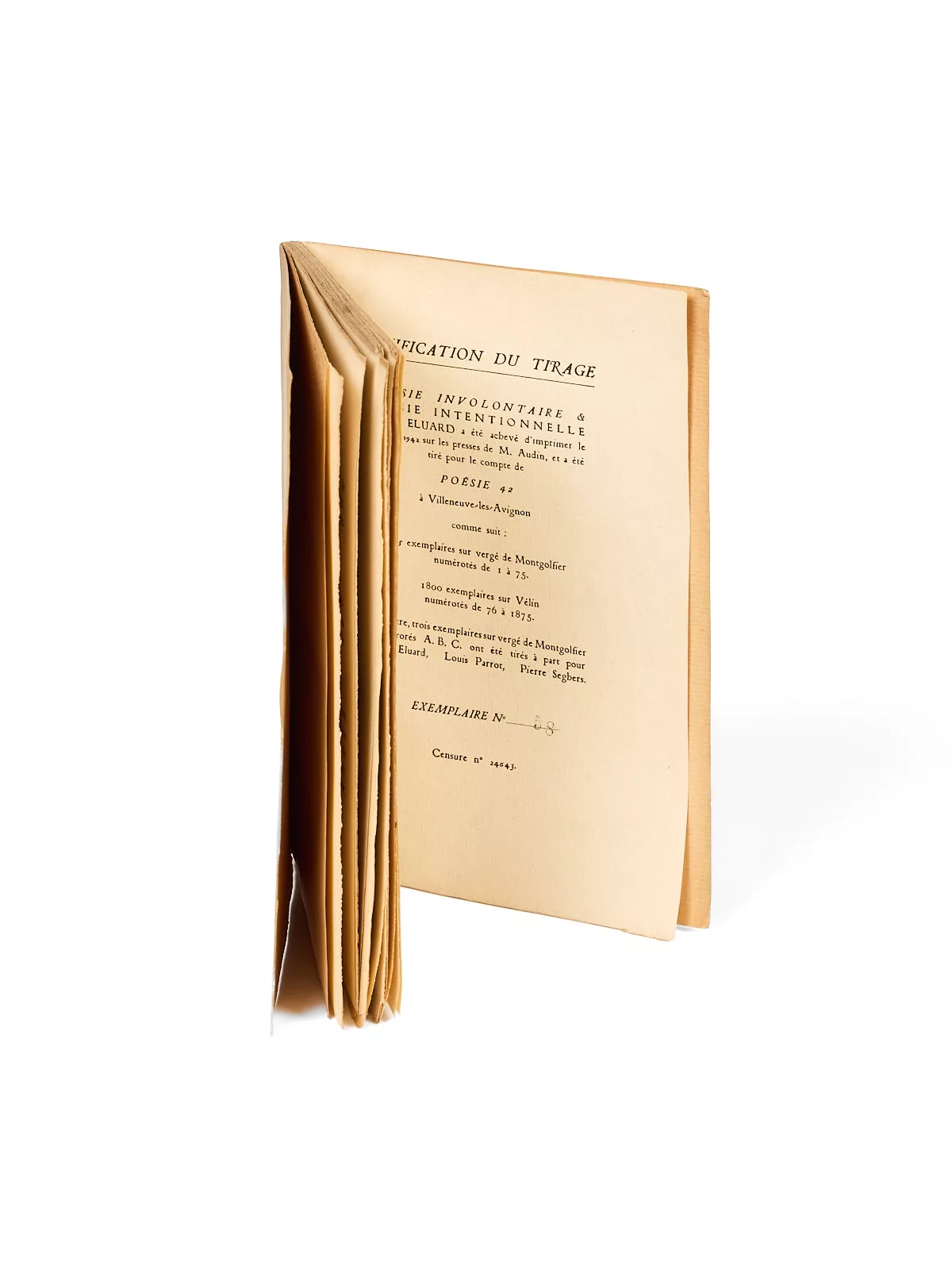
One of 75 copies on laid paper (no. 58).
This has never, to our knowledge, been pointed out before, but this text is that of a prewar lecture which Paul Éluard here revised with a view to having it published by Pierre Seghers, as he explained to his friend Louis Parrot in an interzone card of 14 April 1942. On 21 February 1939, at the initiative of the Compagnie du Diable écarlate directed by Sylvain Itkine — whose troupe had performed in occupied factories during the great strikes of June 1936 — Éluard had in fact spoken at the Proscenium d’Europe of the Théâtre Pigalle, an event widely announced in the press. In its issue of 25 May 1939, Excelsior reported on the event, explicitly describing it as a “séance de poésie involontaire et de poésie intentionnelle” presented through a lecture by Paul Éluard, in which, alongside poems by Rimbaud, Apollinaire, Laforgue and Raymond Roussel, one heard Jules Jouy’s “Vieux Paralytique,” the “Admirables Secrets du Grand Albert,” the dream of an eleven-year-old child, a letter of the Portuguese nun, and Victor Litschfousse’s “Impudiques.”
“I have read your text and the quotations with great joy,” Seghers enthused to Éluard as early as 22 May 1942, “I am delighted, and I shall work toward its absolutely certain success. […] I am leaving for Lyon on Tuesday to bring the text to the printer. I want simple but felicitous typography. I am setting aside my last reams of paper for you.” Two days later, in a letter to Parrot of 24 May, Éluard, wishing his book to be “useful, fruitful,” spelled out his “deep intention”: “to bring the poetic spirit in France, in areas hitherto poorly appreciated, toward a broader objectivity, toward its mother, ‘the life of all men.’” While fragments of the quotations were entrusted to Noël Arnaud’s group La Main à plume, which published them alongside other texts in La Conquête du monde par l’image, the project was further enriched with new quotations that Éluard sent to Parrot in two letters of 30 and 31 May 1942 (Éluard livre d’identité, p. 186); censorship difficulties then somewhat delayed the project, so that the book only went to press on 8 July 1942, after the printing was completed.
“However deep Paul Éluard’s commitment to political and national life,” Decaunes observes in his biography (pp. 202–203), “he never renounced what remained, in his eyes, poetry’s highest function: the discovery, the conquest, through language and across language, of all the treasures of man […]. This is why the publication, in the midst of the Occupation, of Poésie involontaire, poésie intentionnelle is, from a certain point of view, an act at least as significant as that of poems of resistance.” It was in this same spirit that he had drawn closer to Noël Arnaud.
Original publisher’s wraparound band preserved.