

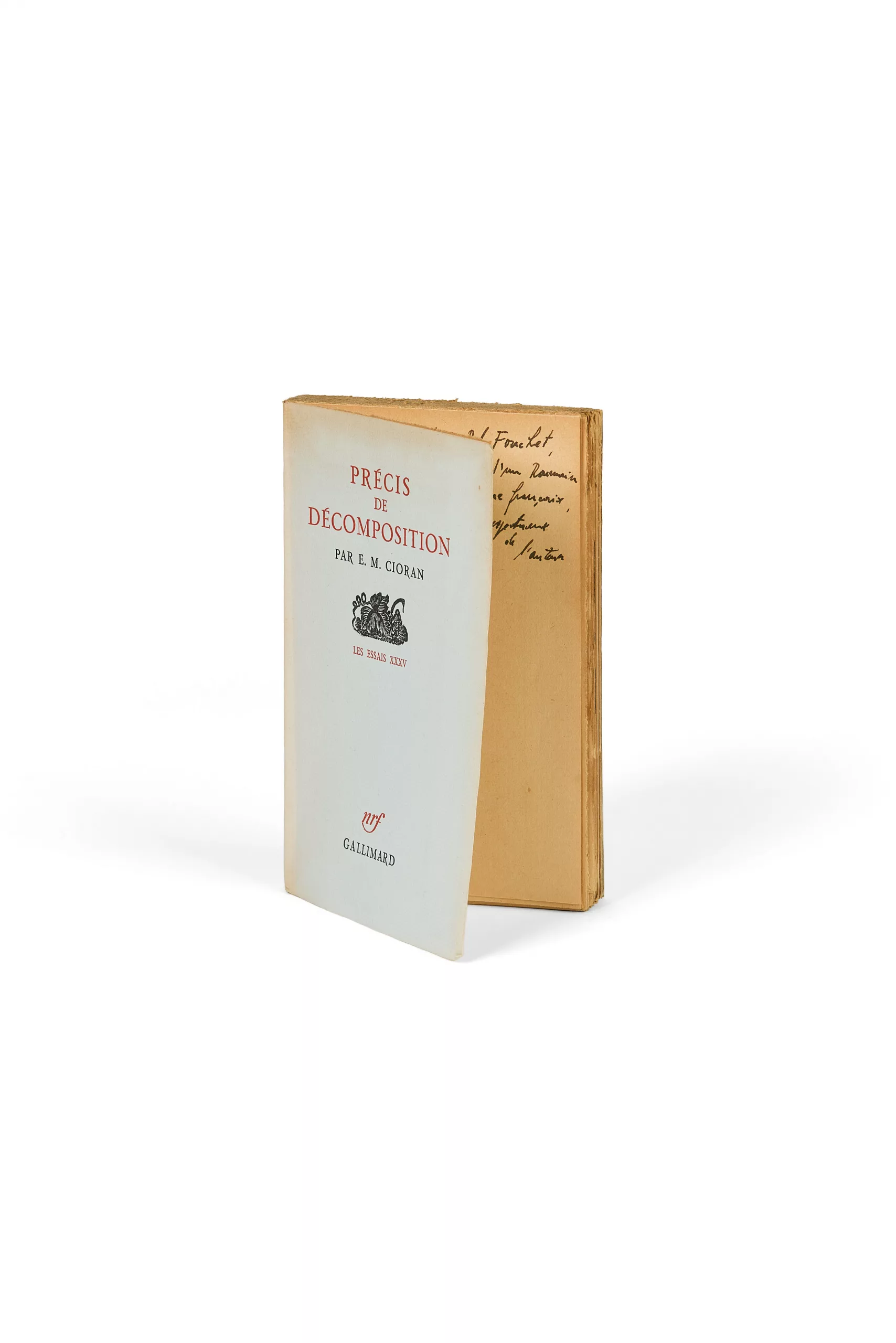
Précis de décomposition
Signed presentation inscription: “À Monsieur Max-Pol Fouchet, - cette incursion d'un Roumain dans la langue française, hommage respectueux de l'auteur.”
Throughout his singular body of work, Cioran consistently placed despair at the very heart of his philosophical reasoning. The first essay he wrote in French, Précis de décomposition — composed in a style of glacial elegance — gives voice to the obsession with doubt, the burden of anxiety, the permanent shadow of suicide, and the painful duality between the Self and the collective. A modern-day Diogenes, heir to Schopenhauer and spiritual son of Nietzsche and Dostoevsky, Cioran never ceases to offer, with despairing lucidity, a dark vision of humanity, itself a witness to his own despair. Rejecting any formal system in the expression of his thought, he preferred the aphorism, which he said produced “the same effect as a slap,” a form suited to conveying his detachment, his contempt, his distress, and even his horror at the condition of existing: life, he wrote, is “a state of non-suicide.”
This incursion into the French language, as he called it to Max-Pol Fouchet in his inscription, was far more than a breach: it was an immense opening in the history of ideas.