

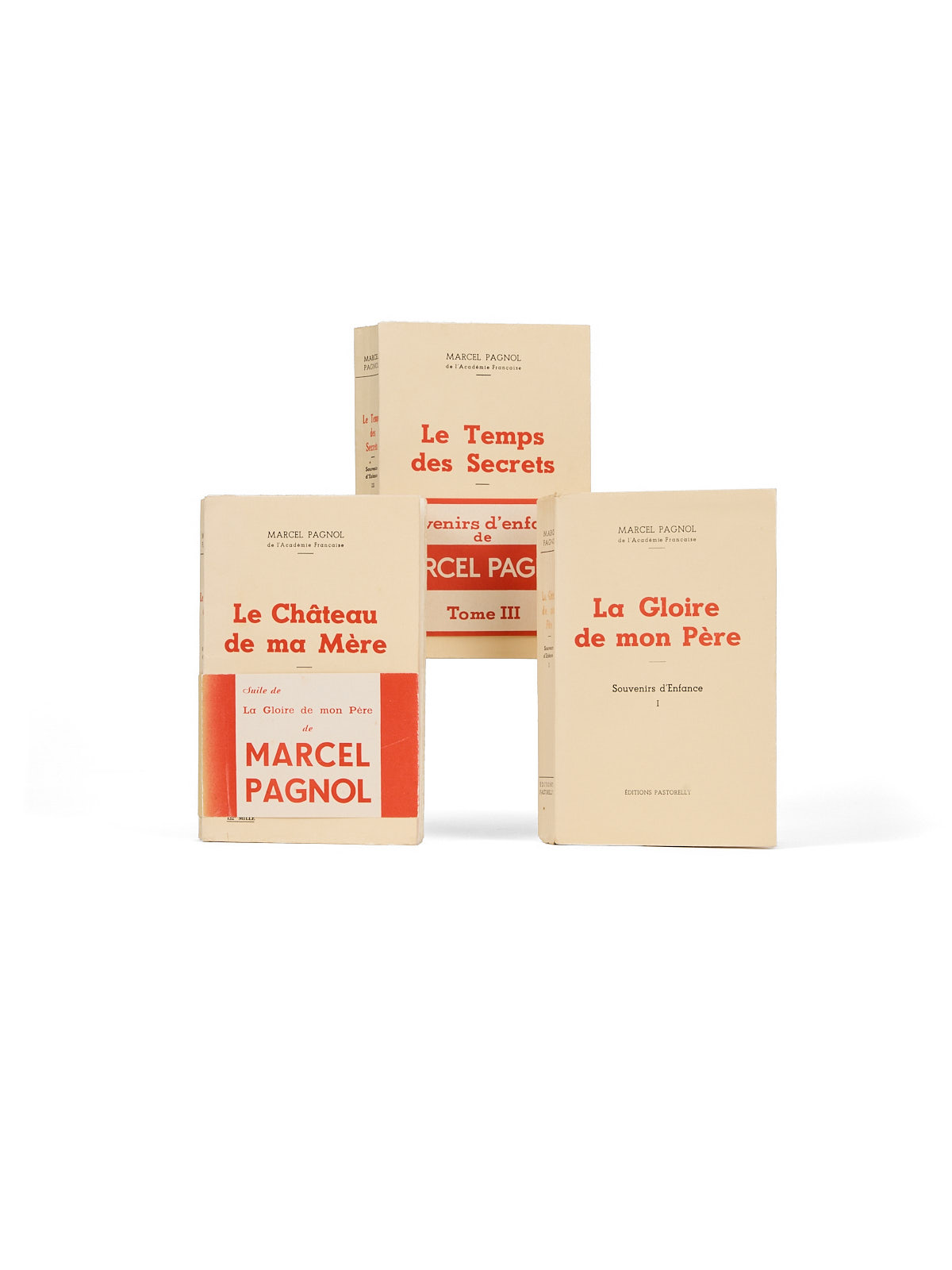
La Gloire de mon père – Le Château de ma mère – Le Temps des secrets
Pagnol’s great novelistic masterpiece, his “diary of childhood.” The success began when a women’s magazine asked Pagnol for a short story for its Christmas issue. He wrote the tale of four castles, a story that awakened in him the desire to tell more. “It is only a testimony to a vanished era, and a little song of filial piety, which may perhaps today pass for a great novelty.” It did indeed: the book was celebrated by both the public and the critics. “Between Paul Arène’s Jean des Figues and Daudet’s Lettres de mon moulin, there was a place to be filled, and it is our Marcel Pagnol who has filled it, without ever having thought to claim such an honor. He has simply written a beautiful and charming book of childhood memories. The success of La Gloire de mon père astonished him, so much so, he told me, that he found literary critics (indeed!) far kinder than theater critics, though the author of Topaze and Marius had not had much to complain of from the judges he met in the theater. What I like in La Gloire de mon père, as in Daudet’s masterpiece, is the naturalness that makes it a book for everyone and will win over every reader of good faith […]. Behind the vivid portrait lies childhood itself, with its games, its illusions and its innocent cruelties, its pleasant curiosities, excellent scenes such as the making of cartridges and Uncle Joseph’s wedding, and the whole nature of Provence, its hidden springs, its greenery and its vehement scents.” (Émile Henriot, in Le Monde, 5 February 1958).
In the first edition of Le Château de ma mère, the following volume is announced under the title Les Grandes Amours, described as the “sequel and conclusion to the childhood memoirs.” Pagnol would go on to work on a fourth volume, Le Temps des amours, which remained unfinished at his death and was published only posthumously.
A fine set, in which the scarce publisher’s bands have been preserved.