

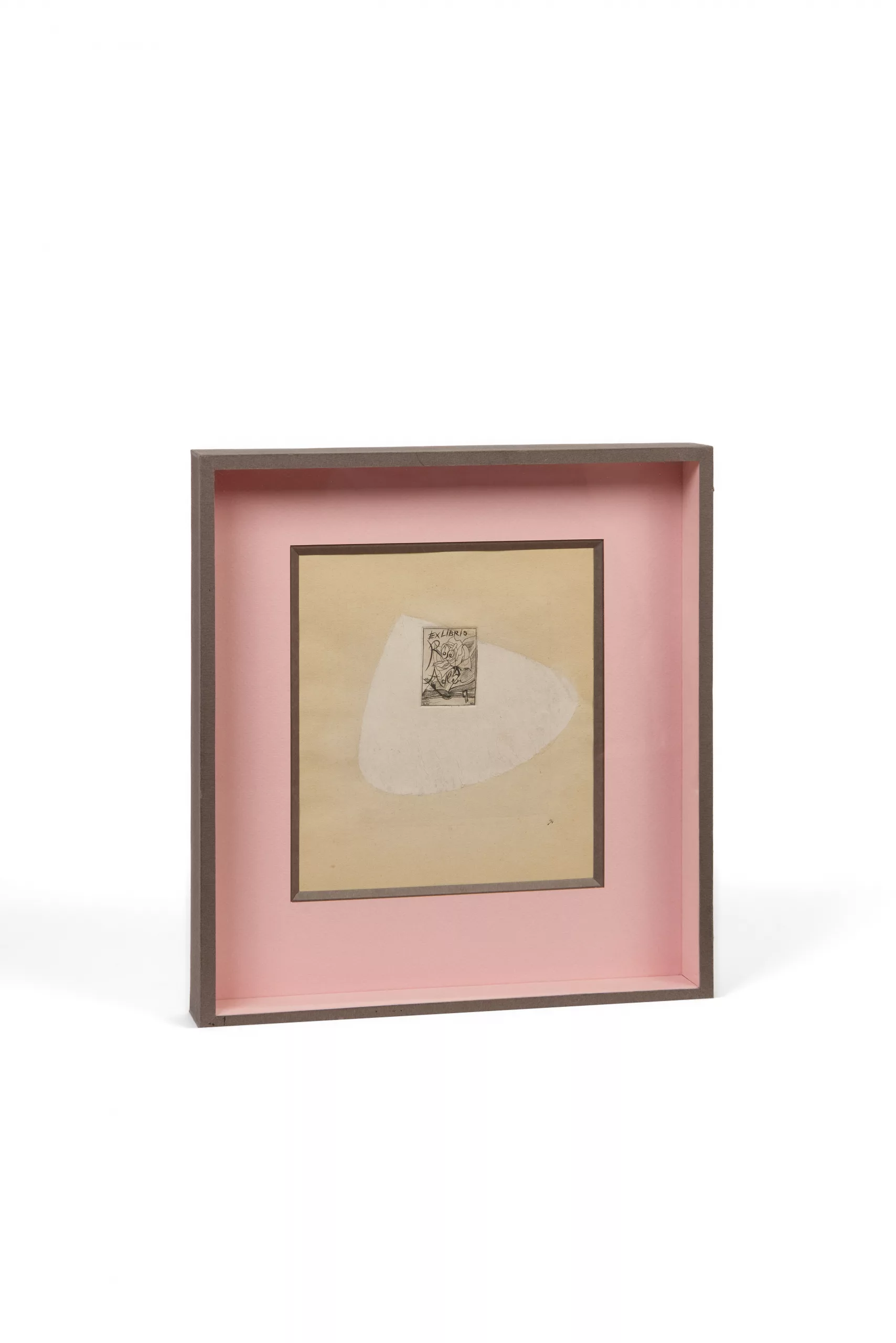
Collage original avec son ex-libris en son centre, gravé à l’eau-forte.
This bookplate appears never to have been printed elsewhere: it is absent from Rose Adler’s own personal books, and only one other occurrence is known — a proof preserved in the bookplate collection of the binder Noulhac, one of her masters in bookbinding, sold at auction about a decade ago (Marseille, Leclere, 2009, no. 94).
It is hardly surprising that such a proof should have been given to him for his collection: Noulhac had trained her in the craft of gilding after her studies at the École d’Art décoratif on rue Beethoven and the École du Comité des Dames de l’Union Centrale des Arts Décoratifs (UCAD). It was under his benevolent guidance that she produced her first bindings: “There, I had the revelation of the beautiful craft, and the conviction that no invention of the most perfect taste holds if the book is not perfectly constructed.” (Journal, 15 May 1930).
Rose Adler later tried her hand at engraving, perhaps under the influence of her friend the engraver Denise Bernollin, but produced very few works, mainly etchings, and rather late, for PAB’s miniature editions. She perfected this art after 1935, when she frequented Atelier 17, run by Stanley William Hayter.
No engravings by Rose Adler can be dated with certainty before 1930 — but this one must necessarily predate that year, since Noulhac died in 1931. Collages of this type are characteristic of the period 1923–1928, when Rose Adler, under the influence and patronage of Jacques Doucet, explored several artistic forms: collages, frames, boxes.
This precious collage is cited and reproduced in Hélène Leroy’s publication, Étienne Cournault et Rose Adler: de Jacques Doucet à l’Union des Artistes Modernes, Nantes, Musée des Beaux-Arts, 2015, published on the occasion of the exhibition “Étienne Cournault, la part du rêve” (Musée des Beaux-Arts de Nantes, Musée des Beaux-Arts de Nancy, 2016).