

Lettre autographe signée à sa mère
An exceptional letter to his mother, Madame Aupick, written a few days before the publication of Les Fleurs du mal: Baudelaire glimpses coming “célébrité,” arranges for a book to be restored for his mother by Lortic, and confides in her with unusual openness.
Fourteen hundred and twenty letters written between 1832 and 1866 make up the surviving correspondence of Charles Baudelaire. The most moving are naturally those addressed to his mother; the earliest to survive dates from 6 February 1834, when Baudelaire was a boarding pupil at the collège in Lyon, where his stepfather Aupick had been posted. As early as July 1837 he was already writing: “Si tu viens, n’oublie pas un peu d’argent ; j’en ai besoin.” It was the first of a long series of such requests, for throughout his life Baudelaire spent far beyond his means; within two years he squandered half his inheritance in what the courts termed “folles prodigalités.” When a conseil judiciaire was appointed to prevent him from freely disposing of what remained, he wrote to his mother in 1844: “Persuade-toi donc bien une chose, que tu sembles toujours ignorer ; c’est que vraiment pour mon malheur, je ne suis pas fait comme les autres hommes.”
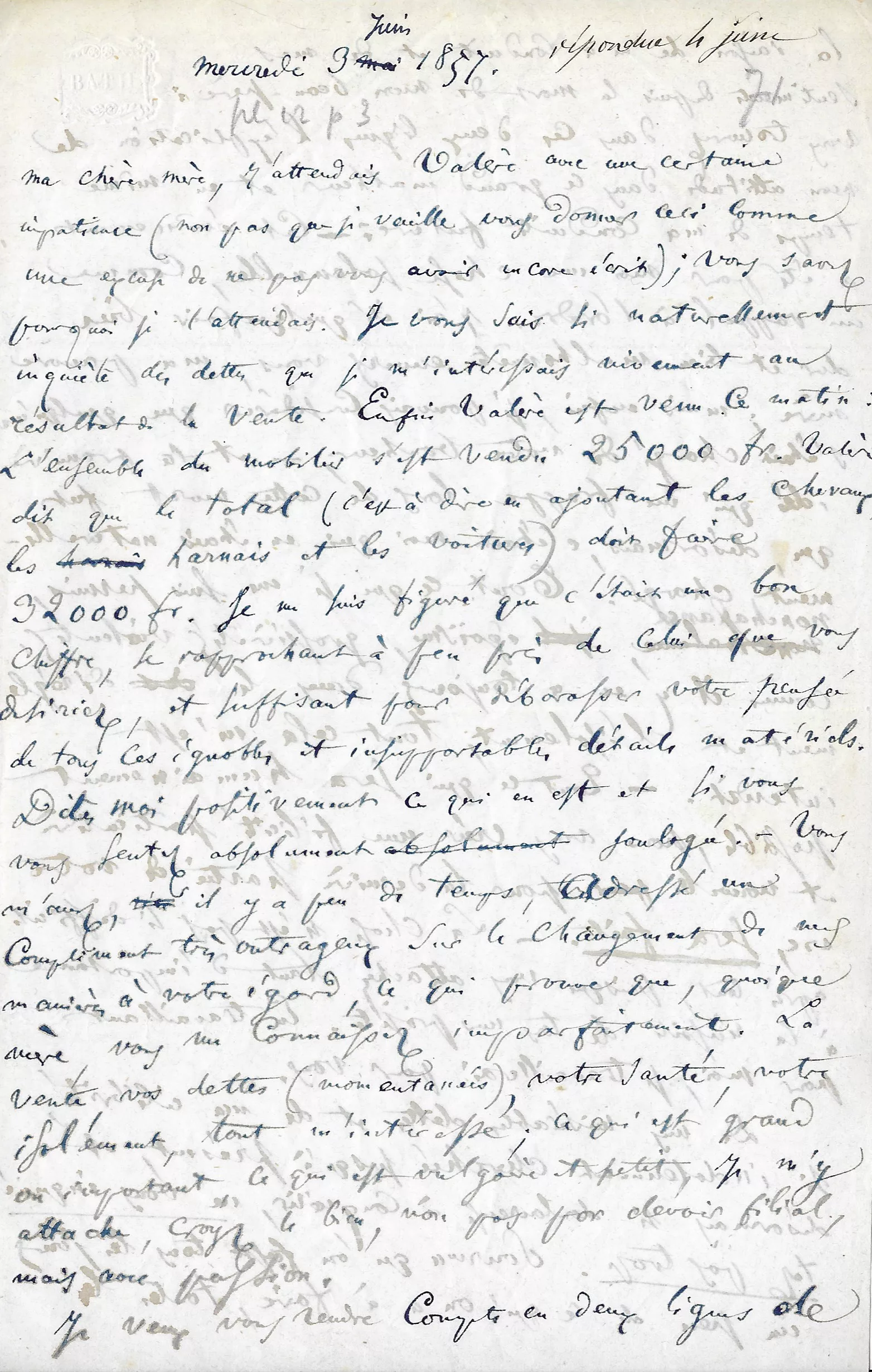
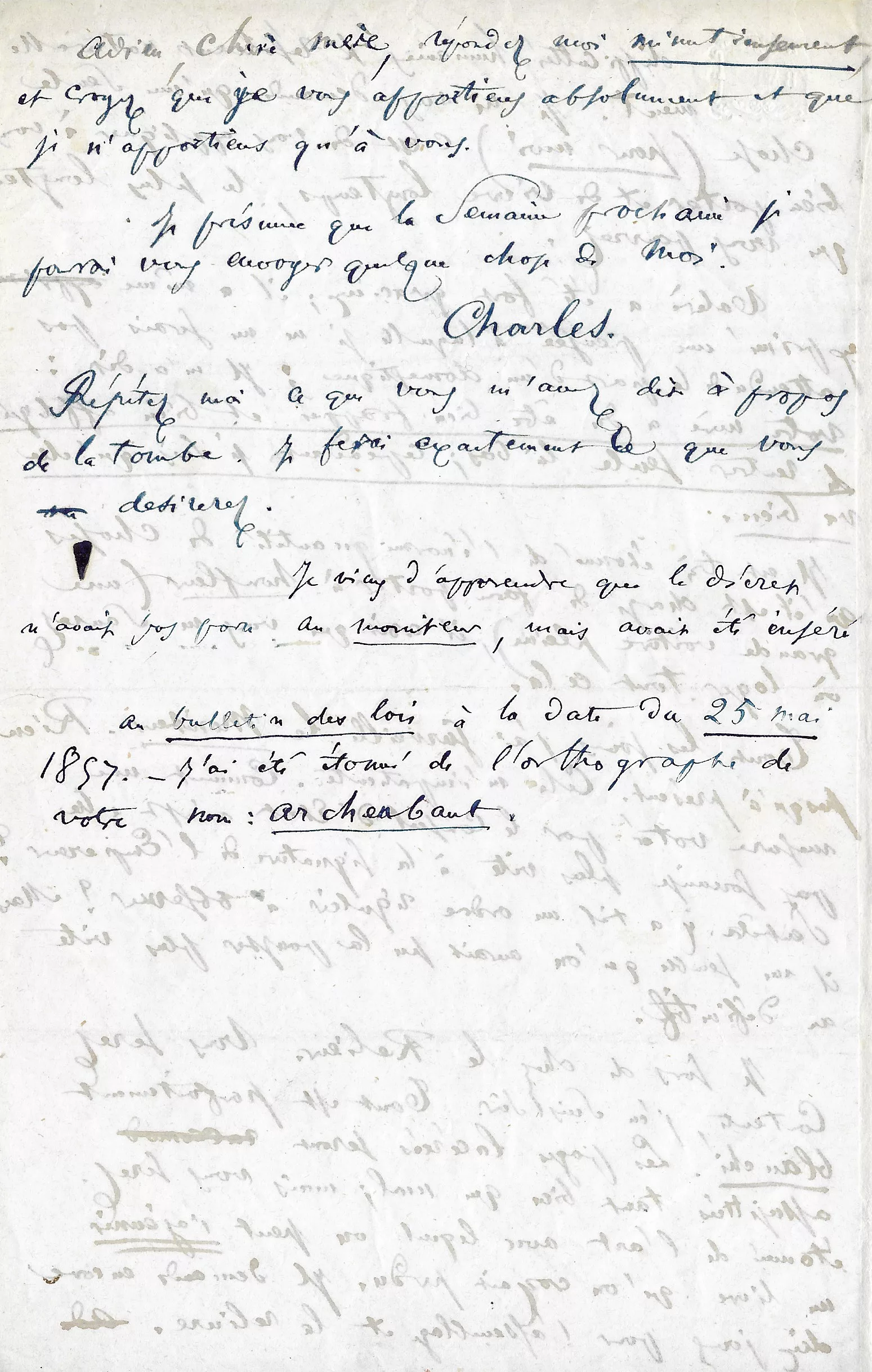
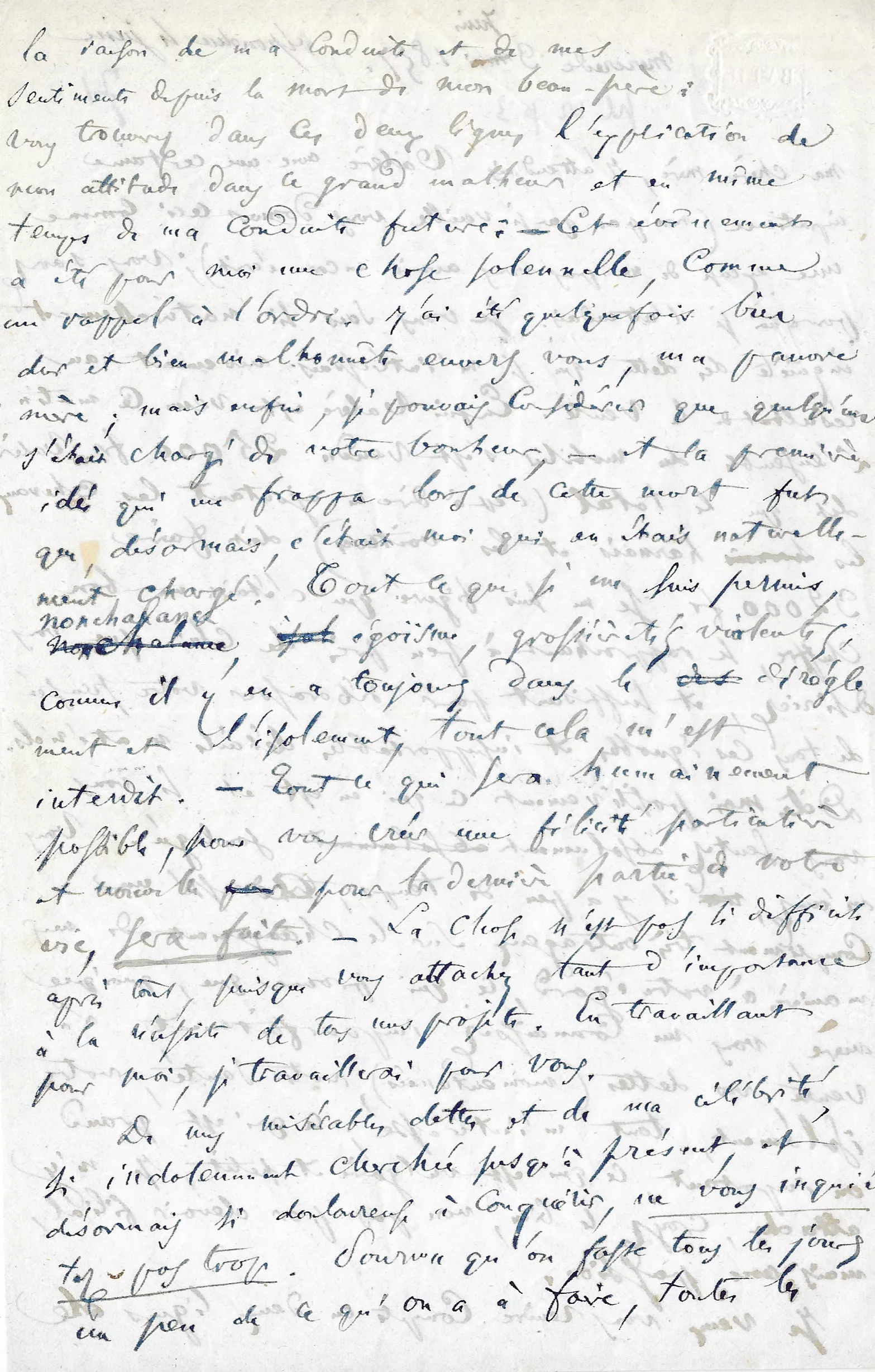
At the time of the present letter, Baudelaire was in Paris overseeing the serialization of Les Aventures d’Arthur Gordon Pym in Le Moniteur universel, and putting the finishing touches to Les Fleurs du mal, whose manuscript he had entrusted to Poulet-Malassis since February. His stepfather Aupick died on 27 April 1857, just as Baudelaire was completing the edition of Les Fleurs du mal, published on 22 June 1857. The widowed Madame Caroline Aupick then decided to sell most of the Paris household goods, which allowed her to live in relative comfort at Honfleur, in the “Maison-joujou” the general had had built on the cliff a few years earlier. This letter of 3 June sets out the new relationship between mother and son: “J’ai été quelquefois bien dur et bien malhonnête envers vous, ma pauvre mère ; mais enfin, je pouvais considérer que quelqu’un s’était chargé de votre bonheur, et la première idée qui me frappa lors de cette mort fut que, désormais, c’était moi qui en étais naturellement chargé […]. Tout ce que je me suis permis, nonchalance, égoïsme, grossièretés violentes, comme il y en a toujours dans le dérèglement et l’isolement, tout cela m’est interdit. — Tout ce qui sera humainement possible, pour vous créer une félicité particulière et nouvelle pour la dernière partie de votre vie, sera fait.” He adds the extraordinary declaration, rare in his hand: “Croyez que je vous appartiens absolument et que je n’appartiens qu’à vous.”
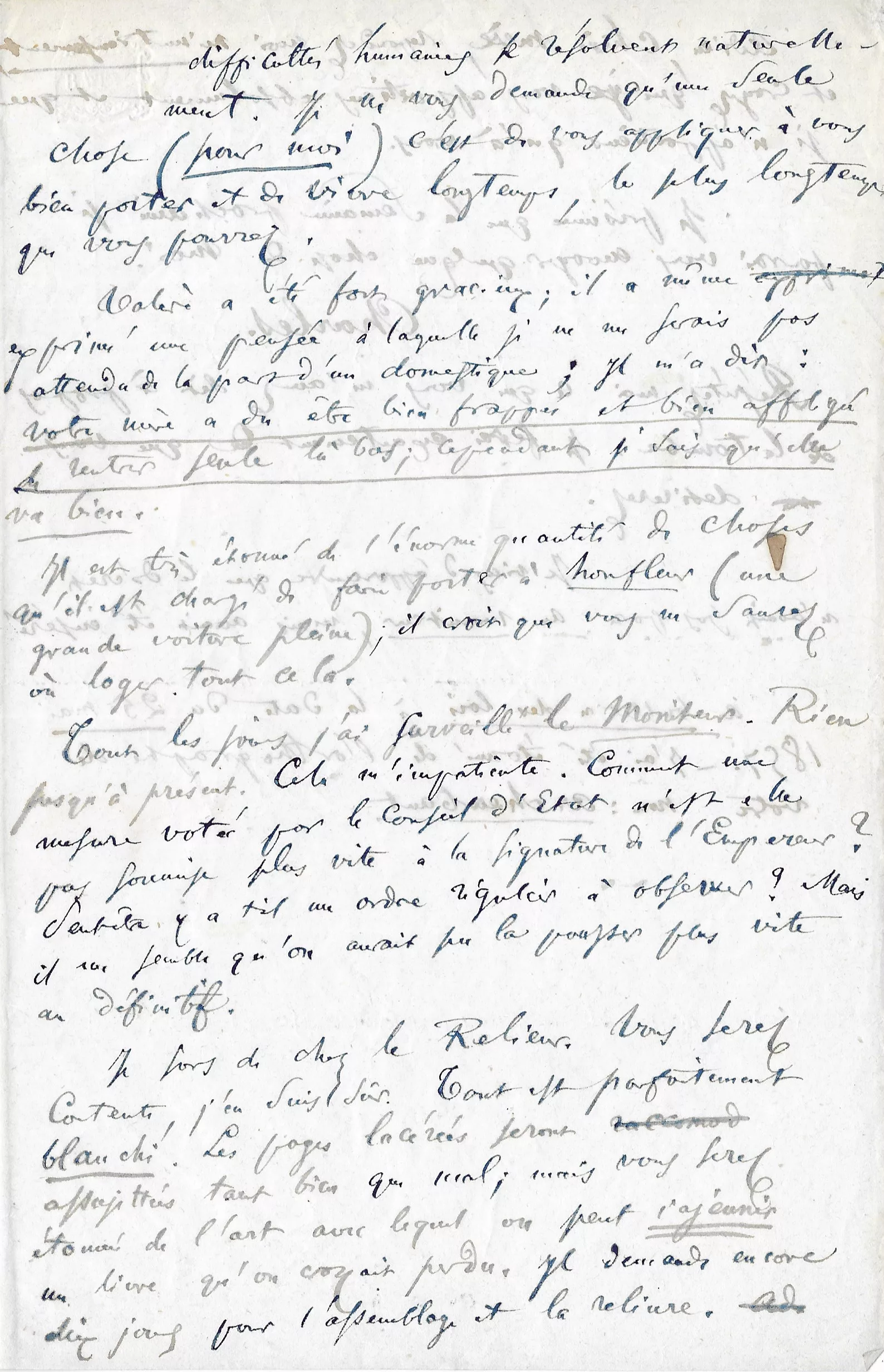
Baudelaire, again unusually attentive, was also having a book restored for his mother at considerable expense: “Je sors de chez le relieur. Vous serez contente, j’en suis sûr. Tout est parfaitement blanchi. Les pages lacérées seront assujetties tant bien que mal ; mais vous serez étonnée de l’art avec lequel on peut RAJEUNIR un livre qu’on croyait perdu. Il demande encore dix jours pour l’assemblage et la reliure.” The previous letter, of 20 May, explains that this was a mourning prayer book, in pitiful condition, which Baudelaire had entrusted to Lortic for restoration. In the meantime, having noticed his mother’s impatience to have a mourning missal while hers was being repaired — a process taking at least three weeks — he sent her another copy, picked up in Paris, “qui n’est pas beau, mais à peu près convenable.”
In this month of May 1857, Baudelaire had settled his accounts. With the help of Valère, his stepfather’s former butler, the sale of “l’ensemble du mobilier […], les chevaux, les harnais et les voitures” realized 32,000 francs, a sum he considered sufficient to relieve his mother of these material concerns. He assured her that he took a passionate, not merely filial, interest in her affairs — the sale, her debts, her health, her isolation.
Baudelaire was confident, even optimistic: the publication of Les Fleurs was expected within a fortnight. He told his mother not to worry too much about his debts or his fame, “si indolemment cherchée jusqu’à présent, et désormais si douloureuse à conquérir.” The letter closes: “Je présume que la semaine prochaine je pourrai vous envoyer quelque chose de moi” — almost certainly a copy of Les Fleurs du mal. On 13 June he gave de Broise the list of copies to be sent; his mother’s name does not appear on it, but the poet had reserved several copies for himself, one of which he evidently gave her.
On the first page, Madame Aupick noted “Répondue, juin.” It was probably under the impression of the reassurances contained in this letter that, a few days later (16 June), Madame Aupick wrote to her daughter-in-law: “Dites à Alphonse que je suis contente de son frère, du moins sous le rapport des sentiments ; quant à l’ordre, je ne sais s’il changera jamais […]” (quoted by Georges Emmanuel Lang, Figaro, March 1922).
A marvelous document.