

« Ce vent, ce sable, ces étoiles, et ce soleil »
This triptych condenses the existential experience of the desert and encapsulates, in Alban Cerisier’s words, “the profound humanity” of the writer-aviator. In 2019, Gallimard made it the subtitle of its exhibition (“Un engagement pour l’homme”), then of the Quarto edition of the Œuvres complètes (2021).
These words were originally meant to form the title of the book. It was only at the last moment, on the Lagny proofs in December 1938, that Saint-Exupéry adopted the title proposed by his cousin André de Fonscolombe: Terre des hommes. In the United States, Lewis Galantière reverted to this original intention and gave the translation published in June 1939 its definitive title, Wind, Sand and Stars.
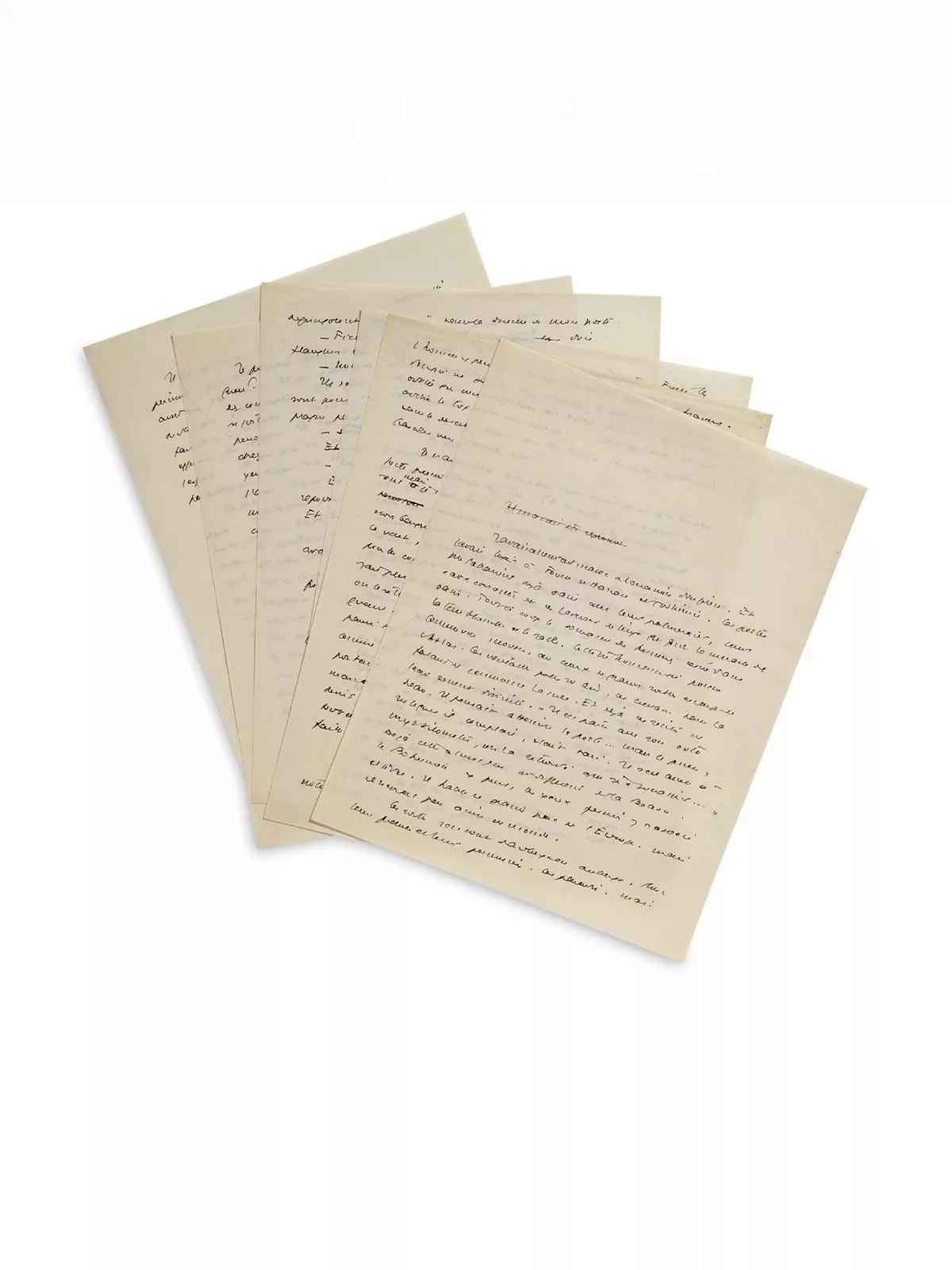
Written around 1937, these notes mix memories of trans-Saharan flights, stops in oases and reflections on the Rif War. They contain evocations of Morocco (Foued el Hassan, Goulimine), palm groves, washerwomen, and the “white beach” stretching for 50 km; a fragment later taken up in Terre des hommes (Pléiade, vol. I, pp. 277-278, 356-357) recounts the episode of Captain de Latour: he receives envoys from a mountain tribe when his outpost is attacked by another tribe, and his guests help him repel the attack. “The next day it is their turn to attack Latour. But before the battle an emissary comes to see him. — Yesterday we defended you. We spent thirty cartridges for you. Give them back to us. — That is fair… Latour returns them, like a great lord, these bullets meant for him. […] He told me this story. And he falls silent and I fall silent. And I know well what he misses. This nobility in human relations.” There follows a meditation on human nobility and the absurdity of political justifications for war, and finally, a vision of the desert as a place of trial and brotherhood: “This wind, this sand, these stars, and this sun. And placed there to preserve them, man.”
From the forced landing in Egypt in 1935 (four days of wandering without water, rescued by Bedouins) to his experiences with Aéropostale, Saint-Exupéry developed a reflection on “taming,” this “creating bonds” that would become the central theme of The Little Prince.
This manuscript bears witness to this intellectual maturation and constitutes a direct source for Terre des hommes, incorporating both fragments later reused and images repurposed, as well as the first appearance of the triptych “wind, sand, stars”: three recurring and central elements of his writing.