

« L’auberge d’Ingrannes » [Le temps d’Anaïs]
In July 1950, Georges Simenon settled with his wife Denyse and their son John at “Shadow Rock Farm,” a ranch in Lakeville, Connecticut. He remained there for five years, during which he wrote some of his greatest “romans durs” — among them Le Temps d’Anaïs, Une vie comme neuve, La Mort de Belle, Les Frères Rico, L’Escalier de fer, Feux rouges, L’Horloger d’Everton, Le Grand Bob and Les Témoins — as well as several of the finest Maigret novels: Maigret au Picratt’s, Maigret et la Grande Perche, Maigret et l’Homme du banc, Maigret se trompe and Maigret et la Jeune Morte.
The first book he wrote there, three months after settling in and savoring the happiness of his new marriage to Denyse and the joys of fatherhood, was Le Temps d’Anaïs. It is no accident that he set the novel in Ingrannes — he even considered calling it L’Auberge d’Ingrannes — a place where he had lived almost exactly fifteen years earlier. At the end of 1934, Tigy and Georges Simenon wanted to leave the château de Marsilly. After searching France in vain for the right place, they found an abbey adjoining a small château, la Cour-Dieu, deep in the forest, and stayed meanwhile at the inn in the nearby village of Ingrannes. Simenon remained at la Cour-Dieu only long enough to write three novels (Faubourg, Quartier nègre and Les Demoiselles de Concarneau) and several short stories. During these three years in the Orléanais he explored the region, met its inhabitants and absorbed its geography in search of material for his work. He was also drawn to walks along the Loire, especially to the town of Meung-sur-Loire, which he later made Maigret’s country retreat, where the inspector loved to rest and fish.
The forest of Orléans and the inn at Ingrannes came back to him fifteen years later, when he wrote his first novel in his new house at Lakeville.
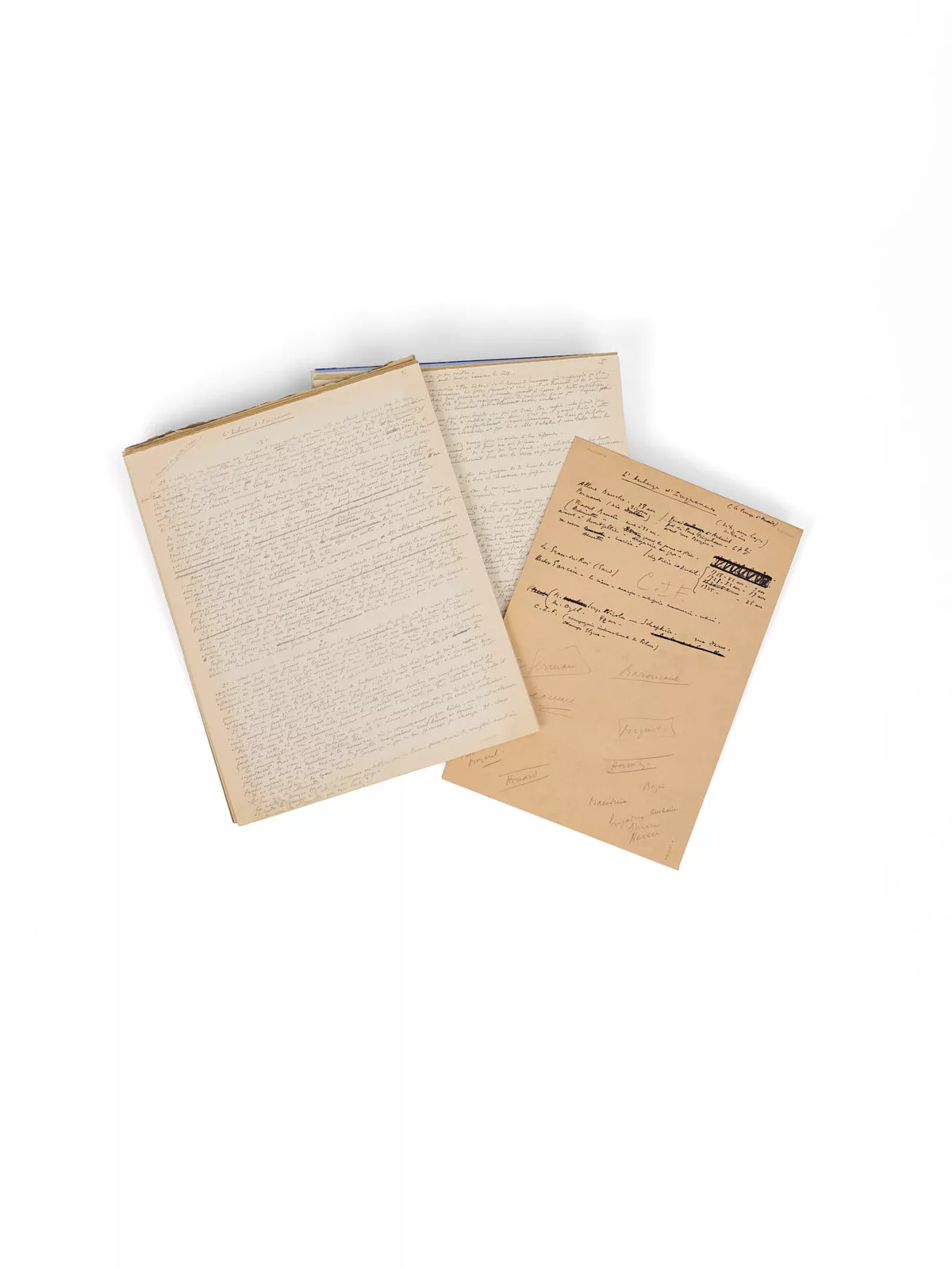
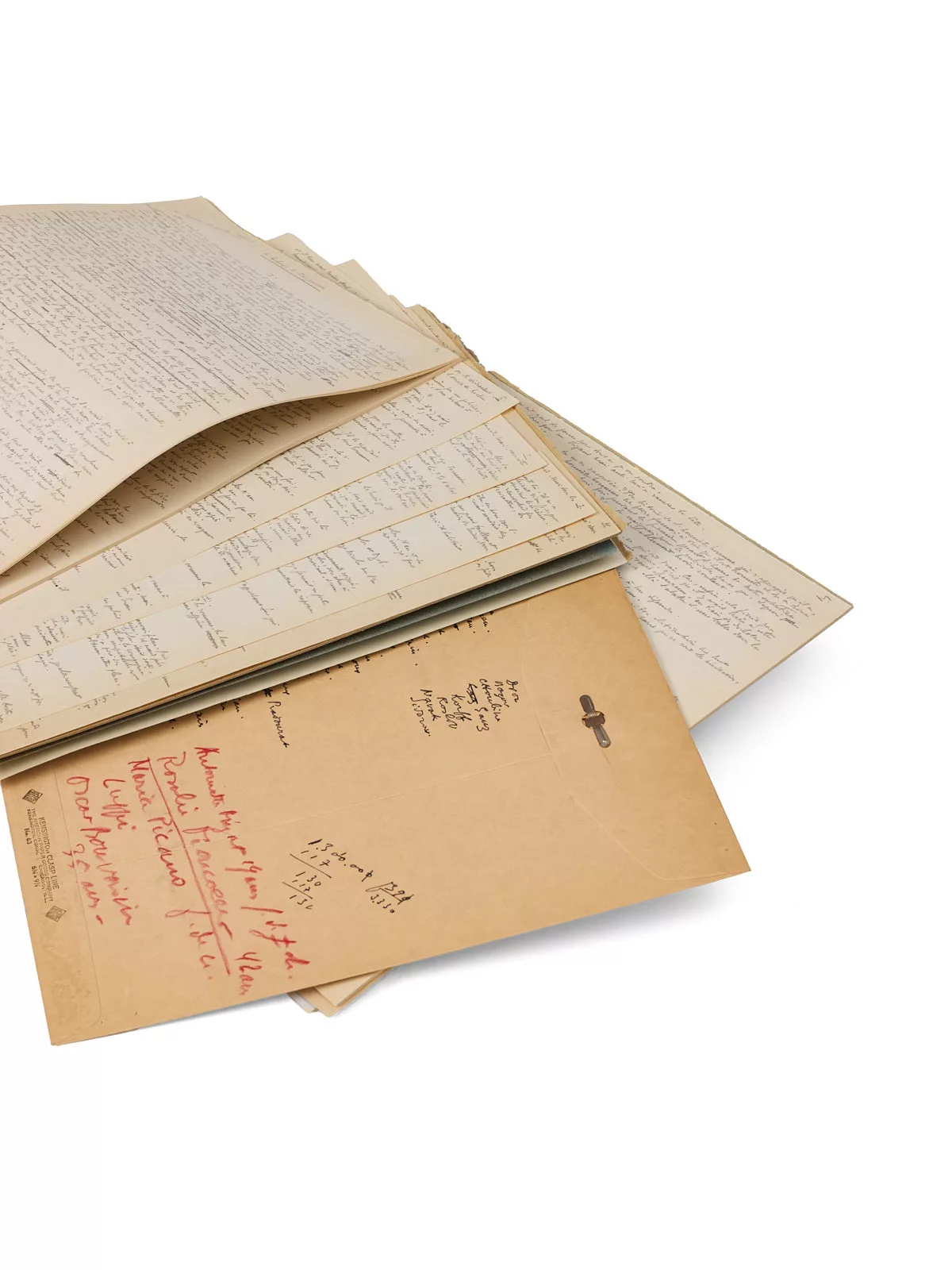
The complete autograph manuscript is written entirely in pencil, in a fine, nervous, confident hand, fast and closely spaced, without margins, filling the entire page, on the recto of 51 leaves from two pads of vélin paper, with an accompanying leaf of lined paper.
Entirely autograph manuscripts by Georges Simenon, a devoted user of the typewriter, are rare. This one was written in a matter of days, from 24 October to 1 November, almost in a single sitting and with very few corrections — proof of his remarkable mastery. A 172-leaf typescript was produced immediately afterward; Simenon habitually typed up each day’s chapter the following morning, introducing many changes, which left his manuscripts largely uncorrected first drafts.
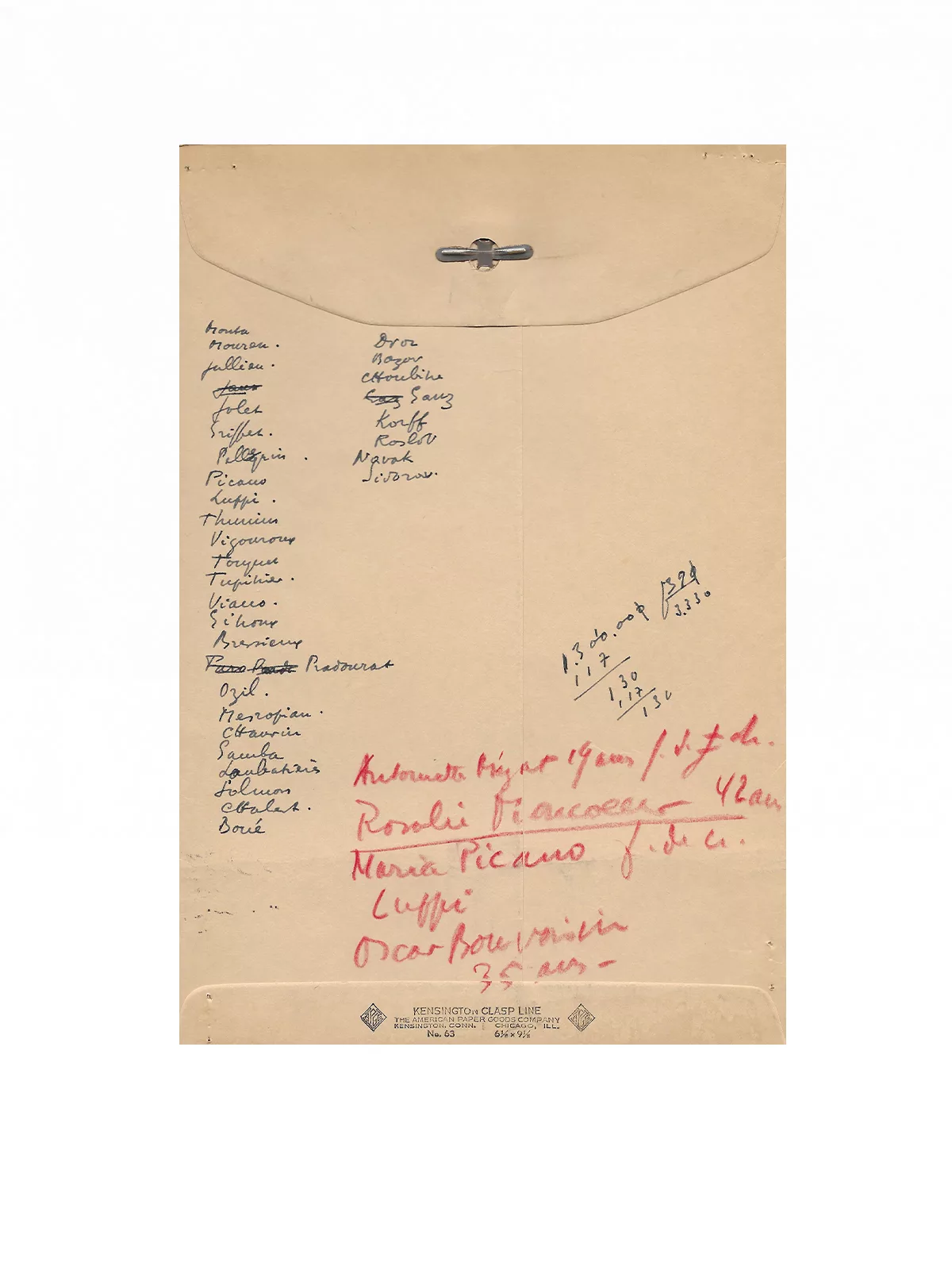
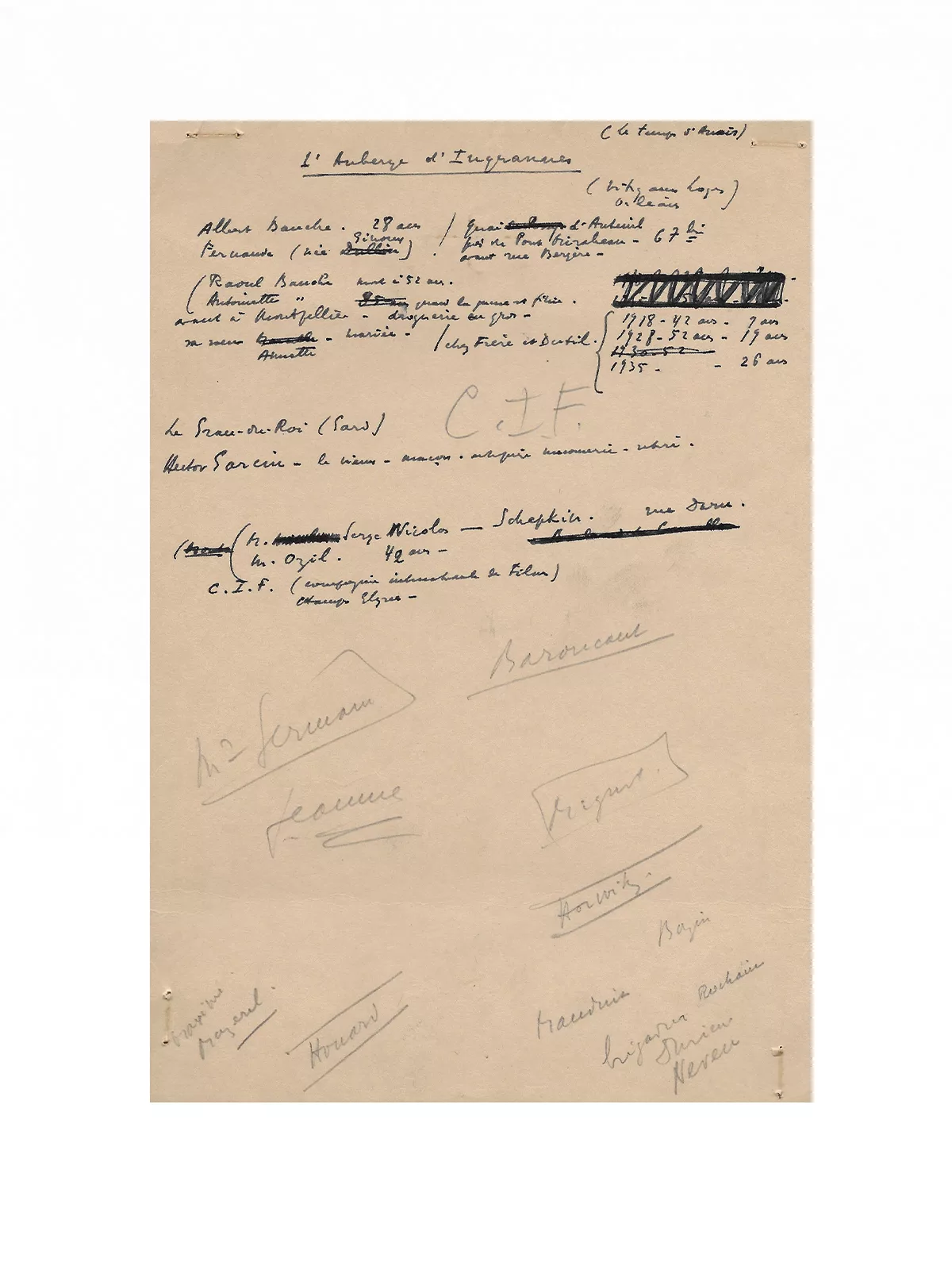
A sealed yellow envelope (165 x 244 mm) served, as usual, as his working guide, listing the characters of the novel then being written. It survives here, which is exceptional. Only about twenty envelopes of this kind are preserved at the Fonds Simenon in Liège, mostly for manuscripts published by Fayard and Gallimard: La Veuve Couderc, Les Demoiselles de Concarneau, Touriste de bananes, Le Suspect, Malempin, Le Haut Mal, Les Rescapés du Télémaque, Le Relais d’Alsace, Quartier nègre, Le Passager du Polarlys, L’Outlaw, Oncle Charles s’est enfermé, La Marie du port, Le Locataire, Il pleut, bergère…
Only two such envelopes are known from the American period: this one, and another for the manuscript of La Mort de Belle, strictly identical and on the same paper.
The other novels, typed directly, have none. For more than thirty years, the yellow envelope was a ritual part of the writer’s process at the start of each novel: the first trace of his work, on which he jotted down the concrete elements that helped him grasp his characters and shape his plot. Here it is titled L’Auberge d’Ingrannes (Le Temps d’Anaïs), proof that Simenon hesitated between the two titles from the outset. It also bears the names Orléans and Vitry-aux-Loges, a commune in the forest of Orléans near Ingrannes. On the recto follow several characters, their ages and fictional addresses, beginning with the novel’s “hero”: “Albert Bauche, 28 ans, [27 dans le livre], quai d’Auteuil, marié à Fernande…,” “Serge Nicolas [the victim in the novel, director of the] C.I.F. (Compagnie internationale du Film), Champs-Élysées… Raoul et Antoinette Bauche ([Albert’s parents], droguerie en gros à Montpellier. Meurt à 52 ans. 1928, 52 ans, 19 ans pour Albert…], etc.” On the verso, a long list of some thirty other characters, with further notes on their relationships. Not all of them appear in the finished novel.
The text of L’Auberge d’Ingrannes — under that title — was first serialized in Le Populaire de Paris from 19 February to 4 April 1951, then published the same year by Presses de la Cité under the title Le Temps d’Anaïs.