

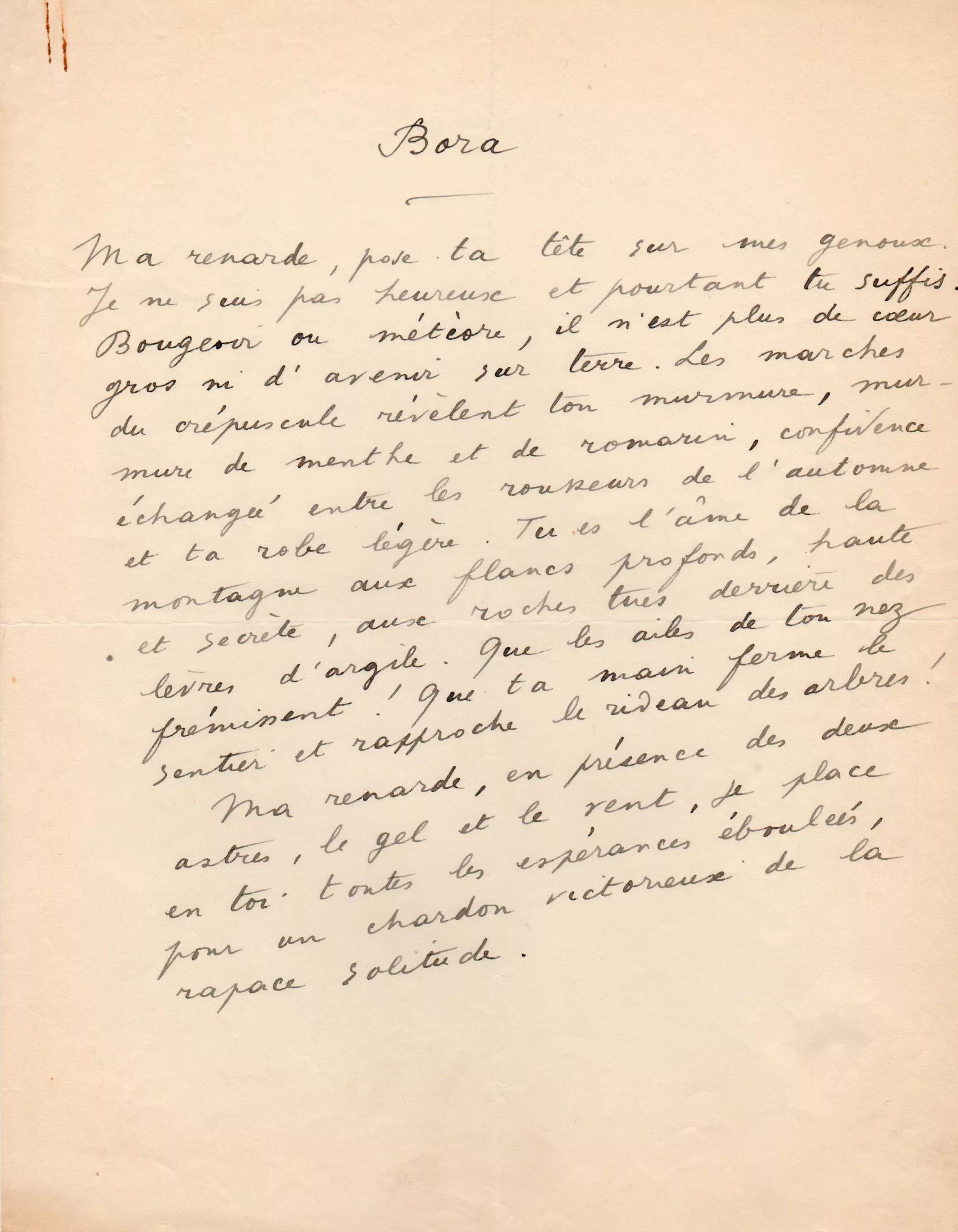
« Bora »
“Ma renarde, pose ta tête sur mes genoux. Je ne suis pas heureux et pourtant tu suffis. Bougeoir ou météore, il n'est plus de coeur gros ni d'avenir sur terre. Les marches du crépuscule révèlent ton murmure, murmure de menthe et de romarin, confidence échangée entre les rousseurs de l'automne et ta robe légère. Tu es l'âme de la montagne aux flancs profonds, haute et secrète, aux roches tues derrière des lèvres d'argile. Que les ailes de ton nez frémissent ! Que ta main ferme le sentier et rapproche le rideau des arbres ! Ma renarde, en présence des deux astres, le gel et le vent, je place en toi toutes les espérances éboulées, pour un chardon victorieux de la rapace solitude.”
In its issue no. 50 of March 1946, Max-Pol Fouchet’s review Fontaine published fragments 222, 219, 213, 214, 218 and 221 of the future collection Feuillets d’Hypnos. At the time, each bore an independent title: “Bora,” “Le vitrail de Valensole,” “La murmurée,” “La révélée,” “La marche” and “La carte du soir”; two further fragments, later published in Le Poème pulvérisé, were also included: “Le muguet” and “La saccade.” The titles given in Fontaine were not retained in the collection, with the sole exception of fragment 221, “La carte du soir,” which kept its title.
Poem 222 was the first to be published in Fontaine, by means of this manuscript: the name “Bora” conceals Marcelle Sidoine-Pons, of whom the poet said that she was “the soul of the mountain with deep flanks” (Dictionnaire Char, entry by Antoine Coron, p. 514) — a female figure like a gleam of hope restoring the strength to believe in victory. The original title would later be used again in Fureur et mystère.
Of the 235 fragments of Feuillets d’Hypnos, fewer than fifteen are known in their original form or an early draft predating the publication of the collection. A few were copied out after the fact, as they came to appear in later collections such as Fureur et mystère and Le Poème pulvérisé.
This manuscript of “Bora,” given by Char to Fouchet for publication in Fontaine, is therefore a rare and precious witness, under its first and original title.
From the library of Max-Pol Fouchet (sale, Mayenne, 8 October 2022, lot 250).