

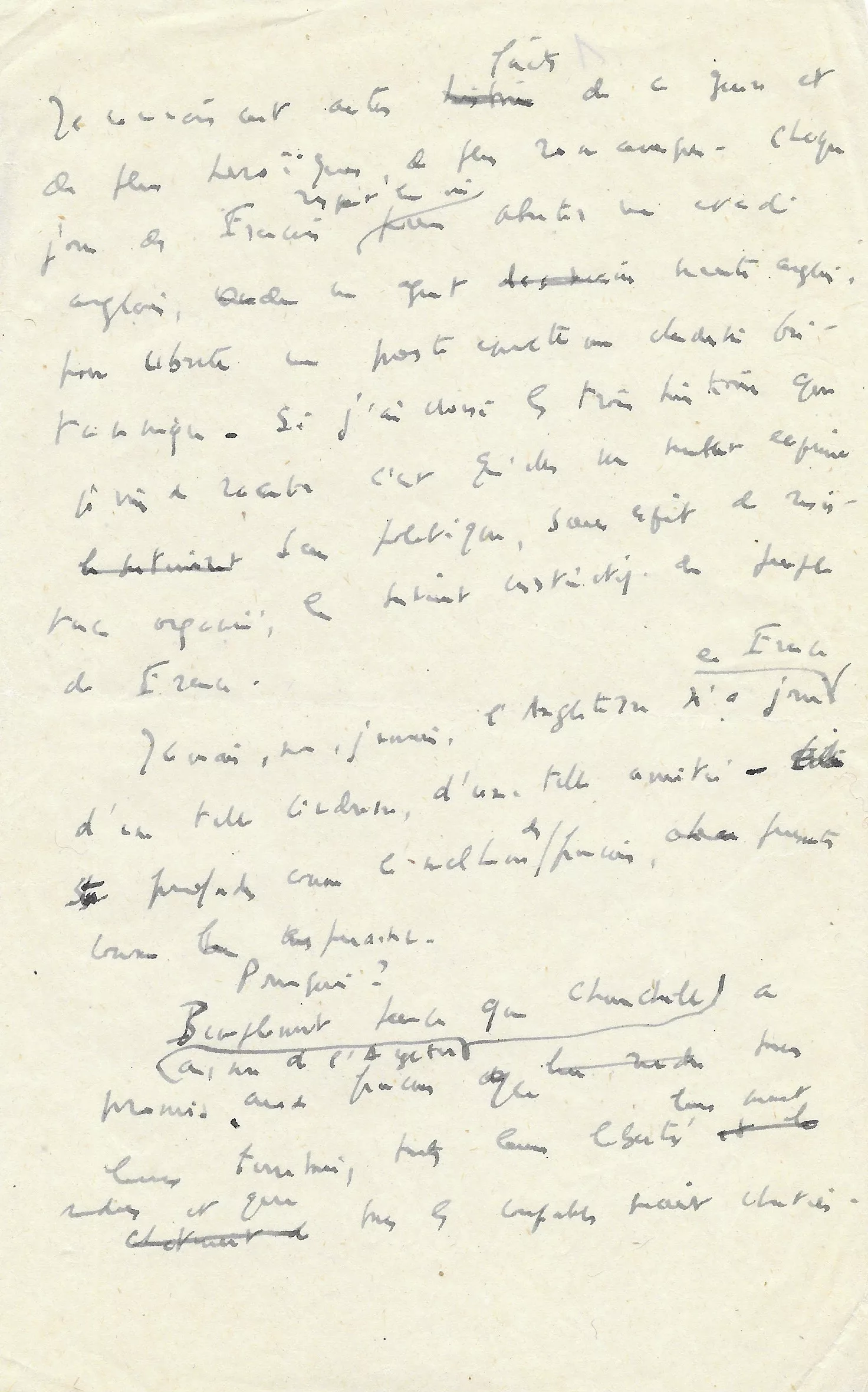
Article pour “La France libre”
Having arrived in London on 23 January 1943, Kessel enlisted in the Forces françaises libres less than a month later, on 10 February 1943. Despite his wish to fly, Kessel did not join a combat unit but was assigned to “the fighting organ of Free France,” the fiercely Gaullist weekly La Marseillaise, directed in London by François Quilici.
General de Gaulle asked Kessel “to bring his testimony to the newspapers,” and his byline appeared as early as 7 March 1943, beneath an article entitled “Le visage de la grande espérance,” a patchwork of testimonies from “men and women, workers and bourgeois, children and the old” whom Kessel had met in France during his travels, when he was working for one of the first networks organized in the southern zone under André Girard, the Carte network: “Since I have been in London, I am constantly asked about the feelings of the French people, and in particular about their feelings toward General de Gaulle. Nothing is more moving […]. One feels […] like the messenger of another world […] but nothing is more distressing either. How can one claim to reflect, or even know, the opinion of an entire country? […] So rather than assert, interpret or deduce, I prefer to relate what I am sure of.”
The article represented by our manuscript has not yet been identified, but dates from that London spring and corresponds exactly to the kind of testimony Kessel felt bound to record: “for someone arriving, as I did, from France, everything in London is a source of surprise: the traffic of taxis and buses, the shop windows, the white bread, the restaurant menus, people dancing, all these uniforms that are not German, free speech […] everything seems unbelievable. But my greatest astonishment was caused, perhaps, by the anxiety some of my English friends showed about France’s feelings toward England […] Never, no, never has England enjoyed such tenderness, such friendship in France […] Why? Simply because Churchill promised the French that all their borders, all their freedoms would be restored to them, and that the guilty would be punished. There was a period when Boulogne was one of the most battered towns in France. English planes came every day to attack the port, which could serve as an invasion base. Never at night, for the inhabitants’ sake.”
Kessel then recounts the siege of Boulogne and the evacuations: “[…] about a hundred children were evacuated […]. One evening a party was held […], they were given a few gray-flour cakes […] and sweets, jams […] In short, wonders for French youngsters. The children were so happy that they began to sing. And they sang… Tipperary.”
He is here referring to “It’s a Long Way to Tipperary,” a music-hall song written by Jack Judge and Harry Williams in 1912, popularized by the Connaught Rangers when they marched through Boulogne-sur-Mer on 13 August 1914. The tune was thereafter regularly taken up as a marching song by soldiers of the British Army. It resurfaced during the Second World War and became even more widely known, being used to mock the Nazi armies’ inability to invade Great Britain. The title was later caricatured by Vichy propaganda, which circulated a poster entitled It’s a Long Way to Rome, parodying the song that had become emblematic of the British Army it sought to ridicule, comparing its pace to that of a snail during the Allied advance in Italy.
Kessel had witnessed these events firsthand: in May–June 1940 he was a war correspondent on the northern coast, at Calais, Boulogne and Dunkirk, from where he was to embark for Folkestone, England. He found himself in the midst of Operation Dynamo, the evacuation of the British Expeditionary Force from Dunkirk, which brought some 300,000 men back to British soil. Despite the operation’s success, 40,000 soldiers, mostly French, were captured in the Dunkirk pocket. The immediate consequence of the operation was a shift in the balance of forces between the Allied and German armies on French soil; from that evacuation onward, the Battle of France was irretrievably compromised. Kessel was the only journalist present, and endured the hell of Dunkirk, where for several days he experienced the “worst fright” of his life, which he related in a striking account published in the newspaper Paris-Soir on 8 June 1940.