

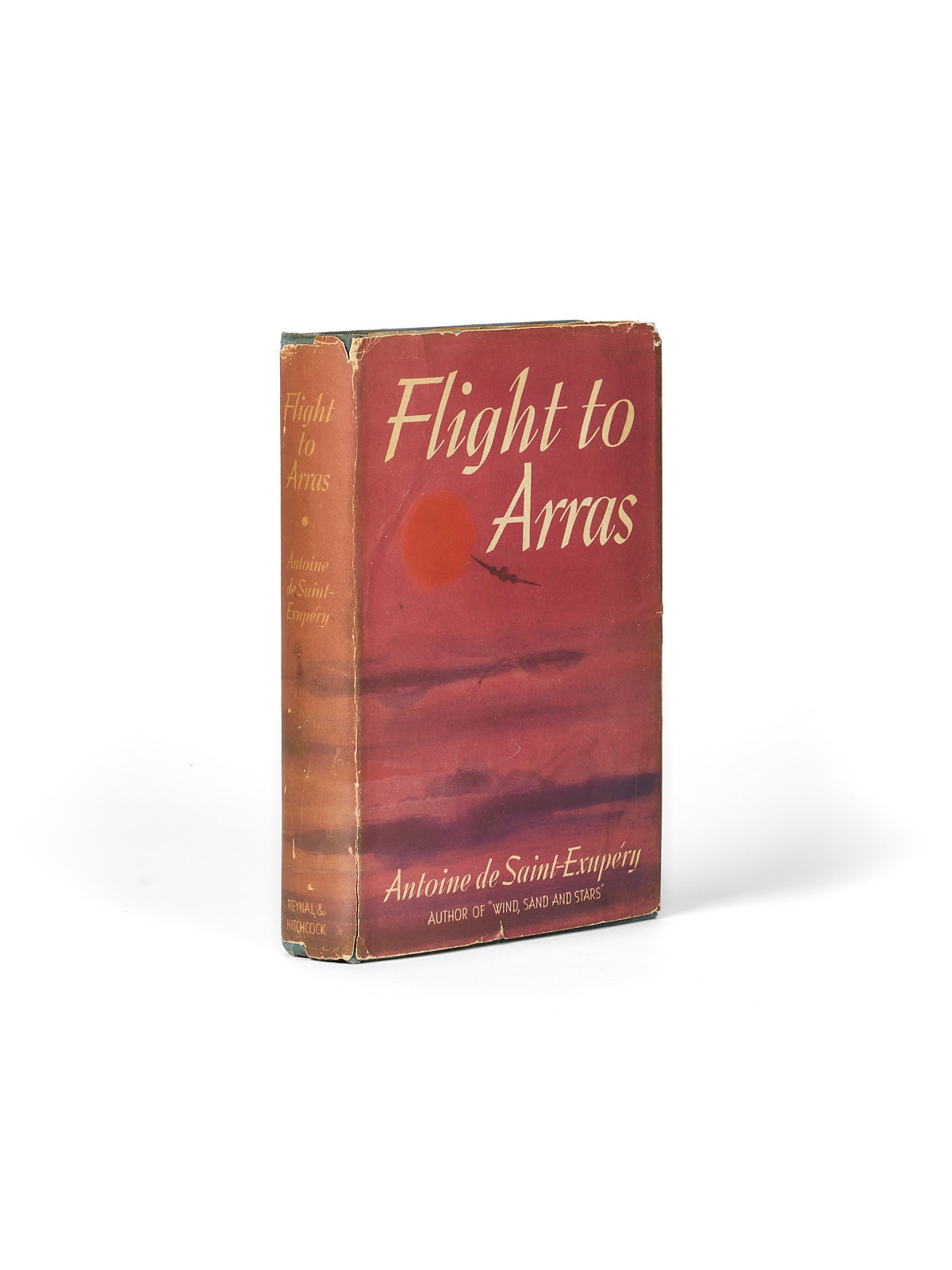
Flight to Arras
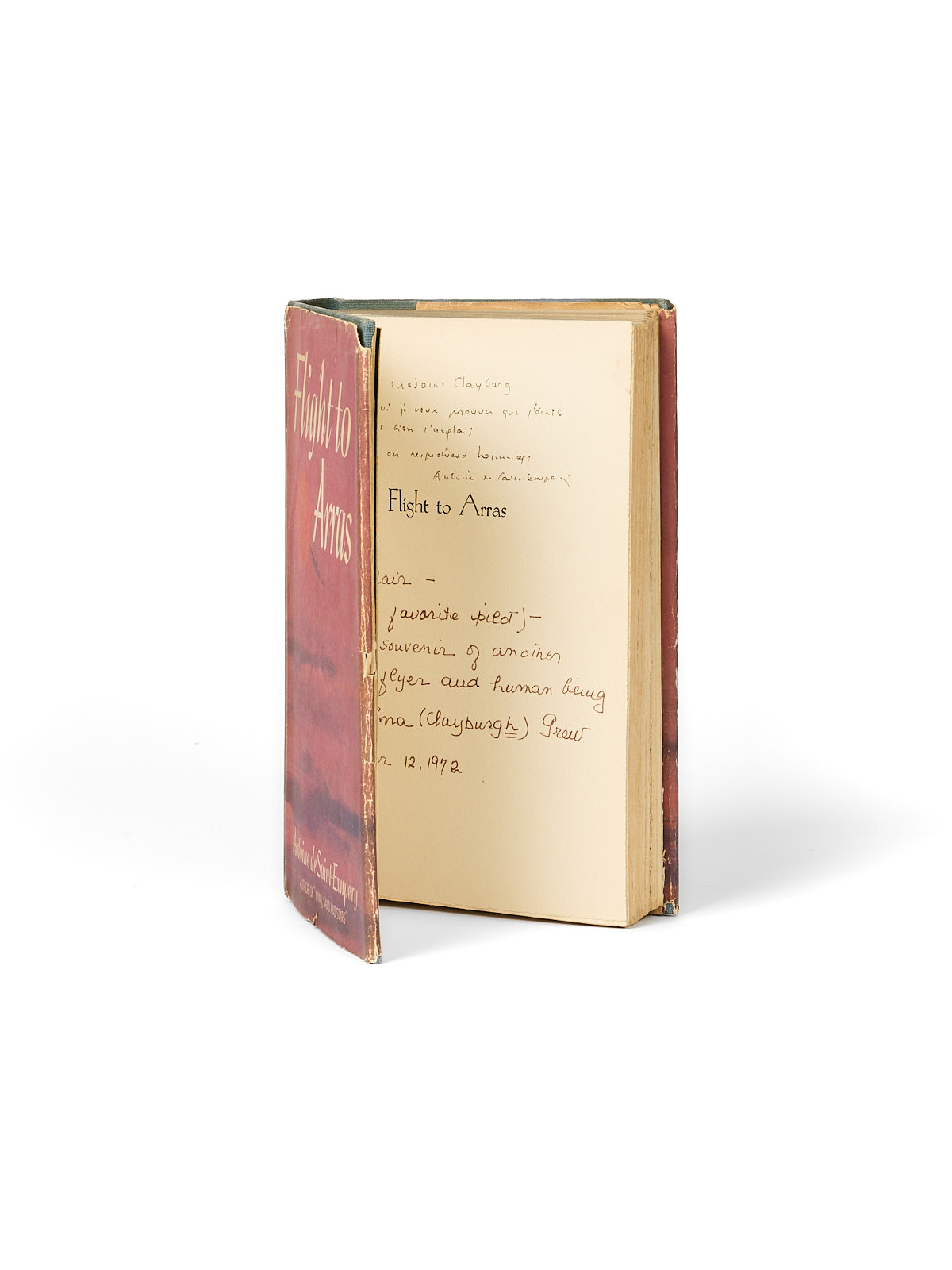
Presentation copy inscribed by Saint-Exupéry to Alma Clayburgh: “Pour Madame Clayburg, à qui je veux prouver que j'écris très bien l'anglais. Et en respectueux hommage. Antoine de Saint Exupéry.”
[“For Madame Clayburg[h], to whom I wish to prove that I write English very well. With respectful homage. Antoine de Saint Exupéry.”]
The copy was subsequently given by the dedicatee's daughter to another recipient, inscribed: “To Adair (My favorite pilot) — A souvenir of another great flyer and human being. Alma [Clayburgh, the h underlined!] Grew.”
In January 1941, Antoine de Saint-Exupéry decided to leave occupied France for good and settle in New York. He was finishing the last pages of Flight to Arras, beginning Citadelle and a “children’s tale” he had ultimately decided to illustrate himself, unconvinced either by the overly elaborate drawings of his friend Bernard Lamotte — who had illustrated Wind, Sand and Stars — or by those Lamotte was then providing for Flight to Arras. In this book, Saint-Exupéry wanted to honor the courage of the young pilots he had flown with: Gavoille, of course, but also Sagon, Pénicot, Dutertre, Hochedé, Commandant Alias and Lieutenant Israël. Through this text, he sought to explain France’s situation and capitulation to an American readership, in the hope of encouraging the United States to enter the war.
The text first appeared, in English, in the January 1942 issue of the Atlantic Monthly, then in book form the following month. It became a bestseller, and Saint-Exupéry’s voice seemed to be heard: “The critics do not merely praise the writer’s talent. They bring into the press the idea of a deeper France, different from the ‘general staff in perpetual retreat’ […]. They convey the absurdity of flying, pursued by German fighters, when in nine months it had not been possible to obtain aircraft able to withstand the cold of the upper atmosphere,” John Barbeen wrote in The Chicago Herald on 29 March 1942. The book remained atop the bestseller lists for six months: “this is a great and beautiful book, perhaps the true book of the war of 1939,” wrote Pierre Mac Orlan in Les Nouveaux Temps on 8 January 1943.
At the end of 1942, Antoine and Consuelo de Saint-Exupéry moved into Greta Garbo’s former apartment on Beekman Place in New York, where they entertained the elite of New York society. It was probably at one of these gatherings that this copy was presented to Alma Clayburgh, a celebrated opera singer, Francophile and patron of the arts. The copy later passed to her daughter, Alma Eveline Clayburgh-Grew, who in June 1938 had married James Hooper Grew, then a teacher of French at the well-known Phillips Academy in Andover, north of Boston. The couple, both fluent French speakers, also moved in the literary circle of writers exiled on the East Coast.
Many years later, presumably, and in memory of Saint-Exupéry, Alma Clayburgh-Grew in turn presented the copy to a certain Adair, her “favorite pilot” — pointedly underlining, in her own signature, the letter the author of The Little Prince had omitted from her mother’s name, proof that while he could certainly write English well, he was rather less attentive to the spelling of his hosts’ surnames.