

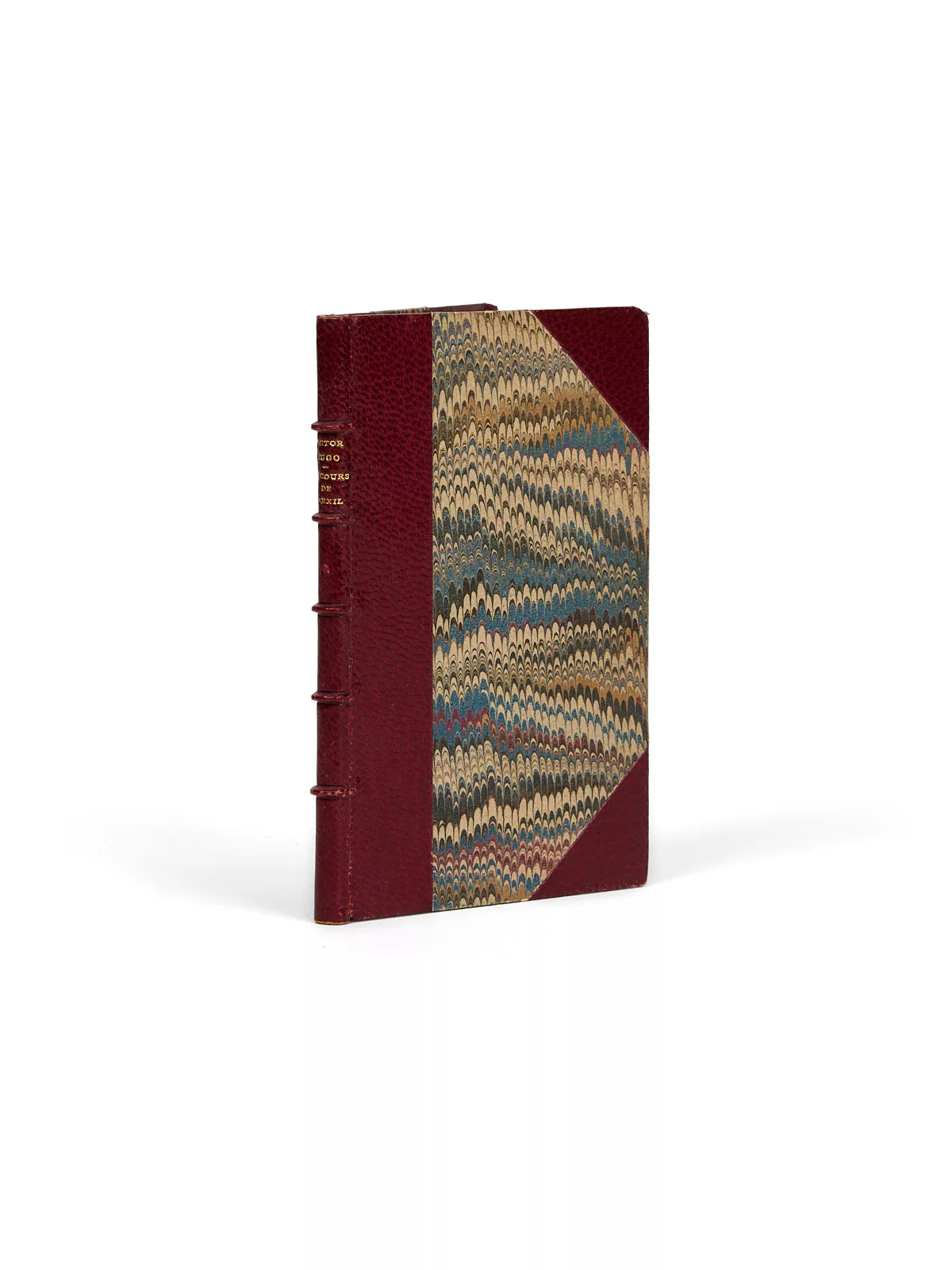
Discours de l’exil. 1851-1854
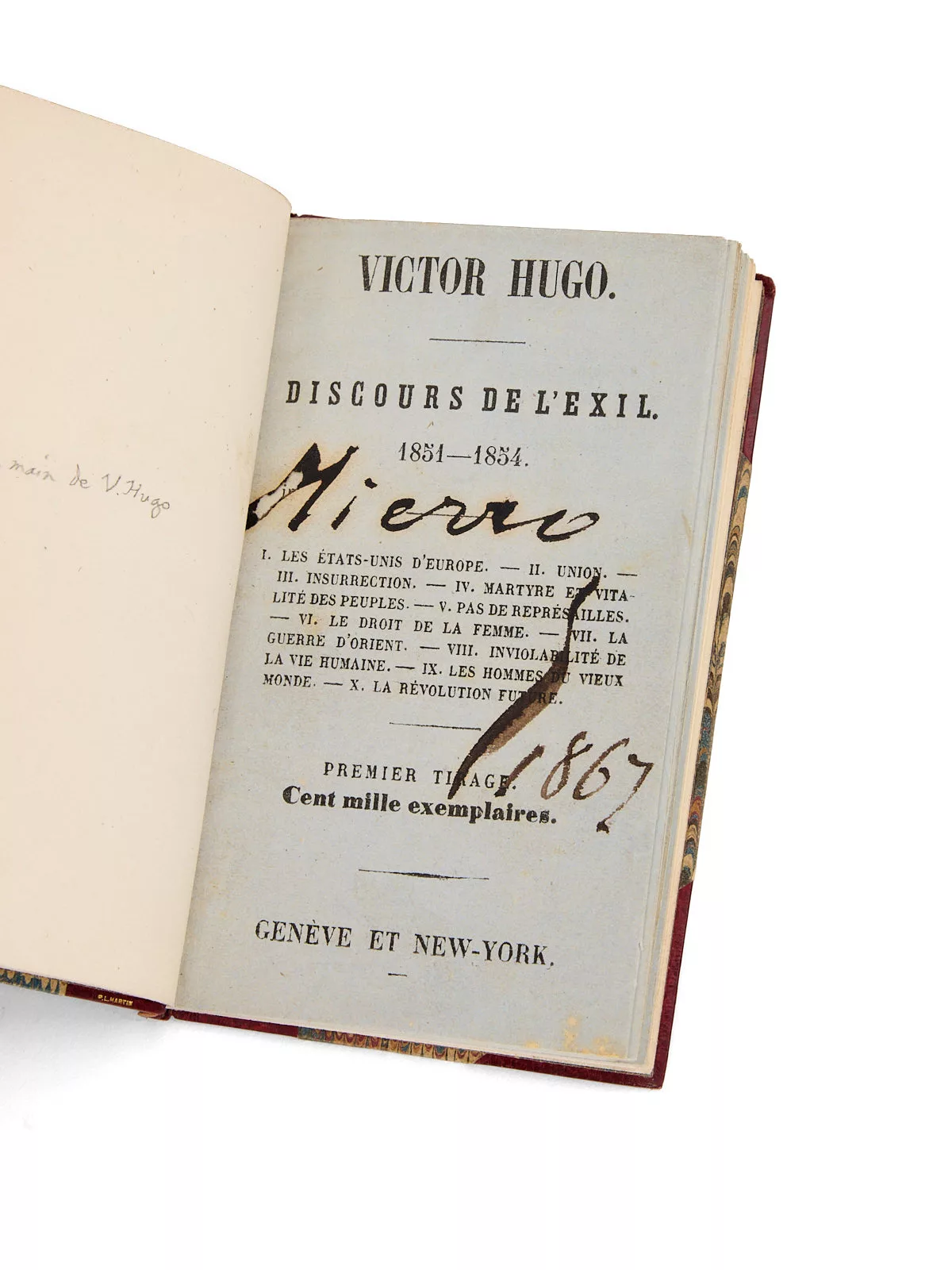
Autograph inscription: “Hierro, 1867.”
One of 18 copies entrusted by Victor Hugo to Auguste Vacquerie in Paris, for distribution among his friends, on the occasion of the revival of Hernani, which would be banned a few months later.
“Hierro” had been Victor Hugo’s rallying cry to his supporters ever since the battle of Hernani. The poet had bought several reams of red paper, cut them into small squares, stamped each with the Spanish word for iron — Hierro — and distributed them to the leaders of his groups of friends: “We do not believe we ever felt greater joy in our lives than when Gérard, taking six red paper squares from the packet, handed them to us solemnly, urging us to bring only trustworthy men. We answered with our lives for this small group, this squad placed under our command” (Théophile Gautier, “Première rencontre,” in Le Bien public, 3 March 1872).
Since the establishment of the Second Empire, Hugo’s plays had been banned from every French stage, and none of his works had been performed since Marion de Lorme in June 1852. But by 1867 his relations with the regime seemed to be improving, and a revival of Hernani was announced at the Théâtre-Français — reportedly at the personal request of the Empress Eugénie, on the eve of the Exposition universelle. Hugo was invited but refused to leave Guernsey, where he had remained isolated since the 1859 amnesty that many other exiles had accepted. From a distance, Hugo insisted on directing the whole affair himself, remaining in constant contact with his two steadfast friends Auguste Vacquerie and Paul Meurice, who followed the rehearsals of Hernani on his behalf.
Thirty-seven years after the first battle, the ten combative texts written in exile and gathered here could not have received a more fitting autograph note from the most celebrated of writers: these Discours pamphlets were distributed by Hugo throughout his years of exile in Guernsey. On 12 May, he informed Vacquerie that he was sending eighteen of these booklets, all bearing the same autograph word of encouragement: “a traveler I told you about will hand you eighteen booklets signed Hierro. 1867. One for you. One for Meurice. — The other sixteen should be distributed by you, as my calling cards, to our best friends: Henri Rochefort, Pierre Véron (and the writers of Le Charivari), Ph. Audebrand, Jules Lermina, Benjamin Gastineau, Montrosier, Carjat, Amédée Blondeau, Mario Proth, Eug. Pelletan, etc. You know better than I who deserves them most. And in this, as in everything, I rely entirely on you.” (Correspondance de Victor Hugo, Hauteville-House, 12 May 1867).
The play was performed on 20 June 1867 and was a triumph. Short-lived: “On 3 and 4 November 1867, Garibaldi was defeated at Mentana by papal troops reinforced by French troops sent by Napoleon III under General de Failly. Garibaldi was sentenced to forced labor. To show his support, Victor Hugo wrote La Voix de Guernesey in three days, from 16 to 18 November. Having it printed at his own expense in Saint-Pierre-Port and actively arranging its clandestine distribution, he once again loudly proclaimed his republican opposition to the pope and the emperor […]. Performances of Hernani at the Théâtre-Français were suspended. The play had been performed seventy-one times between 20 June and 27 December” (Jeanne Stranart, “L’interdiction de Ruy Blas et l’interruption d’Hernani en 1867, vues par Juliette Drouet”).
Jean-Marc Hovasse (ed.), Correspondance et théâtre, Presses universitaires de Rennes, 2012. The texts contained in this pamphlet are: Les États-Unis d’Europe [En quittant la Belgique, 1 August 1852]; Union [En arrivant à Jersey, 5 August 1852]; Insurrection [Au Peuple, 31 October 1852]; Martyre et vitalité des peuples [Anniversaire de la Révolution de Pologne, 29 November 1852]; Pas de représailles [Sur la tombe de Jean Bousquet, 20 April 1853]; Le Droit de la femme [Sur la tombe de Louise Julien, 26 July 1853]; La Guerre d’Orient [23e Anniversaire de la Révolution de Pologne]; Inviolabilité de la vie humaine [Aux habitants de Guernesey, January 1854]; Les Hommes du vieux monde [À Lord Palmerston, 11 February 1854]; La Révolution future [Banquet anniversaire du 24 février 1854]. They were later reprinted in 1875 in Actes et paroles, II, under different titles, indicated here in brackets.