

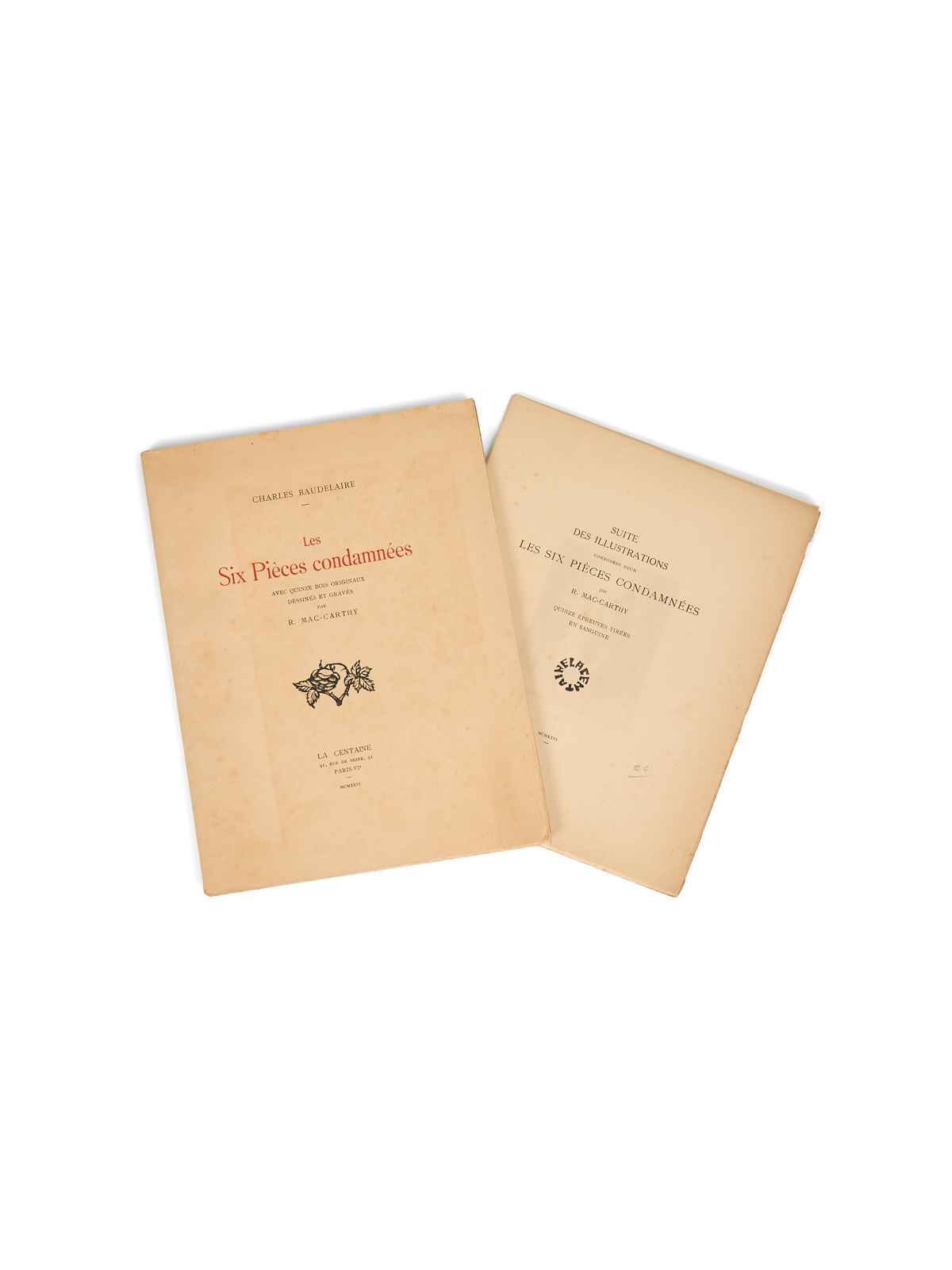
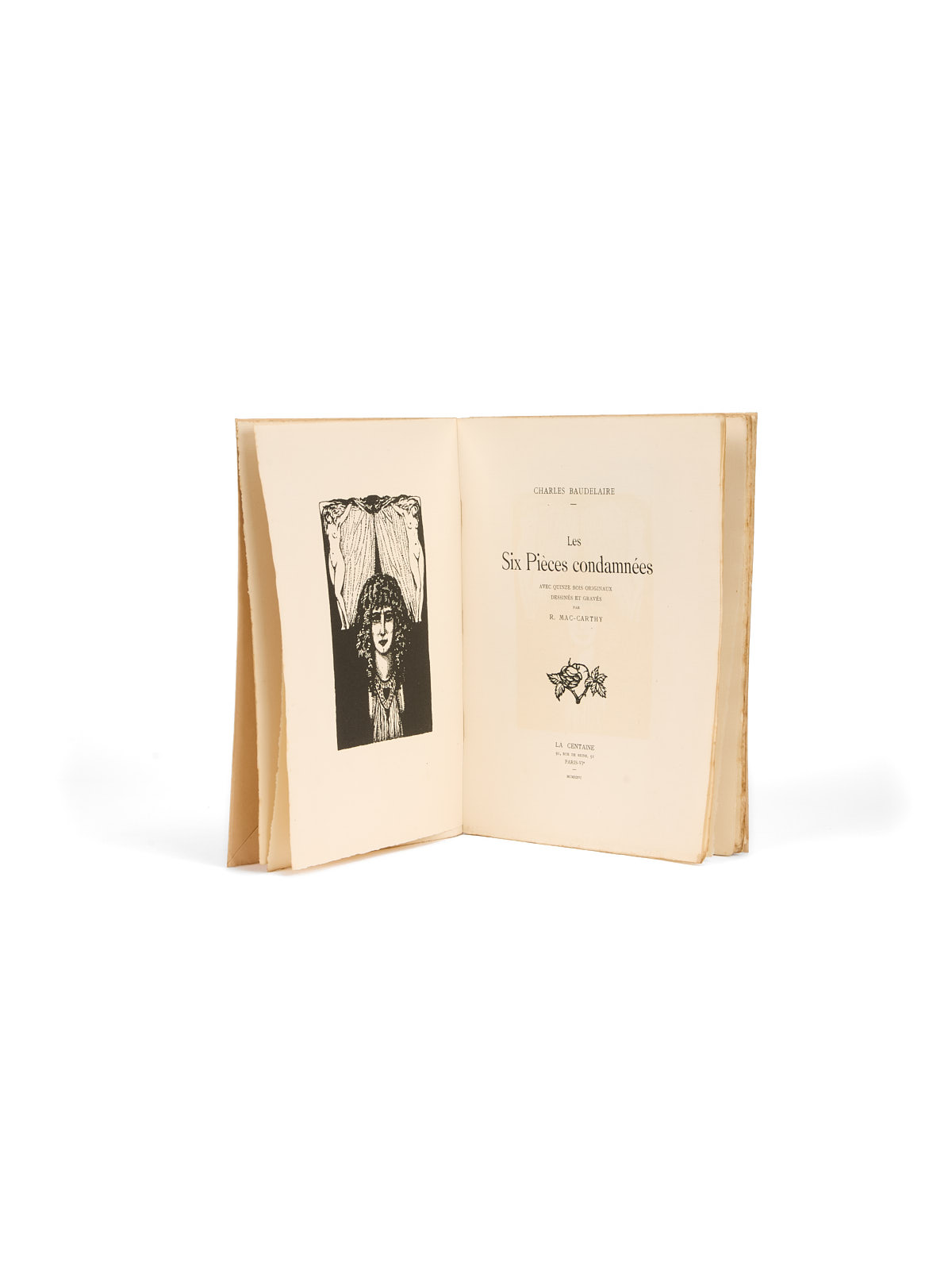

Les Six Pièces condamnées
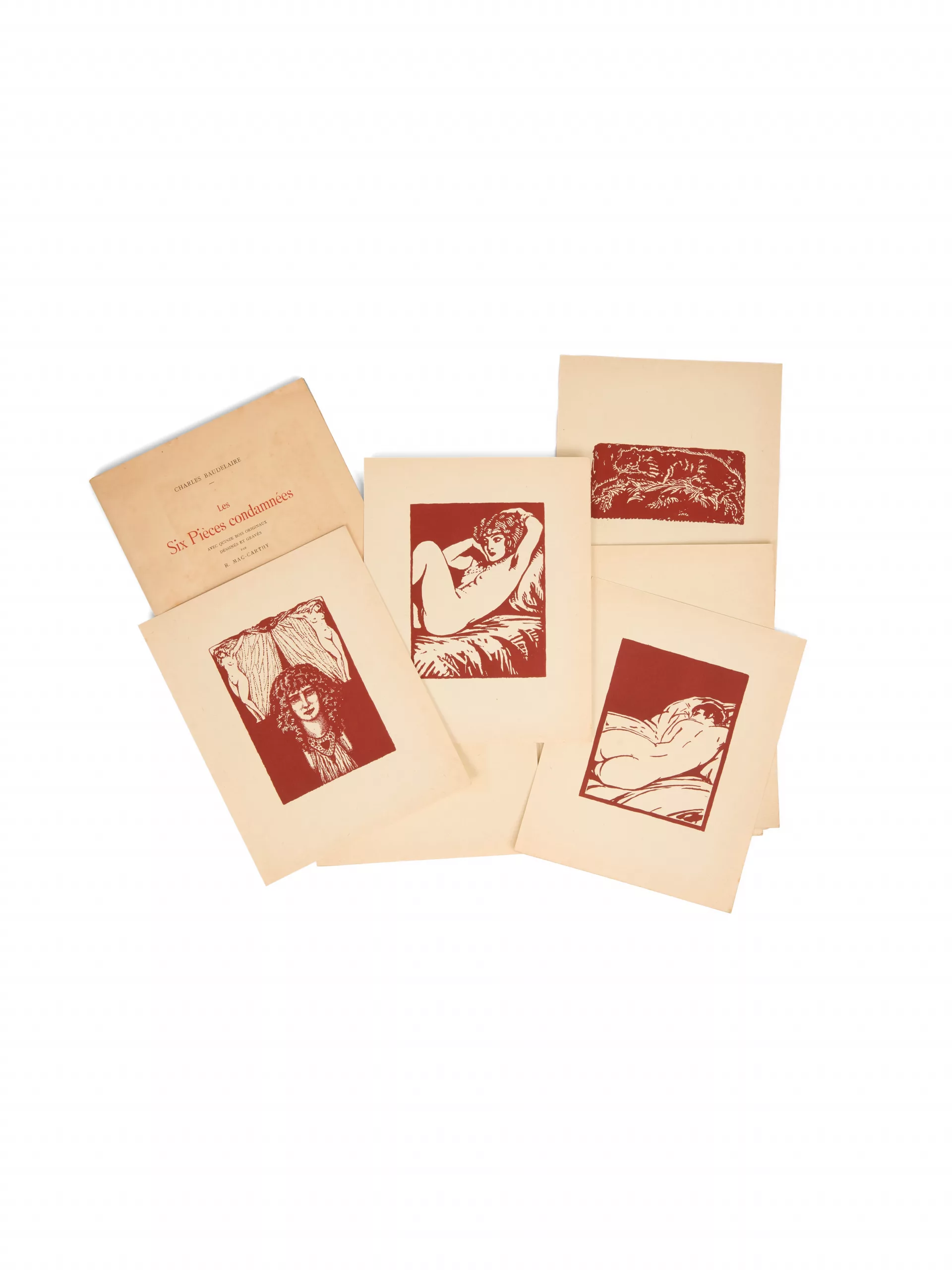
Unique printing limited to 313 copies, this one of the first 100 copies with the suite printed in sanguine on green vellum (no. 43).
On 12 June 1855, Auguste Poulet-Malassis wrote to Charles Asselineau: “I have seen Baudelaire’s horrors in the Revue des Deux Mondes; shake his hand for me.” Two years later, after a complicated relationship, he became the publisher of Les Fleurs du mal, which he issued on 21 June 1857.
An article published in Le Figaro on 5 July 1857 lit the fuse: Gustave Bourdin, while denying that he had “any judgment to render or sentence to pronounce,” denounced the immorality of four poems: “Le Reniement de saint Pierre,” “Lesbos” and the two pieces entitled “Femmes damnées.”
As early as 7 July, a report was drawn up for the Direction de la Sûreté publique, under the Ministry of the Interior: Les Fleurs du mal was there described as “a challenge thrown at the laws that protect religion and morality”; “Le Reniement de saint Pierre, Abel et Caïn, Les Litanies de Satan, Le Vin de l’assassin are a tissue of blasphemies […]. Les Femmes damnées are the expression of the most revolting lubricity […] a hymn in honor of the shameful love of women for women […]. Les Métamorphoses du vampire, Les Bijoux present, at every turn, the most licentious images with all the brutality of expression.” It concluded: “In sum, M. Baudelaire’s book is one of those unhealthy, profoundly immoral publications destined for a scandalous success.” Referral to the public prosecutor was proposed.
The indictment was delivered by Ernest Pinard, who was none other than the same public prosecutor who had brought the case against Flaubert’s Madame Bovary on similar grounds only months before. Here, Baudelaire — and his poetry — was accused of offending “the sense of decency” and multiplying “lascivious depictions.” Both substance and style stood accused.
For the defense, his lawyer Maître Chaix d’Est-Ange argued for the artist’s independence and the beauty of the work. It was not enough: within hours, the collection was condemned for the “offense of outrage to public morality and good morals,” on account of “obscene and immoral passages or expressions.” The poet and his publishers were each fined 100 francs but were nonetheless allowed to continue selling copies once purged of six poems: “Les Bijoux,” “Le Léthé,” “À celle qui est trop gaie,” “Femmes damnées,” “Lesbos” and “Les Métamorphoses du vampire.”
It was not until 1949 that the Cour de cassation finally annulled the conviction of Les Fleurs du mal.
The condemned poems nonetheless reappeared as early as 1864 in Belgium, circulating freely under the counter.
This 1926 edition is the first to be genuinely illustrated.
A rare copy with its suite.
Small stains on the wrappers.