

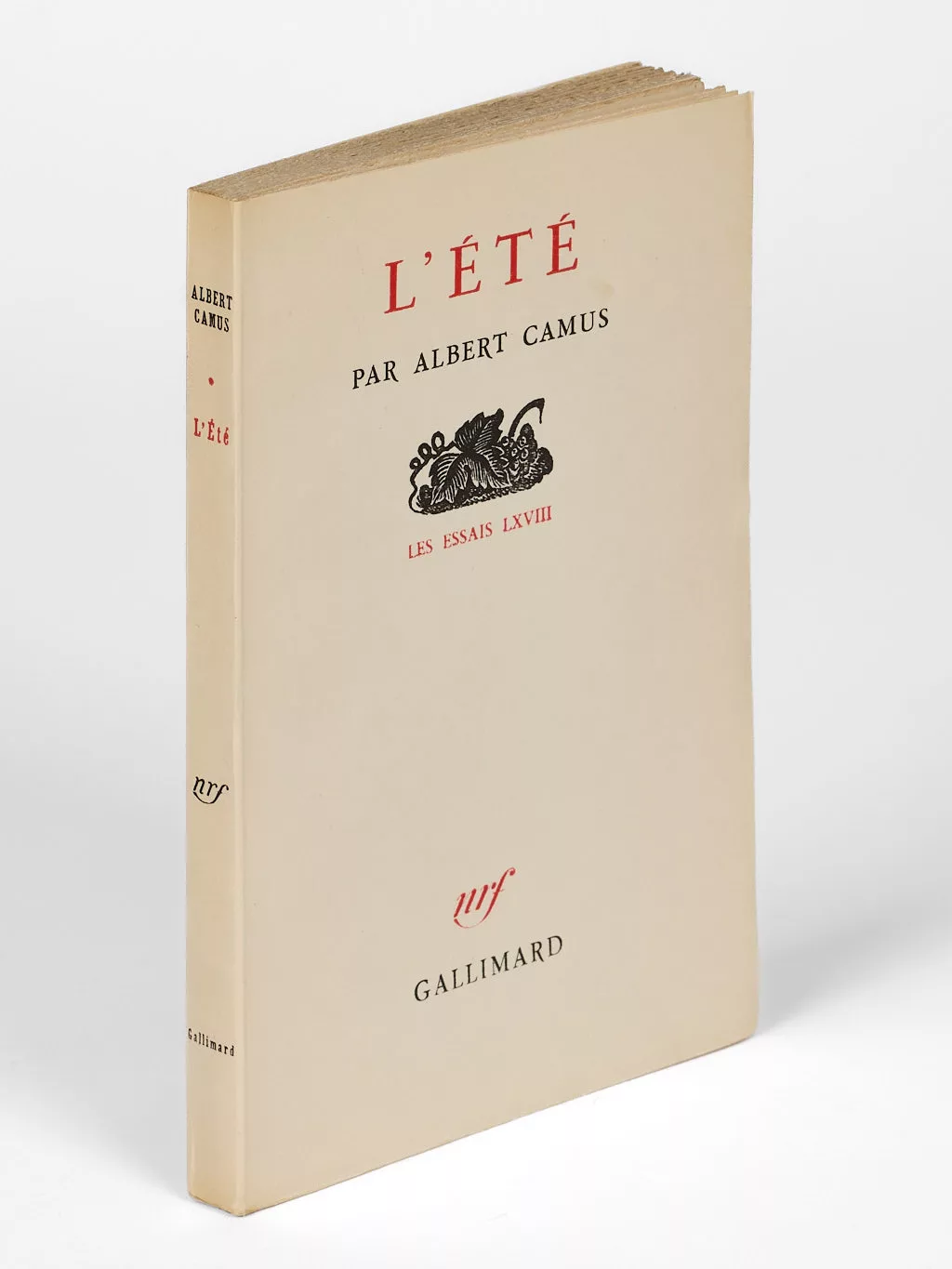
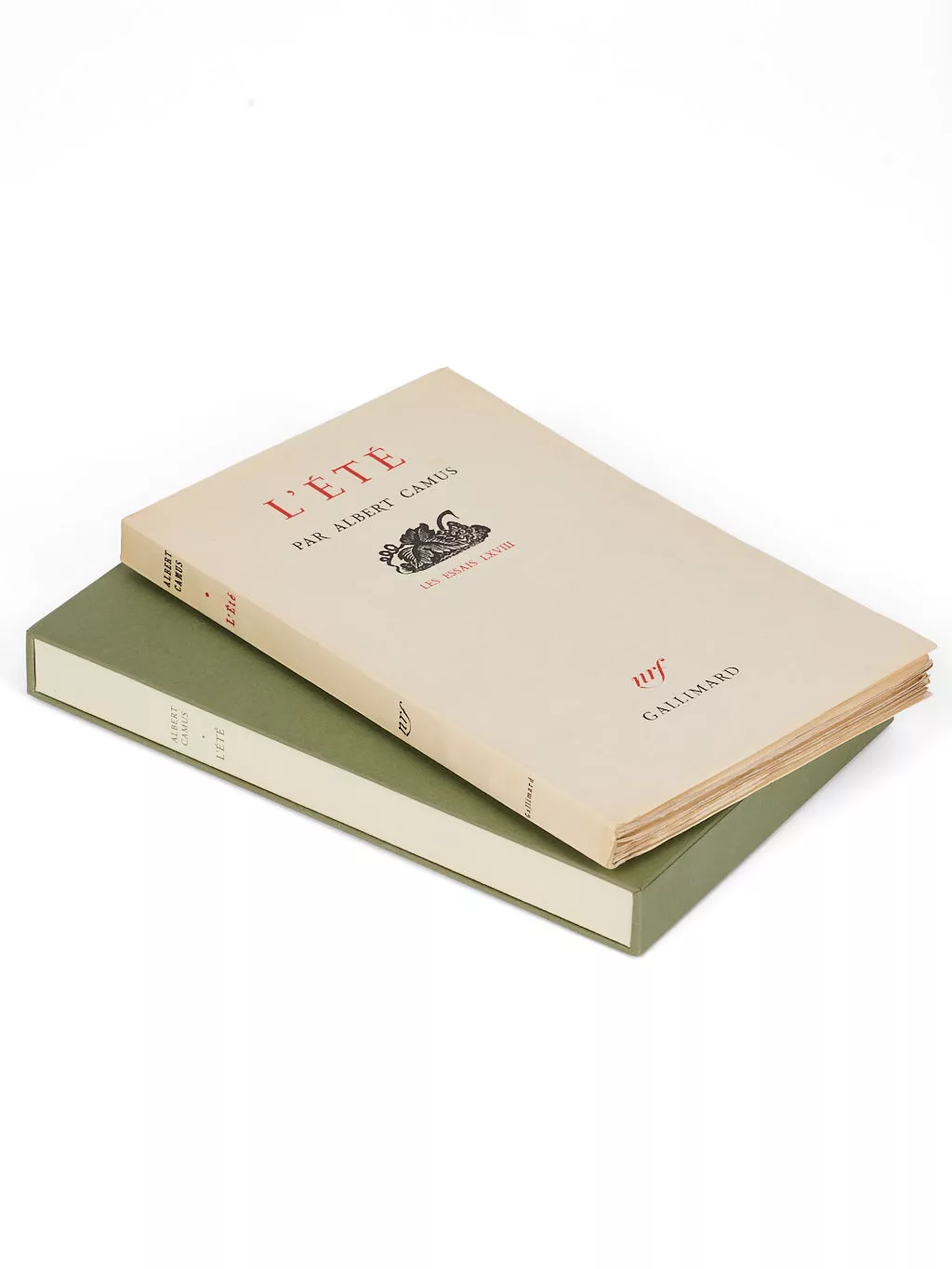
L’Été
One of 175 copies on vélin pur fil — this one of 5 hors commerce copies (J).
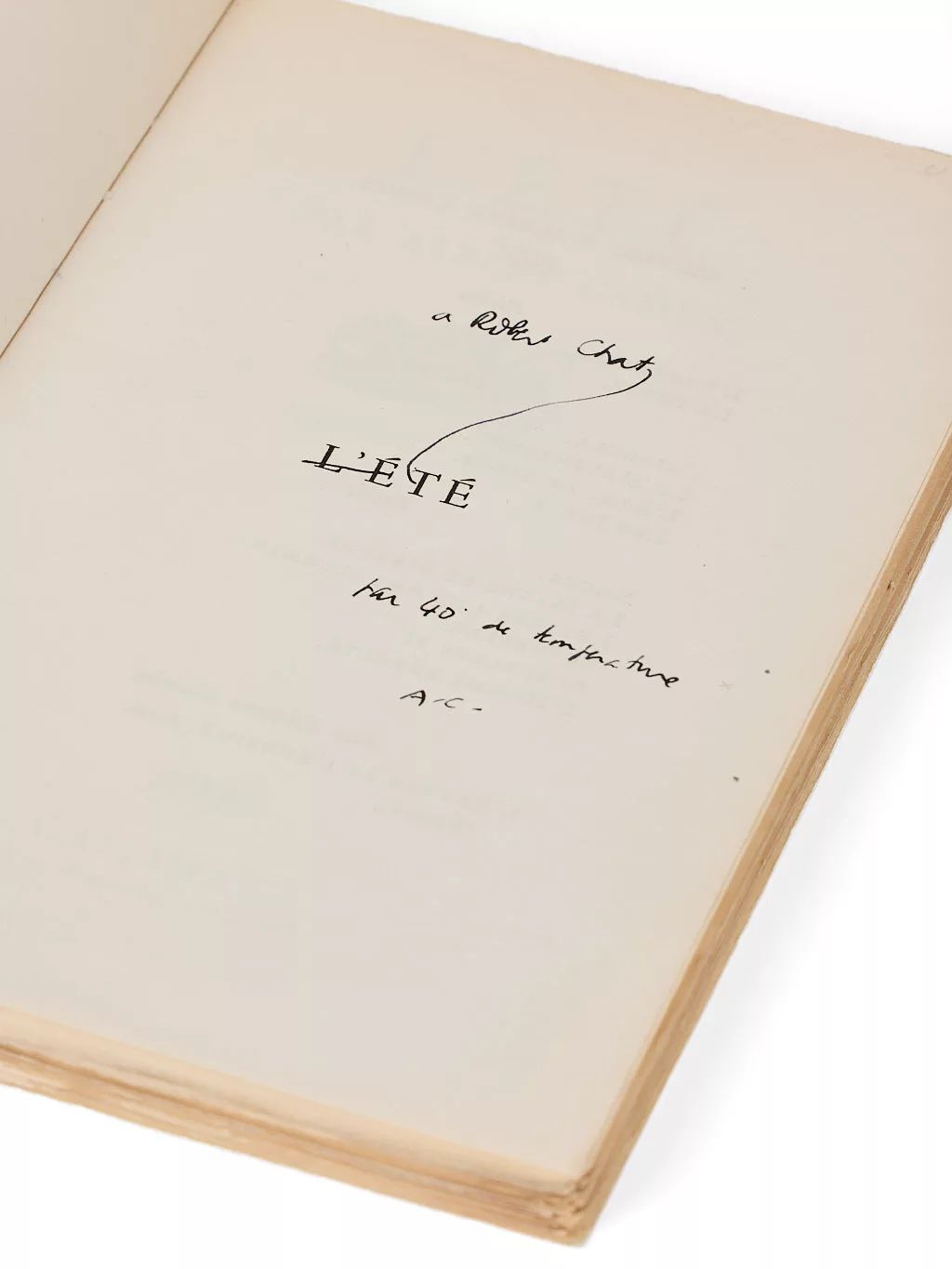
Signed presentation inscription: “à Robert Chat[té], par 40° de température. A.C.”
The eight essays that make up L’Été, with the exception of “Le Minotaure,” published separately in 1950, were previously unpublished. All are “naturally linked to Noces by a kind of golden thread,” that of lyricism, poetic prose and Mediterranean thought, celebrating Algiers, Oran and then Tipasa, which Camus had sung fifteen years earlier in Noces as a place “inhabited by the gods.” Seven years after the publication of La Peste, Camus returns to what is essential to him: the Mediterranean, with “its solar tragedy, which is not that of mist”; the light, “so brilliant that it becomes black and white”; the sea, to which he keeps “as close as possible”; Algeria, his “true homeland.”
This copy belonged to Robert Chatté, one of the great figures of the clandestine book trade. Jean-Jacques Pauvert recalls him in his Souvenirs as “the mysterious bookseller of Montmartre, […] tall, thin, very well-mannered, with strikingly protruding ears, […] who worked out of an apartment and took great precautions, and who had access at Gallimard, where he had started out as a simple clerk. He would only open his door if one used a certain signal. He had also had Bataille’s Madame Edwarda printed in its first edition in 1941.”
His relationship with Camus began early and remained constant until his death on 8 September 1957, which Camus noted in his Carnets: “Death of Robert Chatté. Alone, at the Villejuif hospital.” (III, p. 198). His friend Pascal Pia took charge of the estate and the inventory of his apartment. In Paris for the whole of the first half of 1954, Camus almost certainly gave Chatté his book as soon as it appeared, in mid-February. The 40° mentioned in the inscription is more an ironic echo of the texts in L’Été than a reflection of the actual weather in France: the famous winter of 1954 was one of the coldest of the last century (with a perceived temperature of nearly -40°)! Camus would spend the whole summer, in the cool, at the Gallimard family property at Sorel-Moussel.
This copy was included in the centenary exhibition “Albert Camus de Tipasa à Lourmarin” (no. 155, reproduced).