

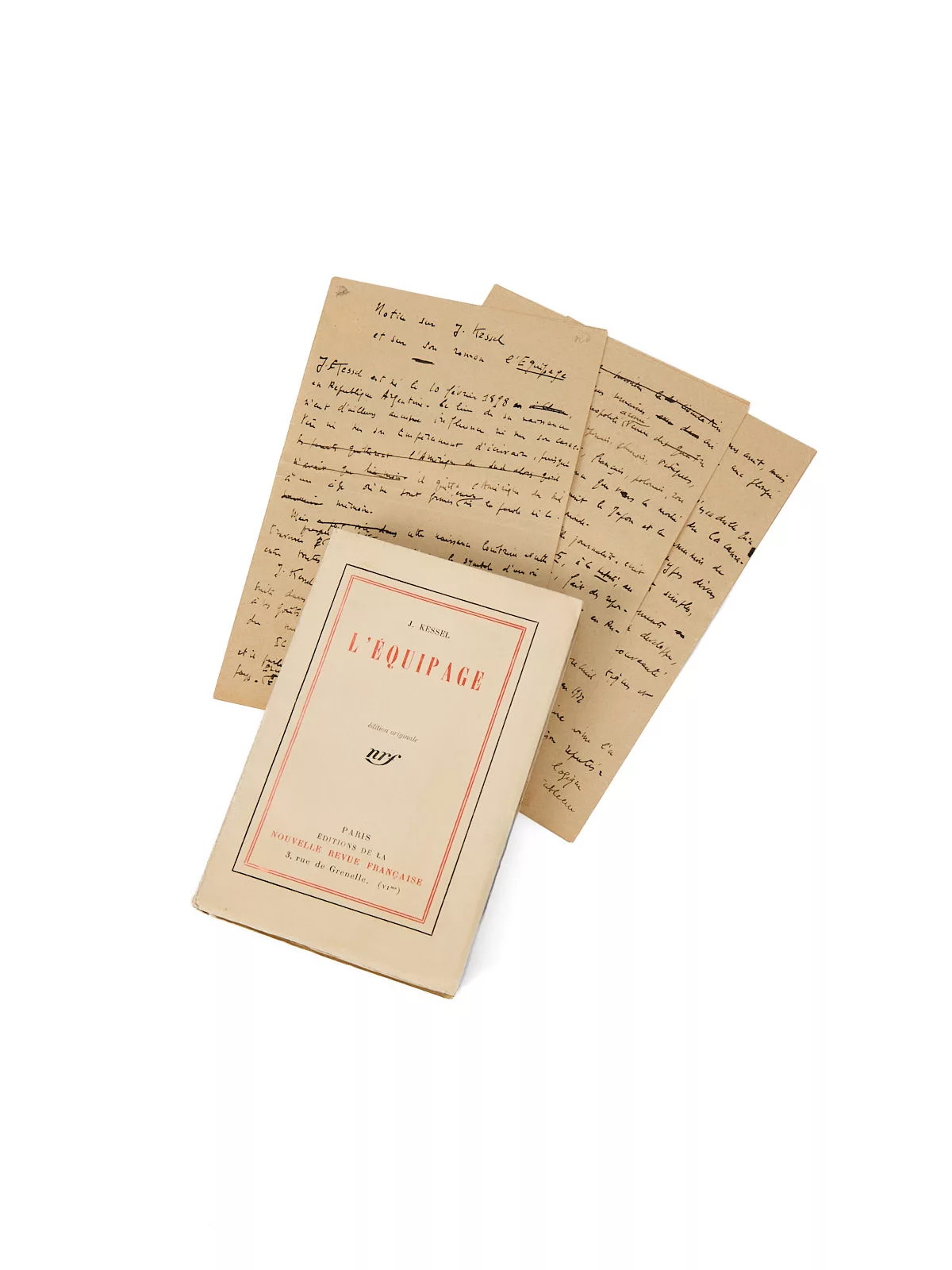
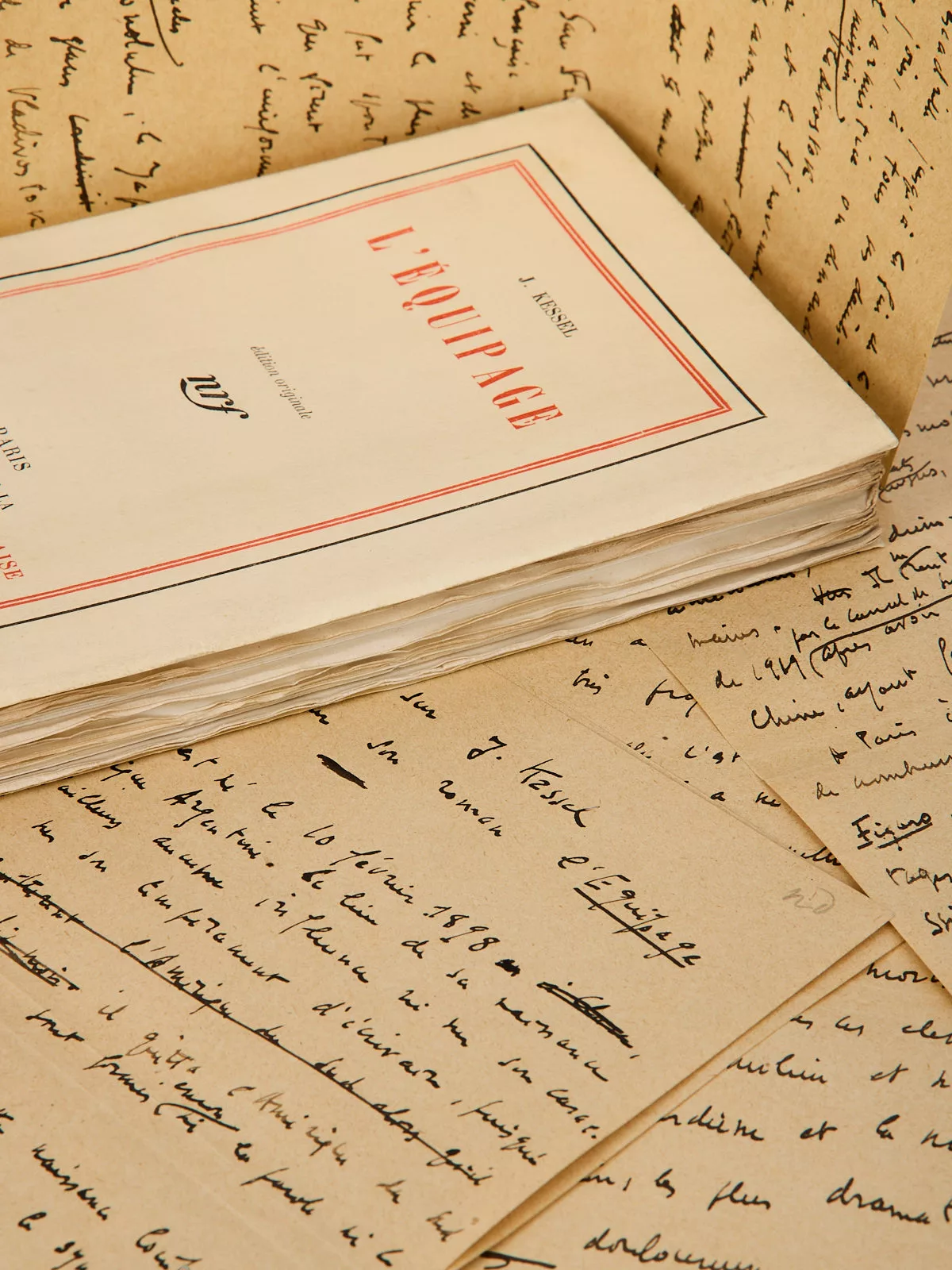
« Notice sur J. Kessel et sur son roman l’Equipage »
Accompanied by: the first edition of L'Équipage (Paris, NRF, 1923 — copy on pur fil paper).
This notice, written in the third person, contains numerous deletions and corrections. In a few pages, Kessel traces his childhood and youth, emphasizing his nomadic character: “J. Kessel was born on 10 February 1898 in the Argentine Republic. […] J. Kessel has never lived more than three consecutive years in the same city. It seems that chance, favorable to his tastes, always pushes him along the great roads of the world.”
Born in Argentina, the son of a doctor of Lithuanian origin who had gone to practice in South America, Kessel was then taken to the other side of the world, to Russia, before returning to France. Having earned a degree in literature at seventeen, he joined the foreign policy service of the Journal des débats. Enlisting as a volunteer in the artillery in 1916, he then served in aviation: this episode gave rise to L’Équipage, the first novel to bring aeronautics into literature — a lasting passion for Kessel, embodied in his friendship with the great pioneers, notably Saint-Exupéry, whom he met in 1929, and Mermoz, of whom he wrote a fine biography in 1938.
Kessel, who loved war and “the healthy, rough family of solitary men,” bears witness here to the exhilarating period he lived through in 1917–1918. Accounts of missions, portraits of pilots, themes of manly camaraderie, dangerous living, gambling and drink all come straight from his memory, dictated by experience. Woven into a simple, tragic and psychologically true sentimental plot, they made L’Équipage a bestseller and turned its almost unknown author into a popular storyteller unanimously praised by critics.
The notice he writes here confirms this: “In L’Équipage, it is squadron life that J. Kessel has depicted. He knew how to portray its wonderful camaraderie… […] a plot arises from this milieu and develops, a plot whose boldness and novelty […] follow those of La Steppe rouge, which brings together stories on Bolshevism.” Kessel then reveals his conception of literary art: “He has only one theory in literature: that one must not have one. He likes books that are vigorously constructed, animated by violent turns of events, where interest never flags for a moment.” A demand he upholds, since La Steppe rouge is “a series of terrible stories, in which the reader is kept constantly on edge.”