



Le Poète assassiné
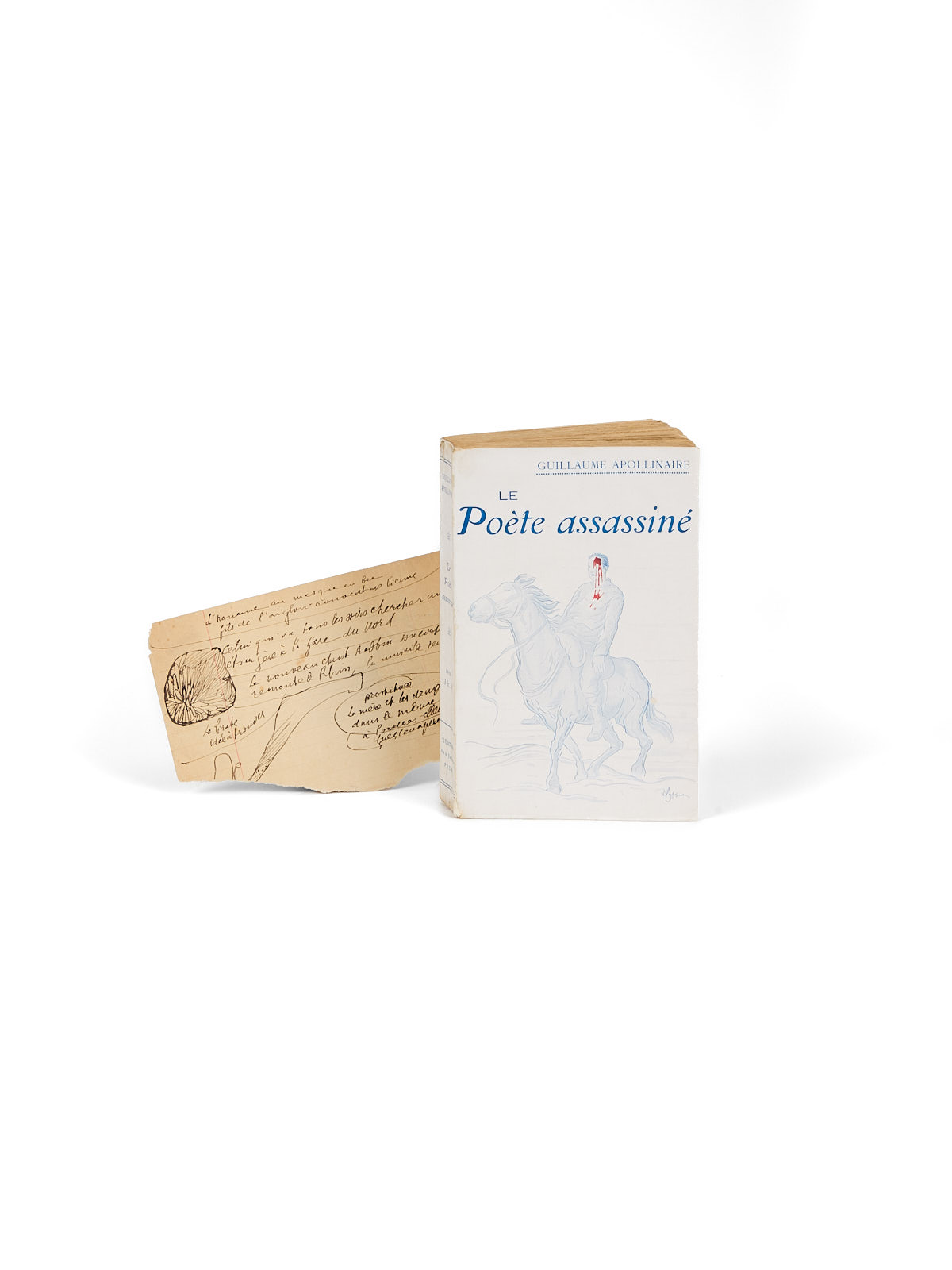
Copy enriched with an autograph note (ink on paper, 145 x 100 mm) containing unpublished working notes.
Under a premonitory title and cover, Apollinaire published in the autumn of 1916 a collection of tales conceived before the war. From the original texts he removed five and added a new one, which inspired both the title and Leonetto Cappiello’s cover design, “Le cas du brigadier masqué ou Le Poète assassiné.” When the collection appeared, the poet was still convalescing after being seriously wounded in the temple by shrapnel. Weakened by several trepanations, discharged to civilian life and awarded the Croix de guerre, he resumed his artistic and literary life: it was his friend André Rouveyre who sketched the portrait of “sous-lieutenant Guillaume Apollinaire” reproduced as the frontispiece.
A very fine, beautifully preserved copy, accompanied by an interesting autograph fragment bearing, on the verso, working notes relating to Le Poète assassiné. The first concerns “La Chasse à l’aigle” (the thirteenth tale), whose subject — the son of Napoleon — preoccupied Apollinaire throughout his life; at this stage he considered other titles for the text, such as “L’Homme au masque en bec,” “Fils de l’Aiglon” and “Convocation de Vienne.” These are followed by further notes, evidently sketches for other tales or stories: “celui qui va tous les soirs chercher une étrangère à la gare du nord”; “le nouveau Christ rabbin remontre le Rhin – la muraille rentre”; “La tirade – idée à trouver”; “prostituée: la mère et ses deux fils dans le même lit et ne s’en aperçoivent pas,” along with an abstract sketch and the fragment of another.
On the verso are ten lines of a text that instead belongs to the period of L’Hérésiarque, and constitutes its earliest known version: “Le Nom du diamant,” which remained at the project stage and was ultimately titled “Un vol à l’Elysée.” Analyzed by Jean-Louis Cornille in his Apollinaire et Cie, this tale features the adventures of Baron d’Ormesan, a character who also appears in L’Hérésiarque. The embryonic version recorded here by Apollinaire forms its synopsis, differing from the final version (cf. Pléiade, Œuvres en prose), though the thread remains recognizable: a famous diamond, a dinner at the ambassadress’s residence, an invited president who inadvertently swallows the diamond, an investigator who recovers it from the presidential feces, before being congratulated and decorated for his perspicacity!
The copy comes from the library of Marcel Adéma, biographer and bibliographer of Guillaume Apollinaire; he was notably responsible for editing the Œuvres complètes in the Pléiade series and the Apollinaire album devoted to the poet.