

Victor Hugo à Louis Bonaparte
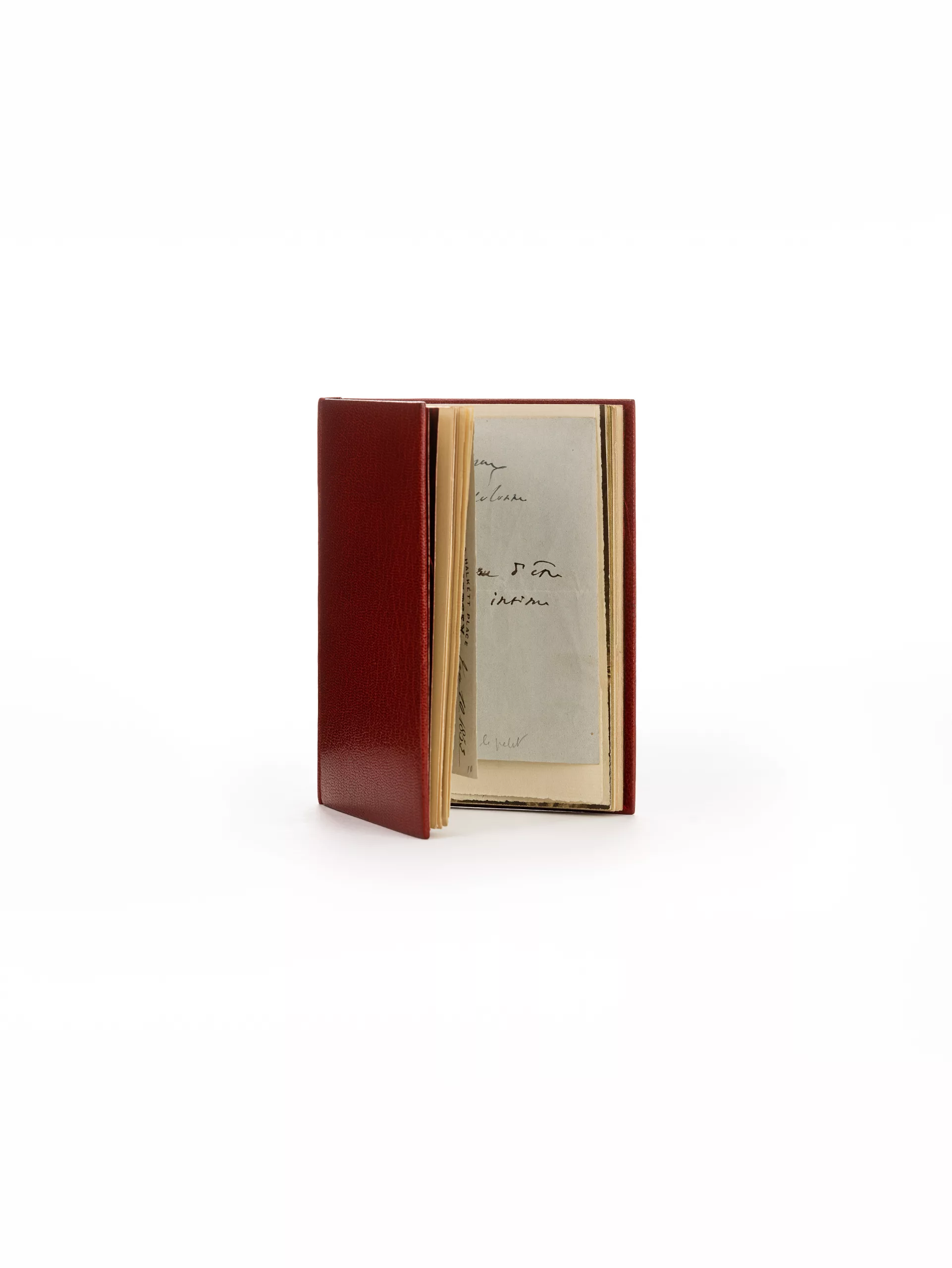
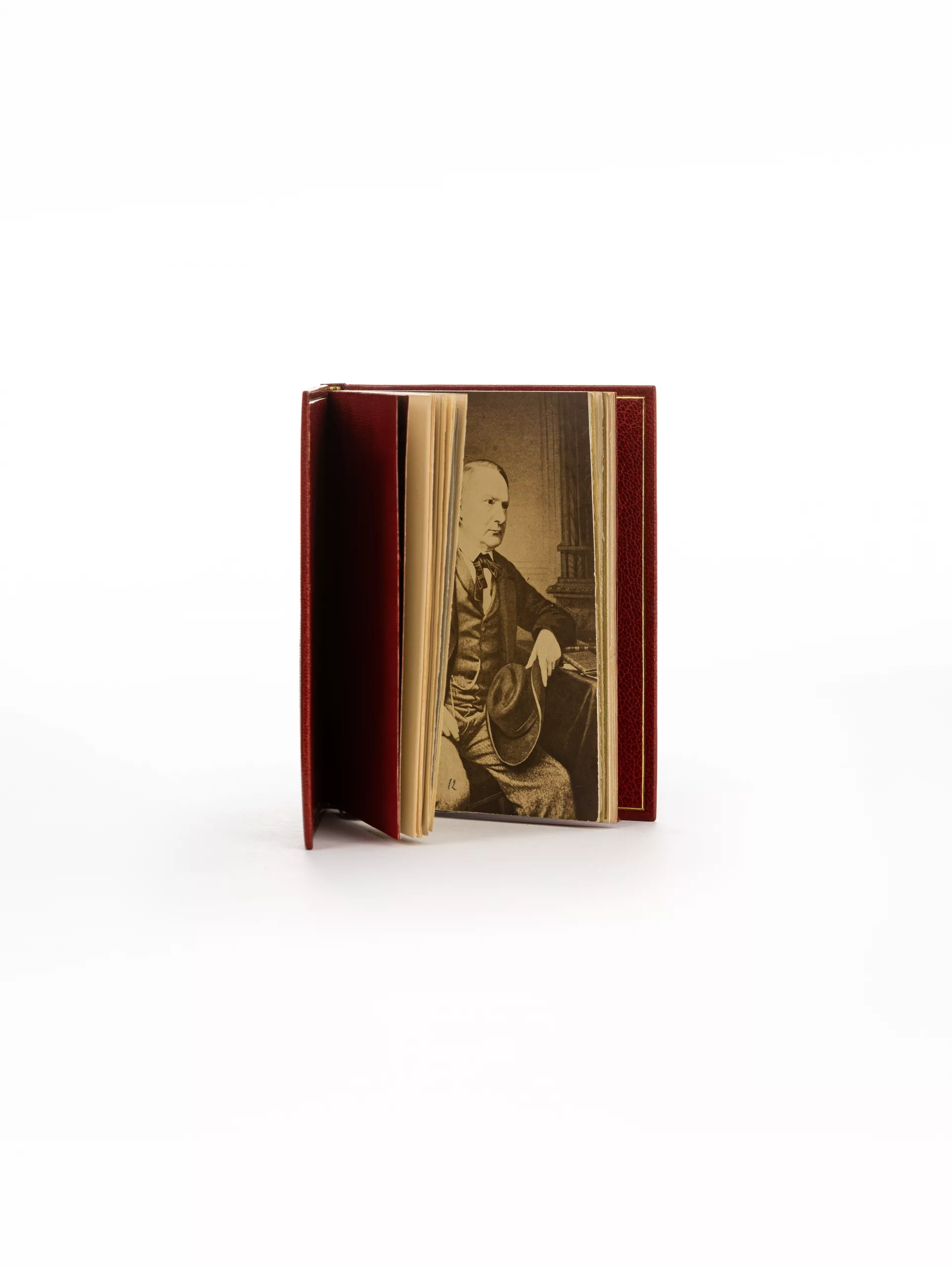
A precious copy enriched with the following items, mounted on guards:
- an autograph letter signed by Prince Napoléon, dated 1849, addressed to Victor Hugo: “Paris ce vendredi 22. Mon cher Collègue, Voici un passage sur papier de ma main, il est fort mal écrit, mais j'ai voulu vous en envoyer l'original. Quand vous l'aurez lu, vous me donnerez vos conseils. Recevez l'expression de toute ma vive amitié.”
- an autograph letter, dated 1850, from an officer sent to Victor Hugo's home to retrieve the manuscript of his memoirs, which President Louis Bonaparte had entrusted to him a year earlier for proofreading;
- an original silver print of a portrait of Victor Hugo, taken in Jersey in 1855 (130 x 100 mm);
- an autograph note by Victor Hugo against Napoleon III, on the back of a caterer's bill dated 10 January 1853: “There will be two Napoleons in history: the Napoleon of the Column and the Napoleon of the Stake. England will have had the fortune to be the executioner of the first and the intimate friend of the last.”
Provenance: Louis Barthou (bookplate, II, no. 574); Jean Inglessi (bookplate).
This prose diatribe targets the “stand-in emperor,” then traveling to London to receive “a kiss of peace” from Queen Victoria.
This pamphlet is the rarest of all those printed in Jersey. One copy was acquired in 1973 by the Bibliothèque de l’Arsenal, when the sale notice described it as “known in 2 copies” (Hôtel Drouot sale, 17–19 January 1973).
Sensing the early signs of a coup d’état, Hugo moved into the left-wing opposition in the spring of 1850, and on 10 February 1851 attacked the prince-president for the first time from the tribune, over the matter of his endowment. In his great speech of 17 July 1851, he denounced the prince-president’s ambitions and delivered this famous line:
“What! After Augustus, Augustulus! What! Because we had Napoleon the Great, must we now have Napoleon the Little!”
On the night of 1–2 December 1851, the prince-president carried out his coup d’état. The Assembly was dissolved; the left-wing deputies, of whom Hugo was one of the leaders, were prosecuted. He was expelled and fled to Belgium. There he wrote in one sitting his virulent indictment, Napoléon le Petit: “To make a prey of France, great God! What the lion would not have dared, the monkey has done! What the eagle would have feared to seize in its claws, the parrot has taken in its paw! Civilization, progress, intelligence, revolution, liberty — one fine morning he brought all this to a halt, this mask, this dwarf, this abortive Tiberius, this nothingness!”
Having promised to leave Belgian soil after writing this pamphlet, he left Antwerp for London on 1 August 1852 with Juliette and Charles, among many other exiles to whom he addressed a farewell speech. On the quay stood Alexandre Dumas, who, fleeing his creditors, had also had to leave France. On 5 August, Victor Hugo was welcomed at Saint Helier, on the island of Jersey, by his wife, his daughter, Auguste Vacquerie and numerous exiles. On 16 August, Victor Hugo and his family settled on the Azette shore, in the house named Marine Terrace.
Upon landing at Dover, the emperor could see on every wall of the city the words of this speech, written by the Jersey exile, whose virulence was matched only by its familiar, provocative tone: “What have you come here to do? Whom do you resent? Whom have you come to insult — England in its people, or France in its exiles?” Hugo invited persecution and awaited it steadfastly: “Whatever it may be, this persecution will remove neither from our eyes, nor from the eyes of history, the hideous shadow you have cast.”
This hideous shadow had haunted Hugo for four years now, far removed from his first meeting in 1848 with Prince Louis Napoleon Bonaparte, nephew of Napoleon I, son of Hortense de Beauharnais and Louis, King of Holland. Hugo, then drawn in by the sense of order implied by the very name Bonaparte, and by the candidate’s progressive social ideas, campaigned for him in his sons’ newspaper, L’Événement, during the elections. On 10 December 1848, Louis Napoleon Bonaparte was elected in triumph. He swore an oath to the Constitution.
In Jersey, Hugo wrote Les Châtiments, then, in 1854, the Lettre à Lord Palmerston, following the execution of a condemned man, Tapner, for whom Hugo had vainly tried to obtain a pardon.
Watched over by a certain Sir Robert Peel, of the House of Commons, who had been contacted by the emperor to identify agitators, Hugo was already being described by the English as “an individual [who] has a sort of personal quarrel with the distinguished figure the French people have chosen as their sovereign.” After a session in the House on 13 December 1854, this same Peel asked the Queen’s ministers whether there might not be some way to put an end to Hugo’s acts and publications. Despite this, the writer produced this pamphlet a few months later, disregarding the warnings of the English government. The blow soon fell. On 27 October 1855, the Hugo family was expelled from Jersey and had to abandon their villa at Marine Terrace; they left Jersey on 31 October, with François-Victor and Juliette, bound for Guernsey.
This last publication, the one that sealed his expulsion, is of exceptional rarity. One copy was acquired in 1973 by the Bibliothèque de l’Arsenal; at the time, according to the sale notice, it was “known in 2 copies” (Hôtel Drouot sale, 17–19 January 1855).