

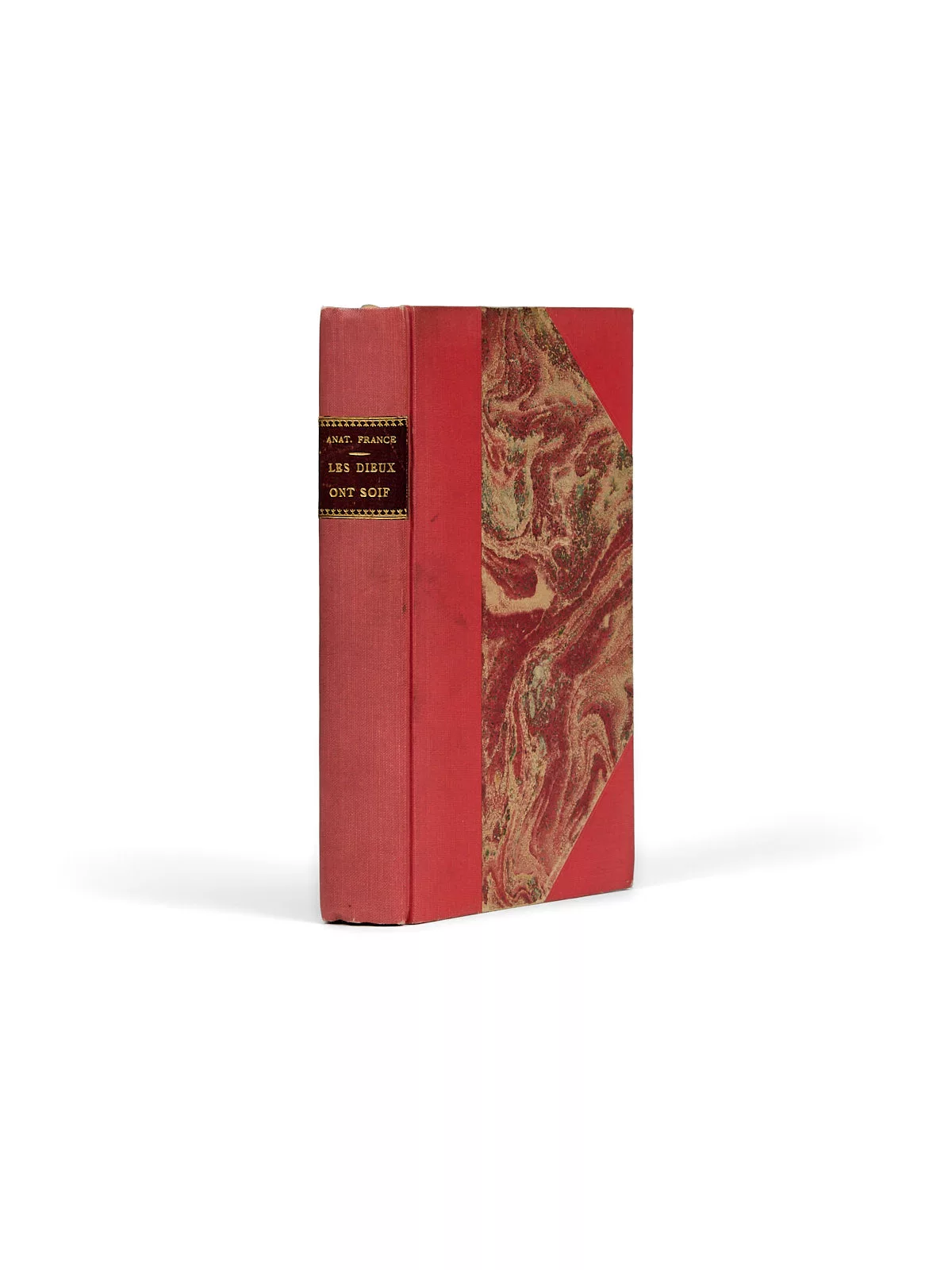
Les dieux ont soif
Anatole France’s political stance, which evolved throughout his life, cannot be reduced to the definitive formula launched in 1891 by Georges Clemenceau: “the Revolution is a bloc from which nothing can be subtracted.” Neither fully on the left (deemed too bourgeois by that side) nor on the right (given his role in the Dreyfus Affair and his support for the Russian Revolution), France claimed the right to think freely, rejecting the binary reading of History that was commonly presented. Through the example of the French Revolution and the episode of the Terror, he denounces the tyrannical potential inherent in every revolution, without ceasing to be deeply committed to the Republic.
Composed using the same methods as Thaïs (1891) or La Rôtisserie de la reine Pédauque (1893), the text draws on a considerable body of historical documentation. Les dieux ont soif is nothing less than an unvarnished portrait of the jurors of the Revolutionary Tribunal, whom France compared to the Inquisition: “My heroes have merely changed clothes.” Gide, who otherwise did not particularly enjoy France’s company, wrote: “It is a very good book.”
Writing the novel cost France little effort, but overseeing and correcting the proofs proved trying: they were first sent to the editor of the Revue de Paris, where the novel was being serialized, and he had cut scenes deemed too crude. France exclaimed: “that paralytic, that agitated man, that madman, that lunatic!”