

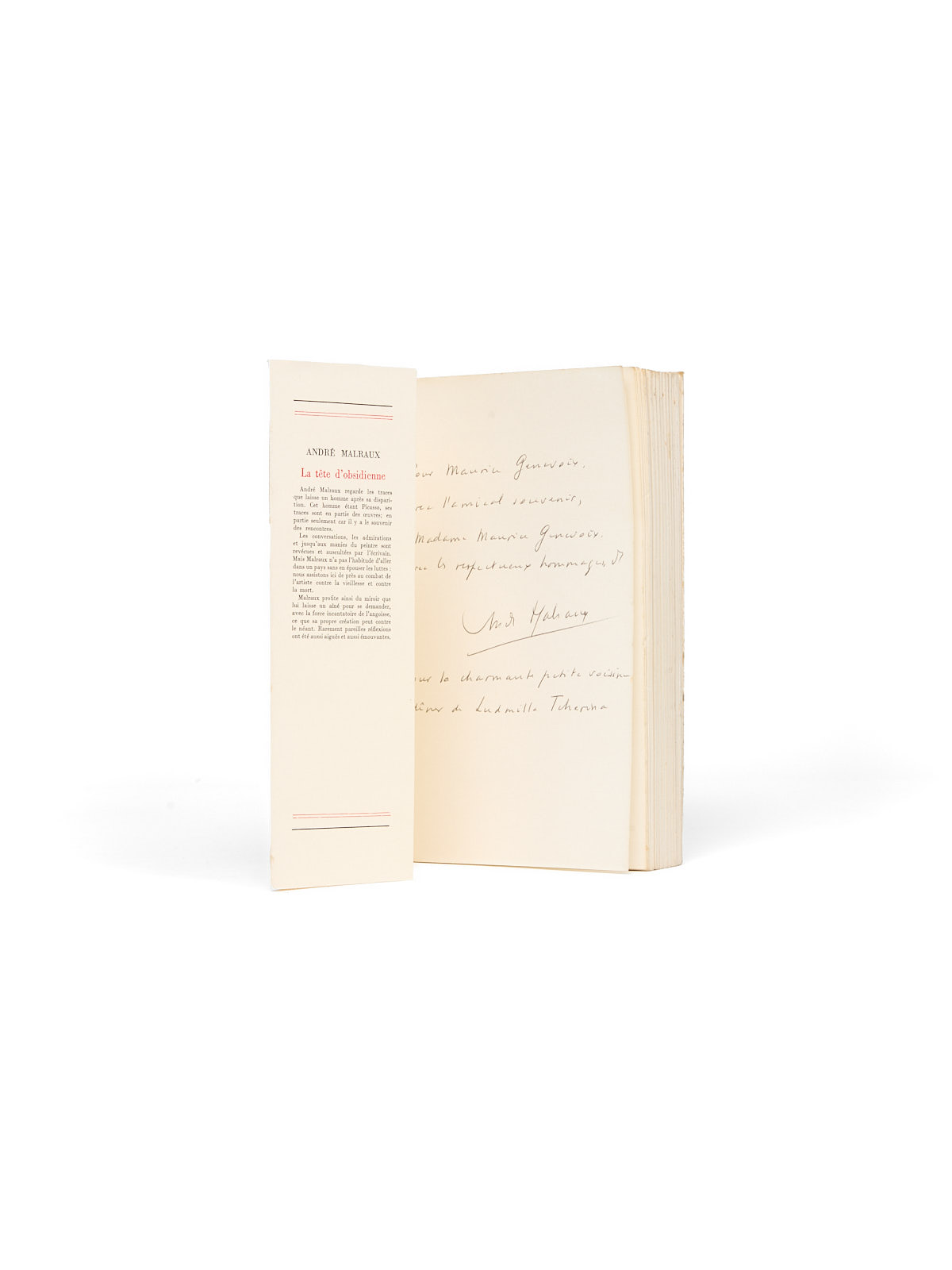
La Tête d’Obsidienne
One of the copies stamped as a press copy.
Presentation inscription signed: “Pour Maurice Genevoix, avec l'amical souvenir, pour Madame Maurice Genevoix, avec les respectueux hommages d'André Malraux, et pour la charmante petite voisine du dîner de Ludmilla Tcherina.”
In 1973, invited by the painter’s widow, Jacqueline Picasso, André Malraux traveled to Mougins and then to Vauvenargues to select canvases for a donation to the State. This journey through the late painter’s studio, and through the corridors of the newly established Fondation Maeght, gave rise to the reflections recorded in La Tête d’obsidienne, which would later reappear, in reduced form, in the late assembly of Le Miroir des limbes.
“Any man who writes, and writes well, serves France,” General de Gaulle once told André Malraux. Maurice Genevoix thus served his country twice over: through his body and through his mind. Severely wounded in fighting at Rupt-en-Woëvre near the Hill of Les Éparges in 1915, he lost the use of his left arm and was discharged with 70% disability. His first war narrative, Sous Verdun, published in 1916, was partially censored. In 1949, three years after his election to the Académie française, he published Ceux de 14, the book that established his reputation as a tragic storyteller — a reputation Malraux, the unforgettable orator at the transfer of Jean Moulin’s ashes to the Panthéon on 19 December 1964, would certainly not have disputed. Genevoix would join Moulin there fifty-six years later, on 11 November 2020.
Malraux’s dedication recalls a dinner at Ludmilla Tcherina’s home: a dancer, actress, painter and sculptor, and later patron of the 1981 exhibition Félines devoted to Malraux, she shared with him a passion for cats. The “charming neighbor” is probably Sylvie, the daughter of the Genevoix couple, who had just completed her studies in Classics in Paris and would later become a major figure in contemporary publishing.
Incidentally, Ludmilla Tcherina is indirectly well known to bibliophiles: she was the daughter of Stéphane and Avenir Tchemerzine, authors of the celebrated bibliography of first editions of French poetry from the Middle Ages to the nineteenth century. She inherited from her parents a significant collection of rare books.
From the library of Maurice Genevoix (inscription and bookplate).