

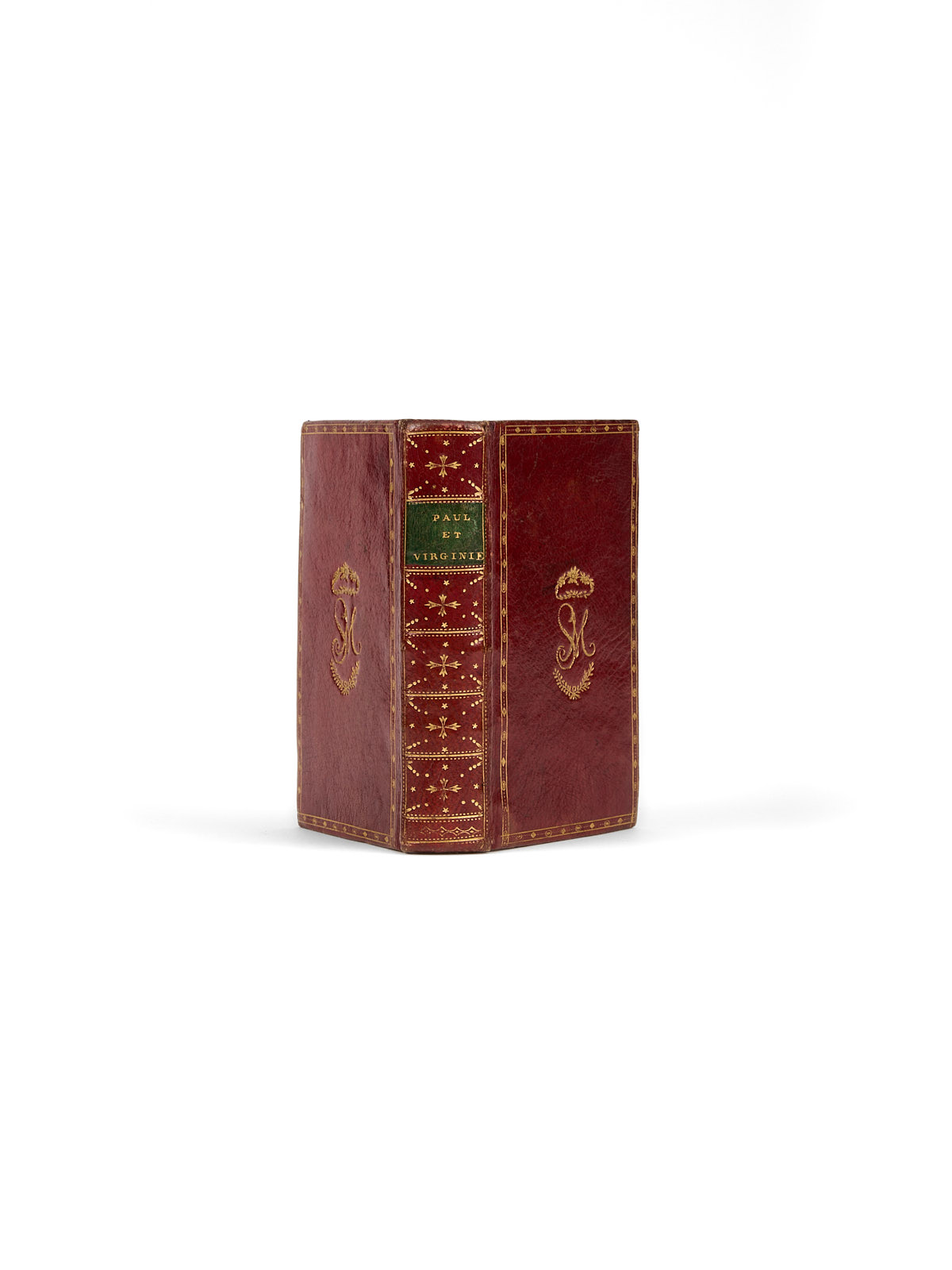
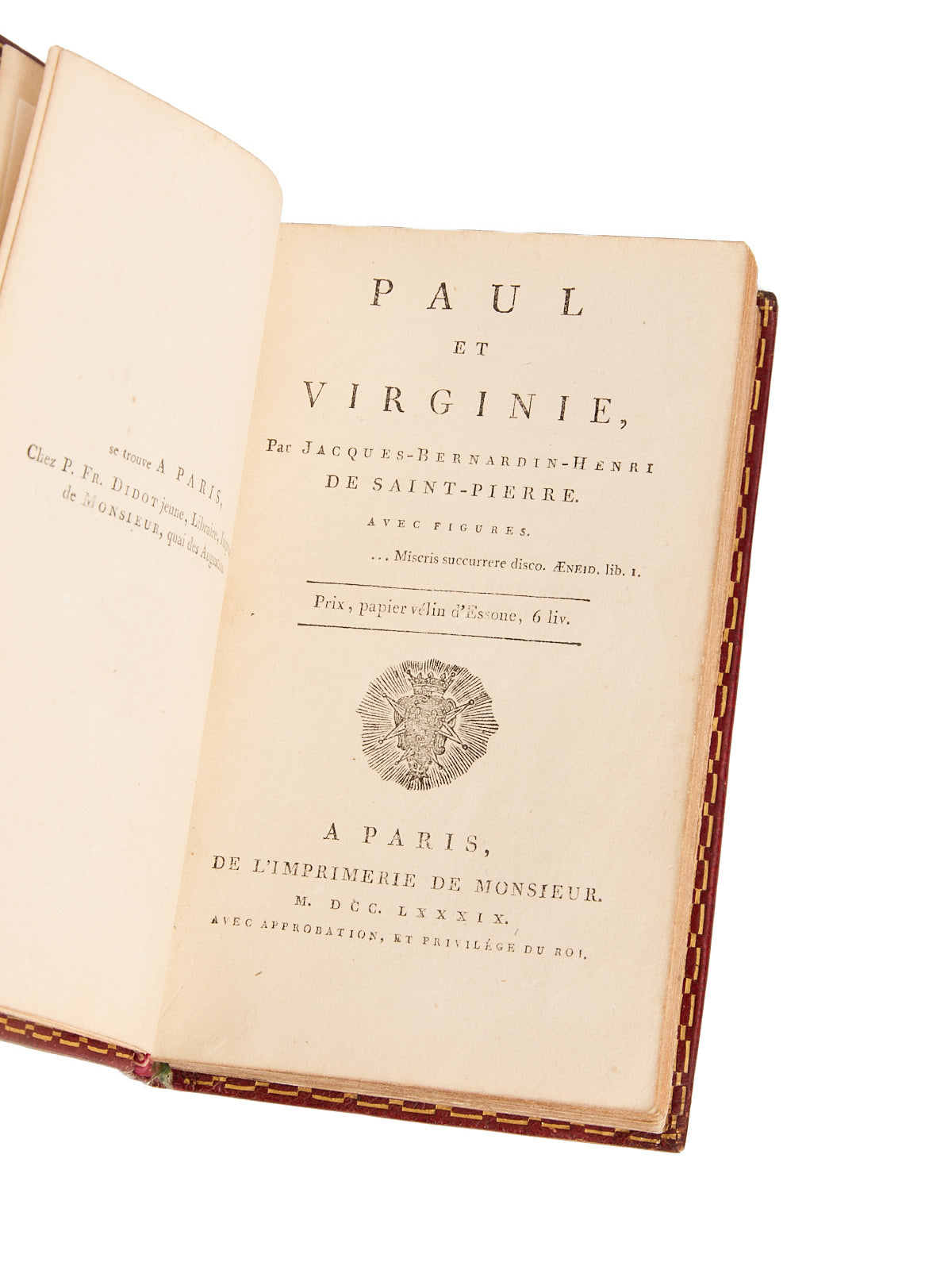
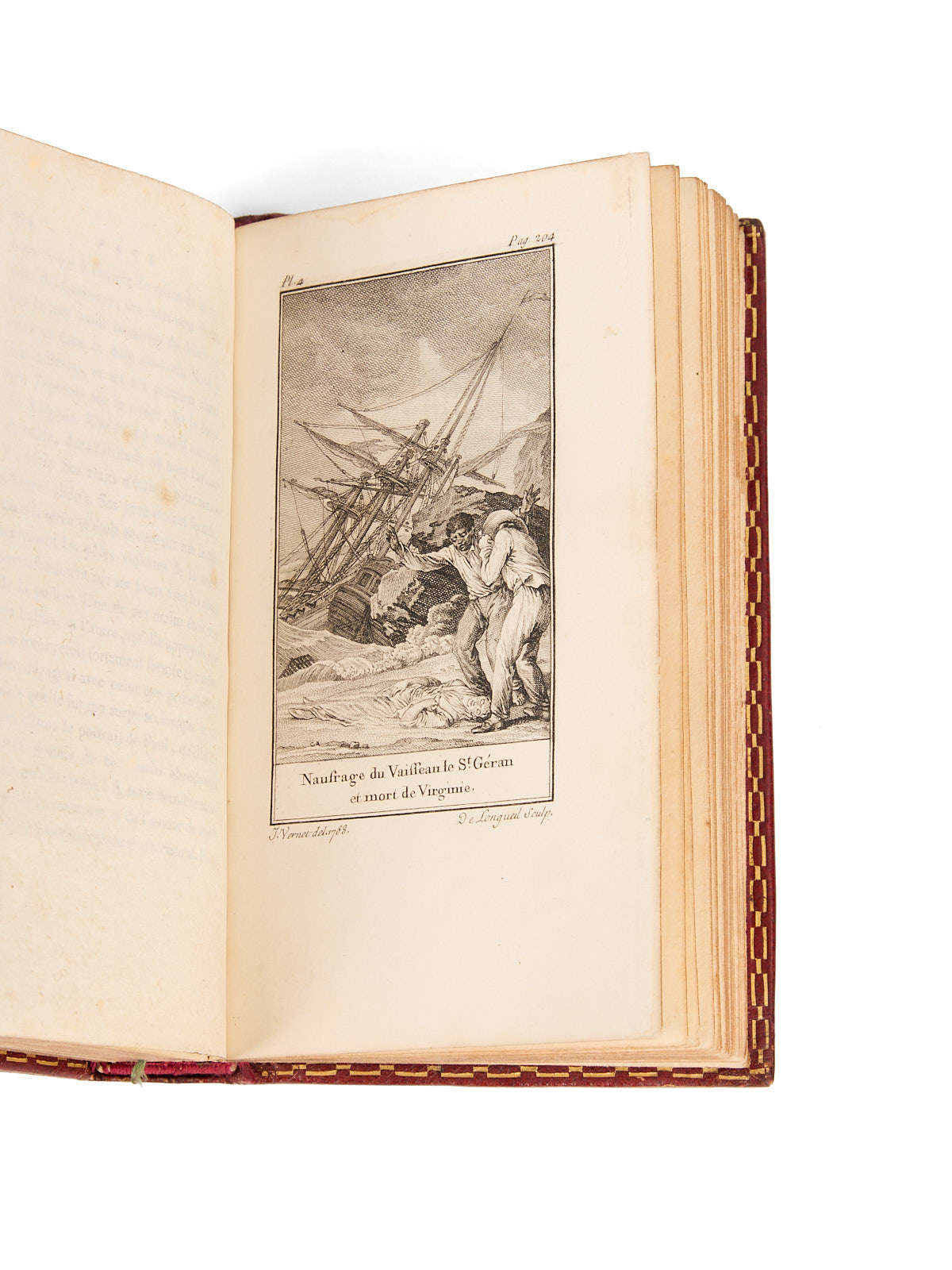
Paul et Virginie
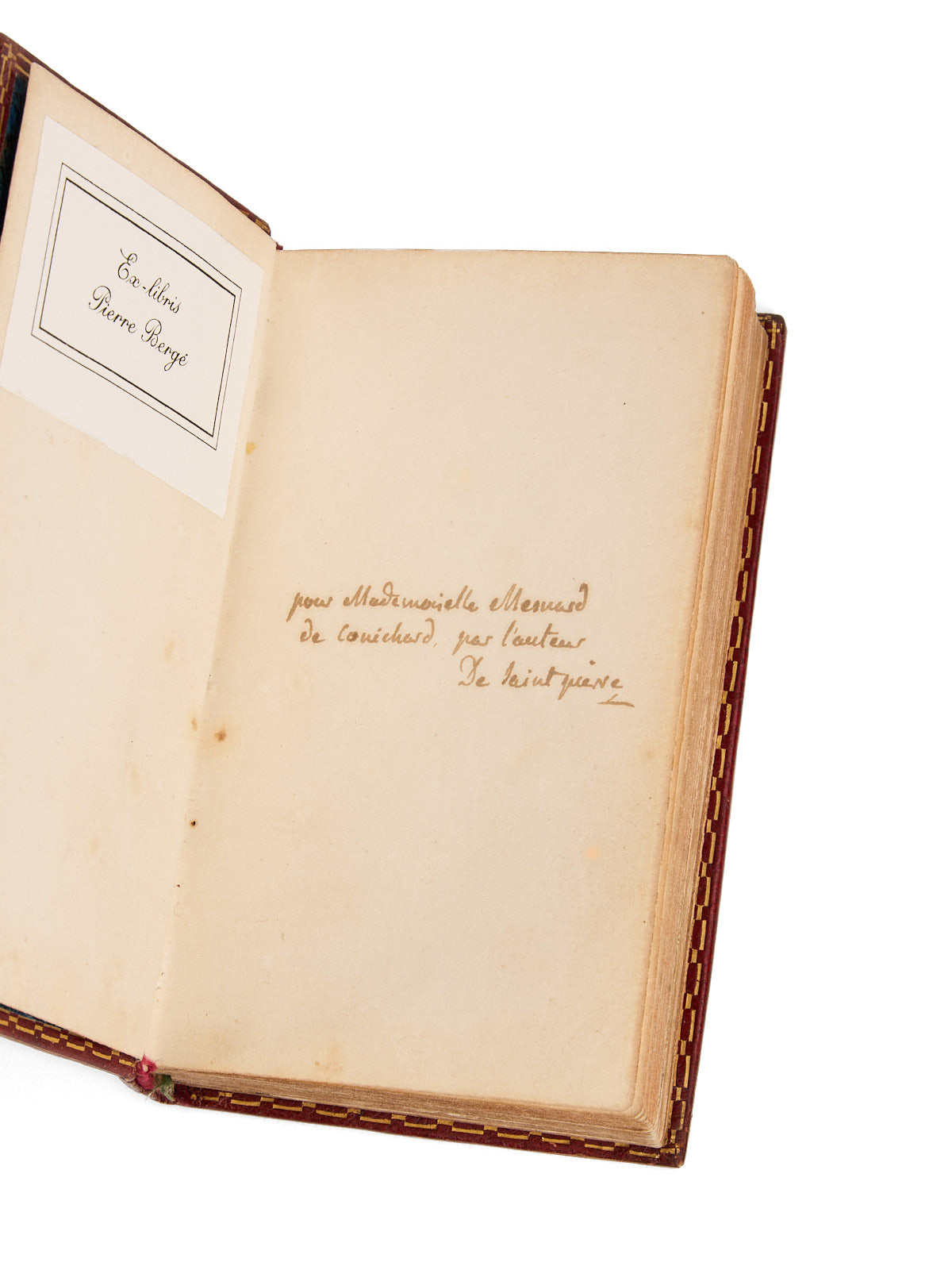
Signed presentation inscription: “pour Mademoiselle Mesnard de Conichard, par l'auteur, De Saint-Pierre.”
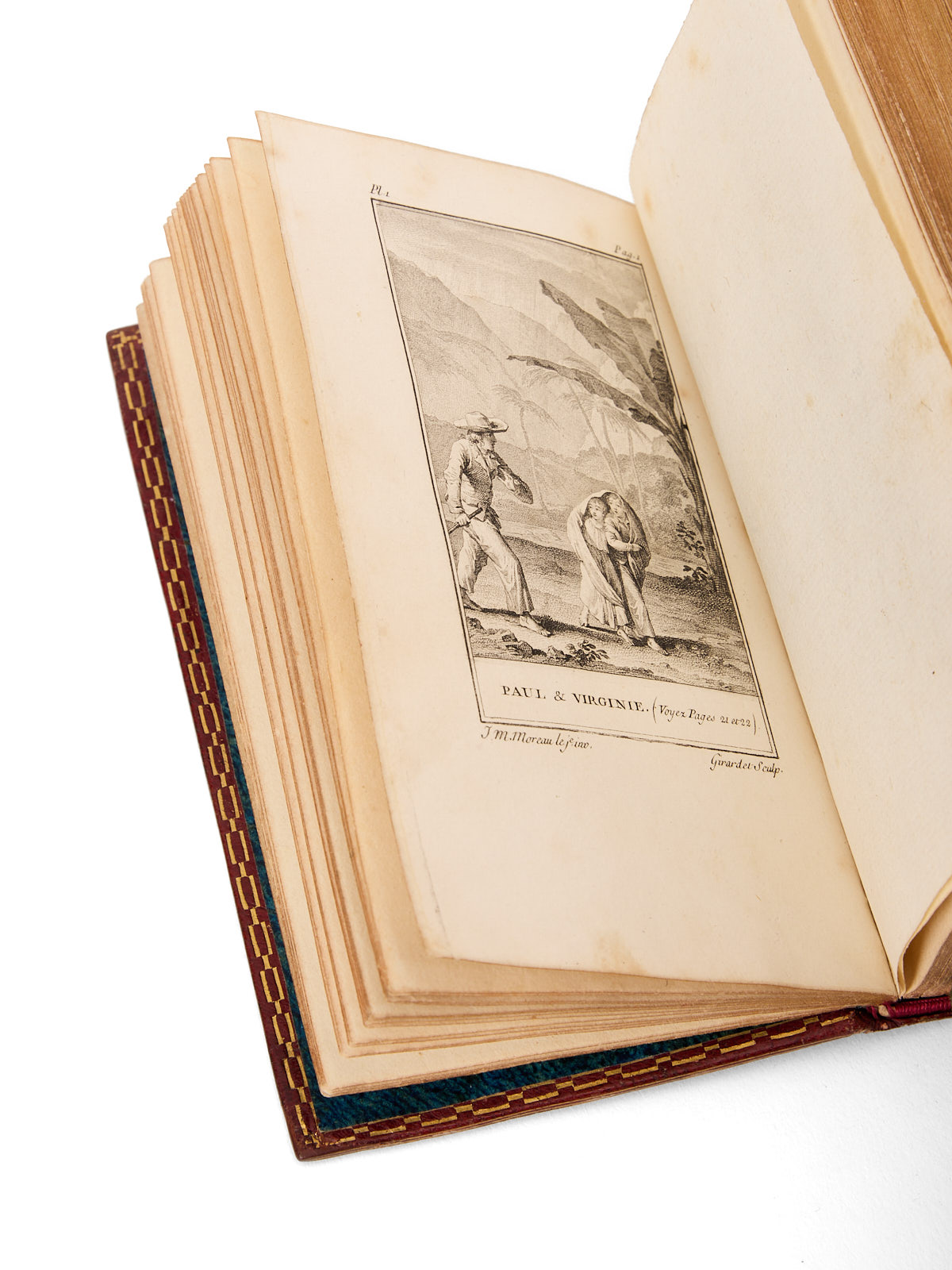
Paul et Virginie is a work difficult to define, even for its author, who called it a “little work,” a “fable-essay” and even a “kind of pastoral.” It was first conceived as a complement to a second edition of Voyage à l’île de France, then to the third edition of Études de la nature, whose theses it was meant to illustrate through fiction. Bernardin de Saint-Pierre intended to apply “the laws of the Études de la nature to the happiness of two unhappy families,” through the tragic outcome he gives his story, shattering the dream of an idyll. He thus departs from the period’s taste for pastoral, even as he retains the genre’s simplicity: two young people grow up together in the enchanting, peaceful setting of Île de France, present-day Mauritius, fall in love, are separated by civilization, and are finally parted forever in the wreck of the Saint-Géran.
Bernardin de Saint-Pierre, raised on the tales of Daniel Defoe’s Robinson Crusoe, sailed at twelve for Martinique on an uncle’s ship — a revelation, but also a discovery of the gulf separating imagination from reality, as he struggled with the heat, the fatigue of the voyage and above all shipboard discipline. After this disappointment, his parents sent him to the Jesuit college in Caen, where he briefly considered becoming a missionary, then to Rouen, before he entered the École nationale des ponts et chaussées in 1757. At the end of his studies he joined the corps of military engineers.
As early as 1773, he denounced the crime of slavery in his Voyage à l’Île de France, à l’Île Bourbon, au cap de Bonne-Espérance, joining the small number of authors who unambiguously opposed slavery and racism in the name of the equality of all men — all the more forcefully as a native of Le Havre, one of the main ports through which enslaved people passed, whose ravages he had constantly witnessed. He returned to the subject in Paul et Virginie, making the enslaved characters Marie and Domingue, who live in harmony with their masters, important figures in his narrative.
The novel inspired a great many later works, from Chateaubriand’s Atala to Flaubert’s Un cœur simple.
“Like most masterpieces, this one brings to the genre and fashion it embodies both its fulfillment and its refutation.” (Jean Favre) Paul et Virginie was an immediate success and remained one of the most frequently reprinted books until the early twentieth century. As proof of its immense success, Lamartine, Balzac and Flaubert each made their heroines — Graziella, Véronique and Emma Bovary — readers of Paul et Virginie: “Emma tried to find out exactly what was meant in life by the words bliss, passion and rapture, which had seemed so beautiful to her in books. She had read Paul et Virginie, and had dreamed of the little bamboo house, the black servant Domingo, the dog Fidèle, but above all of the tender friendship of some good little brother, who fetches red fruit for you from trees taller than church steeples, or runs barefoot over the sand bringing you a bird’s nest.” (Madame Bovary, [1857], p. 36).
A very fine copy, of great rarity, with a detailed and highly pertinent presentation inscription: Mademoiselle Mesnard was the daughter of François Mesnard de Conichard (1727–1792), a correspondent and close friend of Bernardin de Saint-Pierre and a senior official at the Ministry of Finance. Mesnard de Conichard had intervened on Bernardin de Saint-Pierre’s behalf to secure an annual grant for him upon his return from Île Bourbon; the correspondence between the two men attests to a long friendship and an almost familial relationship.
In the autumn of 1784, the author proposed dedicating his Études de la nature to François de Conichard. The latter very graciously declined, having “always avoided above all having people talk about me, and I am too old to change my ways in this regard; I beg you, therefore, that there be no more talk of this dedication […]. Let us speak no more of it, I beg you” (letter to Bernardin de Saint-Pierre, October 1784). The author respected this wish and dedicated the work instead to another friend, Hennin. Nevertheless, in the third edition, published in 1788 and containing the novel Paul et Virginie in its fourth volume, Bernardin de Saint-Pierre discreetly managed to print his gratitude to “my respectable friends Messrs. Hennin and Mesnard de Conichard”; and, the following year, on the occasion of this first separate edition of the novel, he presented this copy to his dedicatee’s daughter. A letter from Mesnard to Bernardin dated 30 April [1773] mentions his daughter for the first time, and Bernardin de Saint-Pierre himself refers to “Mademoiselle Mesnard, daughter of one of my best friends, whom I saw born,” in a letter to the author of the poem “Le Tombeau de Virginie” in 1789 (quoted in Rebecca Ford, “Une correspondance amicale: Bernardin et Mesnard de Conichard,” Autour de Bernardin de Saint-Pierre, Mont-Saint-Aignan, P.U. de Rouen et du Havre, 2010).
At the time of the volume’s publication, she was only seventeen — exactly the age of Bernardin de Saint-Pierre’s heroine, since Virginie leaves the island at fifteen and returns only two and a half years later, to meet the tragic end well known to readers. Marie-Françoise Mesnard de Conichard would later marry Jean-François Pierre Puy de Rosny, a future baron of the Empire.
In 1792, Bernardin de Saint-Pierre himself married the daughter of his printer, Didot, with whom he had two children, naturally named Virginie (born 1794) and Paul (born 1798).
Provenance: Marie-Françoise Mesnard de Conichard; Pierre Bergé (bookplate; II, no. 191).
Tchemerzine V, p. 649; Cohen, 931.