

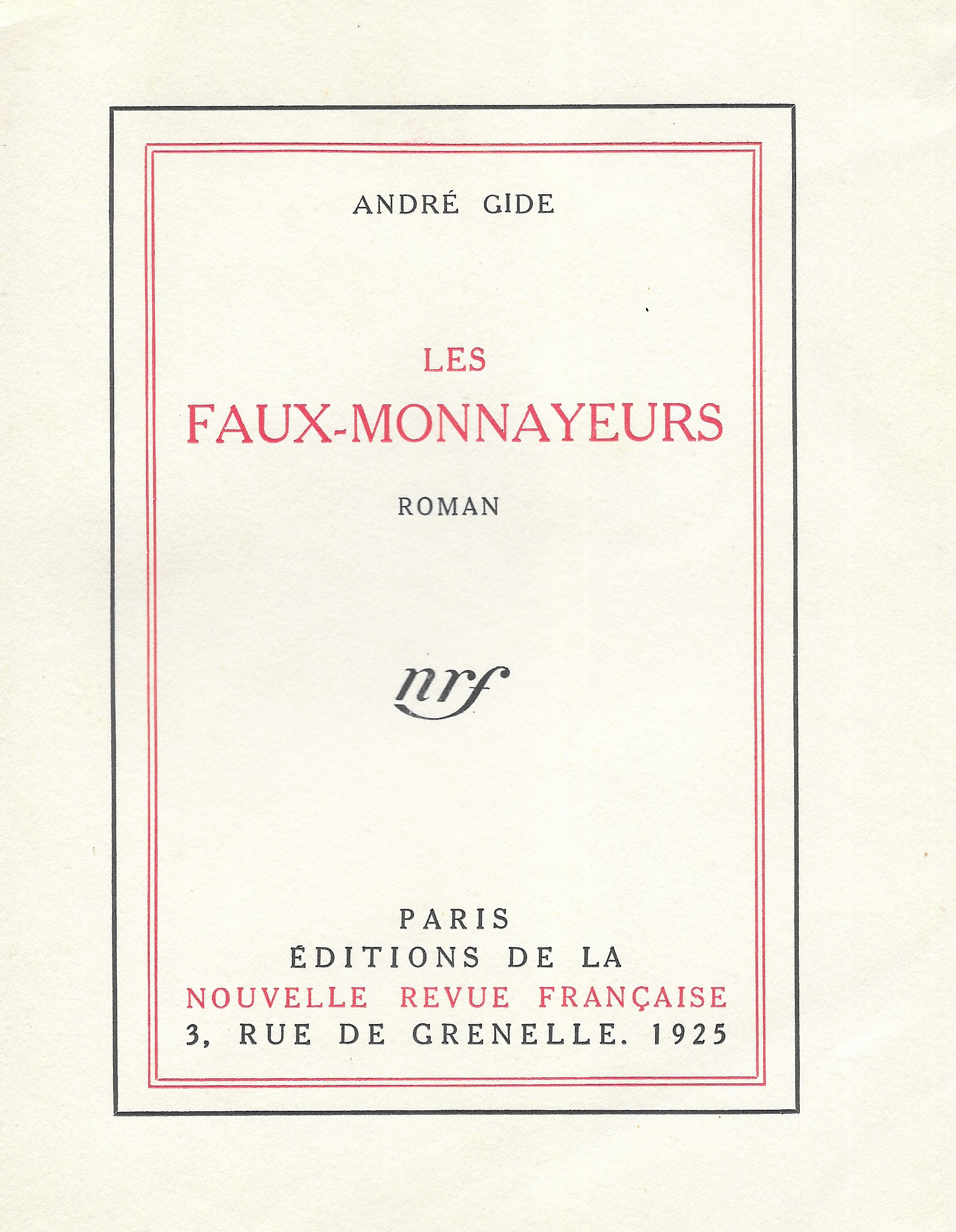
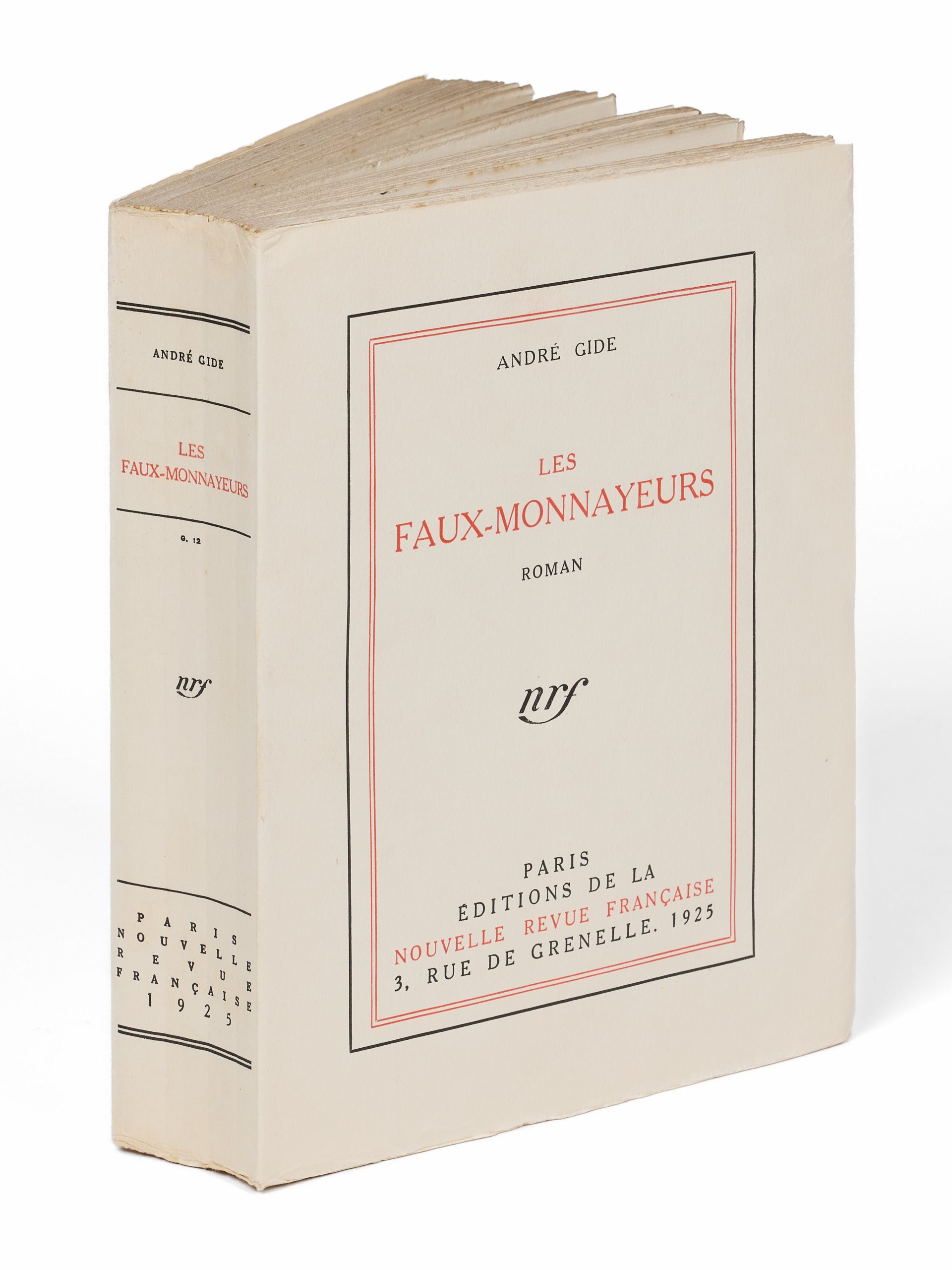
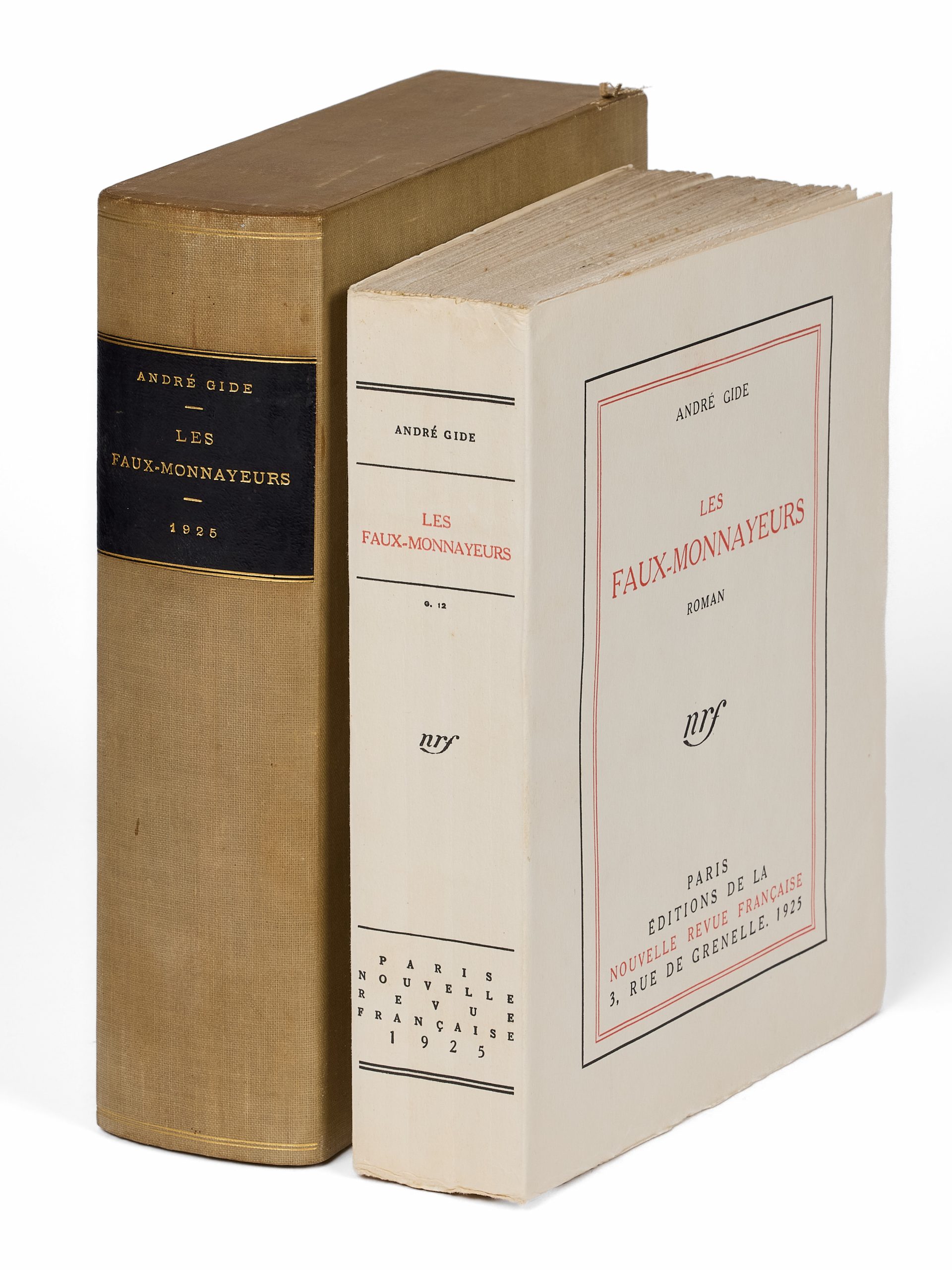
Les Faux-Monnayeurs
One of 121 copies from the first réimposé issue on vergé paper (no. I).
The copy of M. Henry Church.
Les Faux-Monnayeurs is “the novel watching itself being made” (Sarraute), but it is also the novel in crisis: “Throughout my life, at the slightest shock, I would like to give off a pure, honest, authentic sound. Almost everyone I have known rings false. To be worth exactly what one appears to be; not to try to appear worth more than one is… People want to deceive, and become so preoccupied with appearances that they end up no longer knowing who they are…” This sums up the creed of Édouard, the character who wants to write, within the novel, a book entitled Les Faux-Monnayeurs. For the novel itself relies formally on the device of mise en abyme. The expression, in this particular spelling, was coined by Gide, who used it as early as 1893 before giving a first sketch of it in Paludes in 1895. What might be described as theater within theater (as in Shakespeare’s Hamlet or A Midsummer Night’s Dream, or François Truffaut’s Day for Night) here becomes the novel within the novel, through which Gide revolutionized the rules of the genre.
The American Henry Church (1880–1947) was one of the greatest collectors and patrons of the twentieth century. A descendant of one of the Mayflower emigrants and of a pharmacist who held the monopoly on the sale of baking soda in the United States, he devoted part of his immense fortune to the arts and letters. From 1920 he settled in France, with his wife Barbara, at Ville-d’Avray. Between 1927 and 1929 they had two, then three adjoining villas built there, designed and constructed by Le Corbusier and later furnished by Charlotte Perriand. During this period, he financed the literary review Mesures, which he founded with the help of Jean Paulhan in 1935 and directed alongside him. He became an important patron of the Parisian arts and obtained from Gaston Gallimard the assignment of no. 1 of the celebrated nominative réimposé copies of the literary collection, which remained in his name for more than a decade.
A very fine copy.