

Pseudo
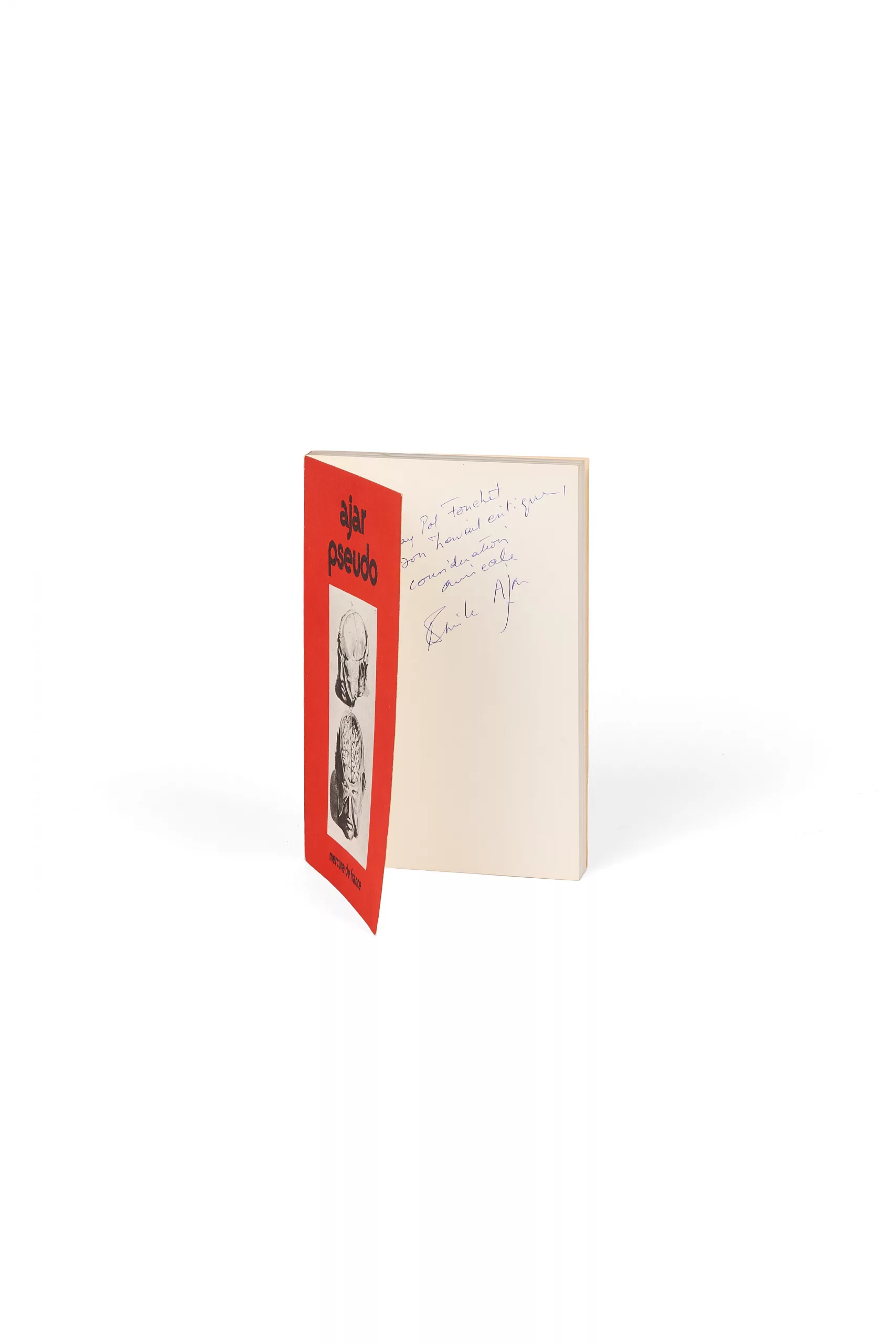
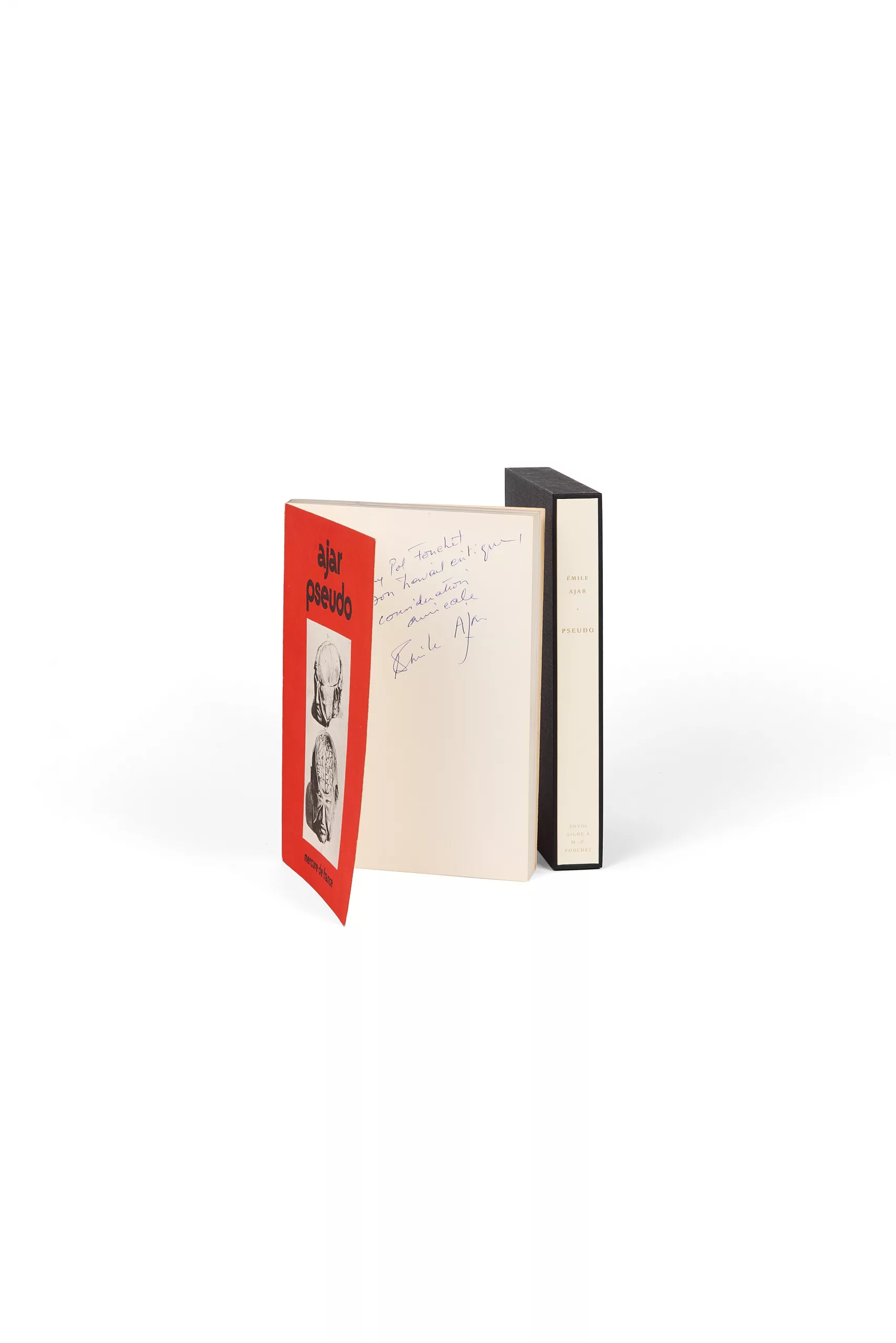
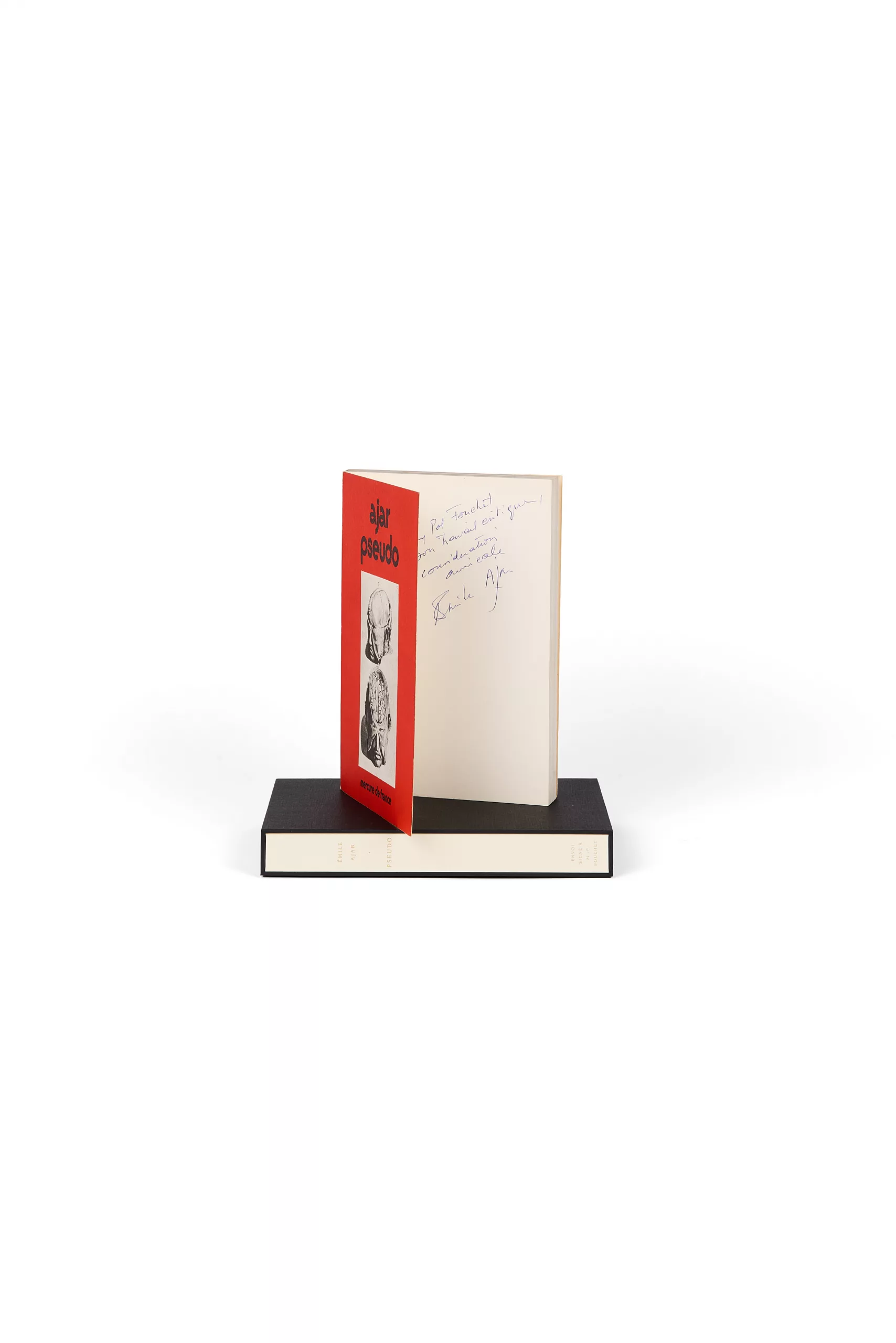
Rare presentation inscription signed [by Paul Pavlowitch]: “Pour Max-Pol Fouchet et son travail critique, considération amicale, Emile Ajar.”
The title itself reads as a wink, given what would prove to be the greatest hoax in literary history — Romain Gary himself acknowledged only one hoax of comparable scale, Macpherson’s invention of the poet Ossian. Weary of the reputation he had carried for thirty years, Gary was reborn as Émile Ajar. “It was a new birth. I was starting over. Everything was given to me again.” After the success of Gros Câlin, the first Ajar novel, Gary refined his scheme for the release of Pseudo, written in fifteen days, by giving his double a face: his cousin Paul Pavlowitch would embody the writer. Gary took delight in the fact that no one recognized him behind the texts, and that critics who praised Gary tore Ajar apart, and vice versa. To those who criticized Pseudo as a “vomited” book devoid of any “cunning,” Gary replied: “If there is a book by an old professional, it is indeed Pseudo: the cunning consisted in not letting it show. For this novel of anguish, of a young being’s panic in the face of life before him, I had in fact been writing since the age of twenty, abandoning it and starting it over again endlessly, carrying pages with me through wars, winds, tides and continents, from earliest youth to maturity…”
Written in fifteen days in 1976 by a Romain Gary shut away in a Geneva studio, Pseudo presents itself as a furious, impulsive and brutal narrative meant to silence all those speculating on Émile Ajar’s true identity. “But who is this Ajar?” all of Paris wondered. “My nephew Paul Pavlowitch,” Gary answered, determined to carry the hoax through to the end. With Pseudo, Gary rebuilt the entire Ajar defense piece by piece, with the relentless mastery of the worst machinations. In this supposed autobiography of Paul Pavlowitch, Gary achieved his aim: putting an end to the rumors, deceiving the press and settling a number of scores with — himself, where imposture pushed to its extreme produces authenticity: “I invented a Paul Pavlowitch from scratch in the novel. A raving man. I wanted to express anguish, and I burdened you with that anguish. I am also settling scores with myself — or more precisely, with the legend that has been pinned on my back.”
A very fine provenance, to one of the few critics Gary held in esteem.
He would go on to send him his other works, adorned with fine and sincere inscriptions.