


Les Rois maudits
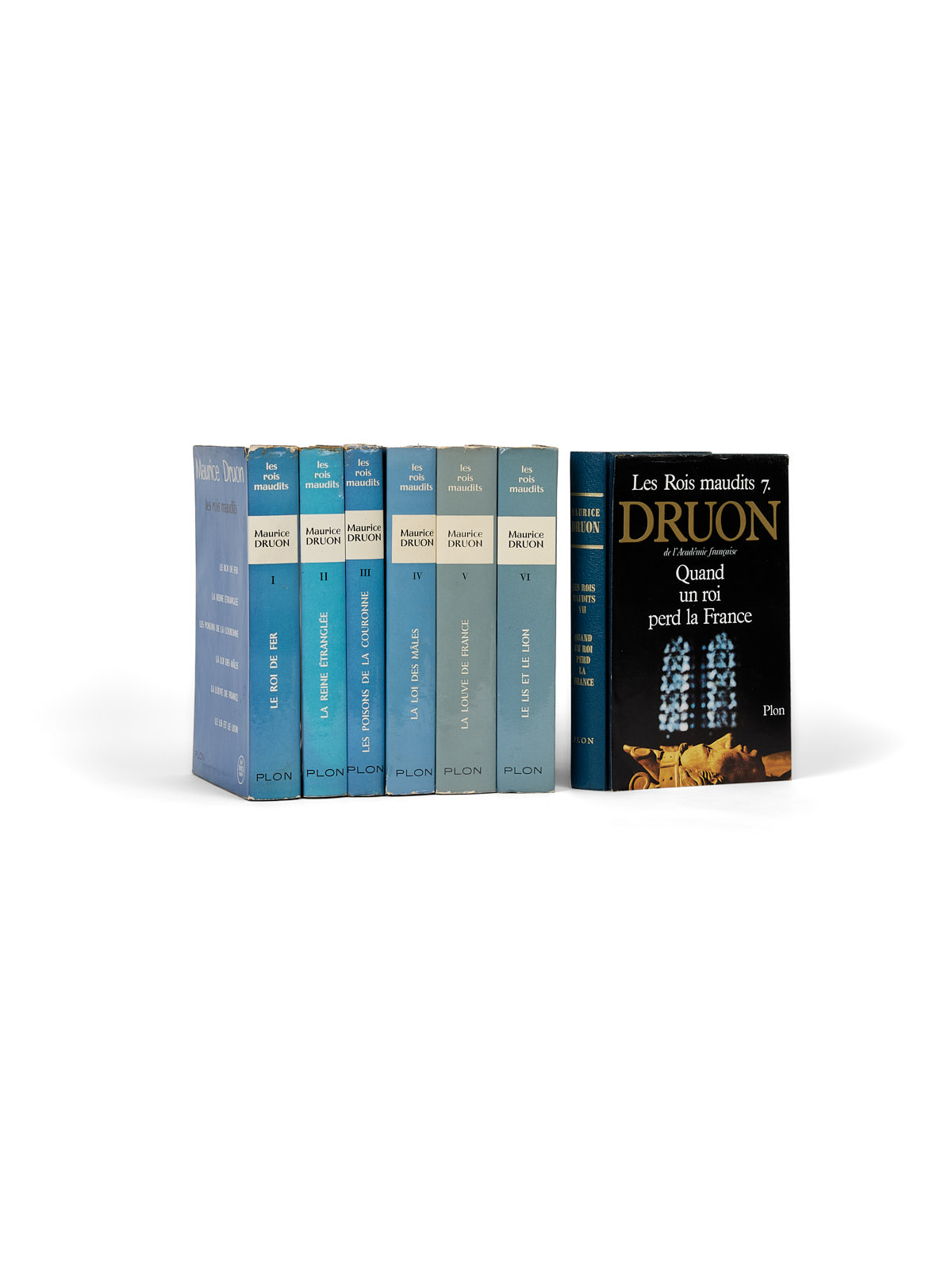
All volumes are in the first printing.
The Maurice Genevoix copy.
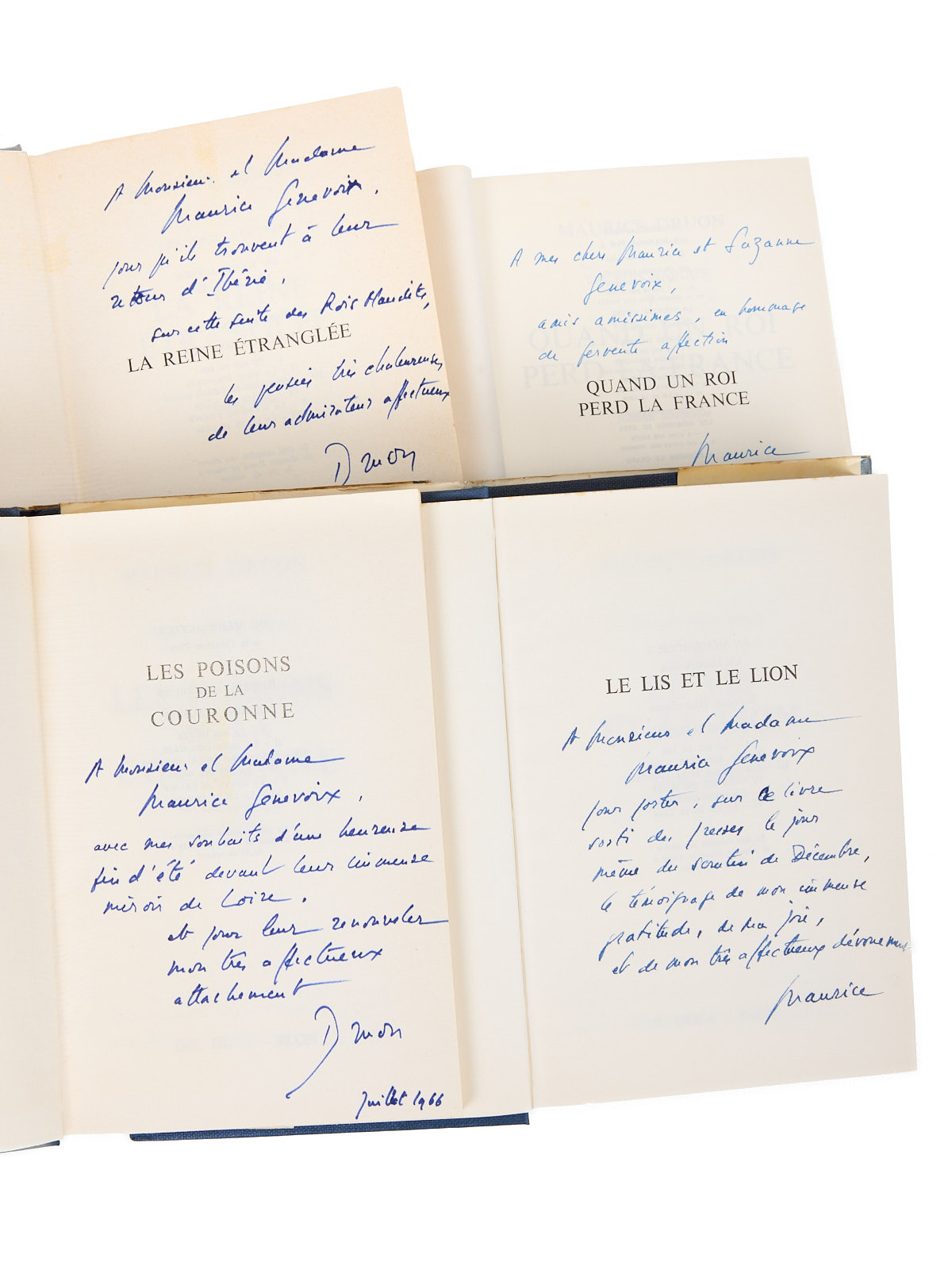
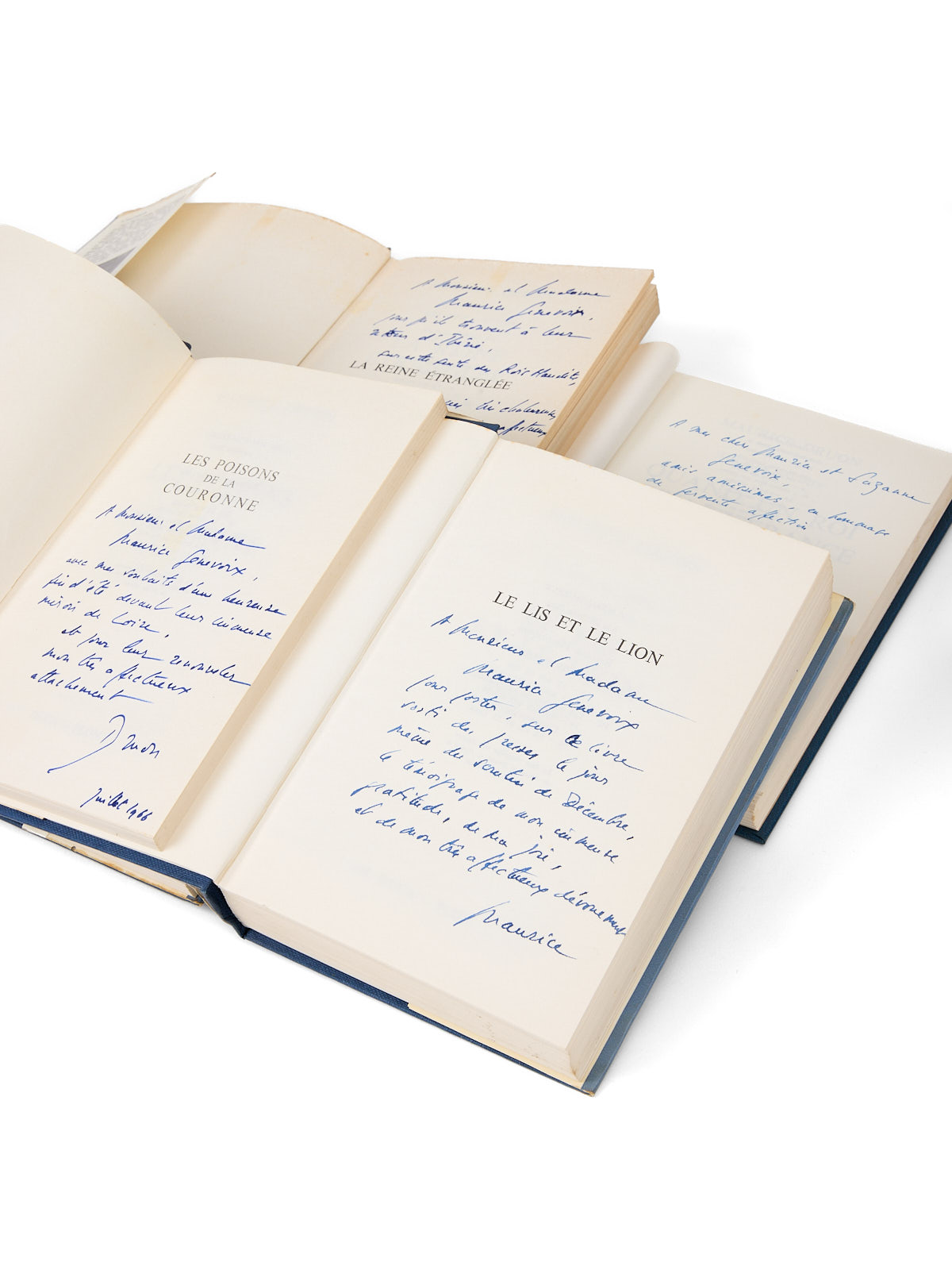
Signed presentation inscriptions in five of the seven volumes:
“À Monsieur et Madame Maurice Genevoix qui habitent glorieusement et pour l’agrément de leurs amis, à l’emplacement de l’ancien Hôtel de Nesle où se déroule en partie ce récit. Hommage d’affection, Druon, 1966.”
“À Monsieur et Madame Maurice Genevoix, pour qu’ils trouvent à leur retour d’Ibérie, sous cette tente des Rois maudits, les pensées très chaleureuses de leur admirateur affectueux, Druon, Juillet 1966.”
“À Monsieur et Madame Maurice Genevoix, avec mes souhaits d’une heureuse fin d’été devant leur immense miroir de Loire, et pour leur renouveler mon très affectueux attachement, Druon, Juillet 1966.”
“À Monsieur et Madame Maurice Genevoix pour porter sur ce livre sorti des presses le jour même du scrutin de Décembre, le témoignage de mon immense gratitude, de ma joie, et de mon très affectueux dévouement, Maurice.”
“À mes chers Maurice et Suzanne Genevoix, amis, en hommage de fervente affection, Maurice.”
Maurice Druon came from a literary lineage: he was the nephew of the writer Joseph Kessel, the great-grandson of Antoine Cros, third and last king of Araucania (now a region of Chile), and the great-great-nephew of the poet Charles Cros. His 1948 novel Les Grandes Familles won him the Prix Goncourt, securing his place in literary Paris. But it was the historical saga Les Rois maudits that brought him lasting fame.
Druon’s fresco opens in the early fourteenth century, at the time of the largest trial history has recorded: that of the Templars. Jacques de Molay, the Grand Master of the Order, dies at the stake, hurling his terrible curse at the King of France, the Pope and the great men of the realm: “Cursed, all cursed to the thirteenth generation of your line!”
Druon never concealed that the series was the product of a “workshop” effort: among the collaborators he thanks in his preface are Gilbert Sigaux, Matthieu Galey, Pierre de Lacretelle, José-André Lacour and Edmonde Charles-Roux, alongside several lesser-known ghostwriters. The chief collaborator was Georges Kessel, Joseph’s brother. A historian and journalist, he had married the actress Janine Crispin in 1938; she would later appear in the 1973 television adaptation of Les Rois maudits.
A very fine complete set of the first Plon edition, which followed the original Del Duca edition published between 1954 and 1960. This new series was issued in publisher’s boards with illustrated dust jackets, beginning in January 1966. The final volume appeared in December of the same year. Druon completed the cycle in 1977 with a seventh volume; the copy of this volume present here is in its first edition, with dust jacket.
A precious literary provenance, from one permanent secretary of the Académie française to another: a candidate for Louis Gillet’s seat in April 1946, Maurice Genevoix withdrew in favor of Paul Claudel. He was elected unopposed on 24 October of that year to the seat of Joseph de Pesquidoux, and was received on 13 November 1947 by André Chaumeix. “You wonderfully humanized the office,” Joseph Kessel would later say, when Genevoix resigned in 1973, eager for the freedom to write. As in the aftermath of the Great War that had given rise to his literary vocation, Genevoix then rediscovered “with intoxication” the Loire valley of his childhood and his property at Les Vernelles, on the riverbank: a way of quietly taking leave of himself, in order to find himself elsewhere — bidding farewell to all he had been, the man of letters, the soldier, the confidant of academicians — and returning to writing. At the close of life, the only stake left was one last day of freedom. It was to write that great book of a single day that Maurice Genevoix broke his chains: “This novel I had always wanted to write,” he said, “that of a single day among days, like yesterday, like tomorrow, through which love and death, storm and clear skies would pass…”
The penultimate volume is especially moving, since Druon had just been elected to the Académie française: “À Monsieur et Madame Maurice Genevoix, pour porter, sur ce livre sorti des presses le jour même du scrutin de décembre, le témoignage de mon immense gratitude, de ma joie et de mon très affectueux dévouement. Maurice.”
Maurice Genevoix served for fifteen years, from 1958 to 1973, as permanent secretary. Jean Mistler succeeded him from 1973 to 1985; on 7 November 1985, it was the author of Les Rois maudits who took over from Mistler, who resigned for health reasons. Druon held the office for thirteen years, until 1999 — roughly the same span as Genevoix.
Since 2004, the Académie française has awarded the Prix Maurice Genevoix to a work illustrating moral and human values.
From the library of Maurice Genevoix, at “Les Vernelles” (bookplate).