

Terre des hommes
An important account of a decisive “Spanish night”: the “Madrid” reportage made by Antoine de Saint-Exupéry for Paris-Soir and published on 27 and 28 June and 3 July 1937. This article, “Hep, Sergent, pourquoi es-tu parti,” is the last of the three published; its central and final part would be taken up, in substance and in form, for the conclusion of Terre des hommes and the important chapter VIII, “Des hommes.”
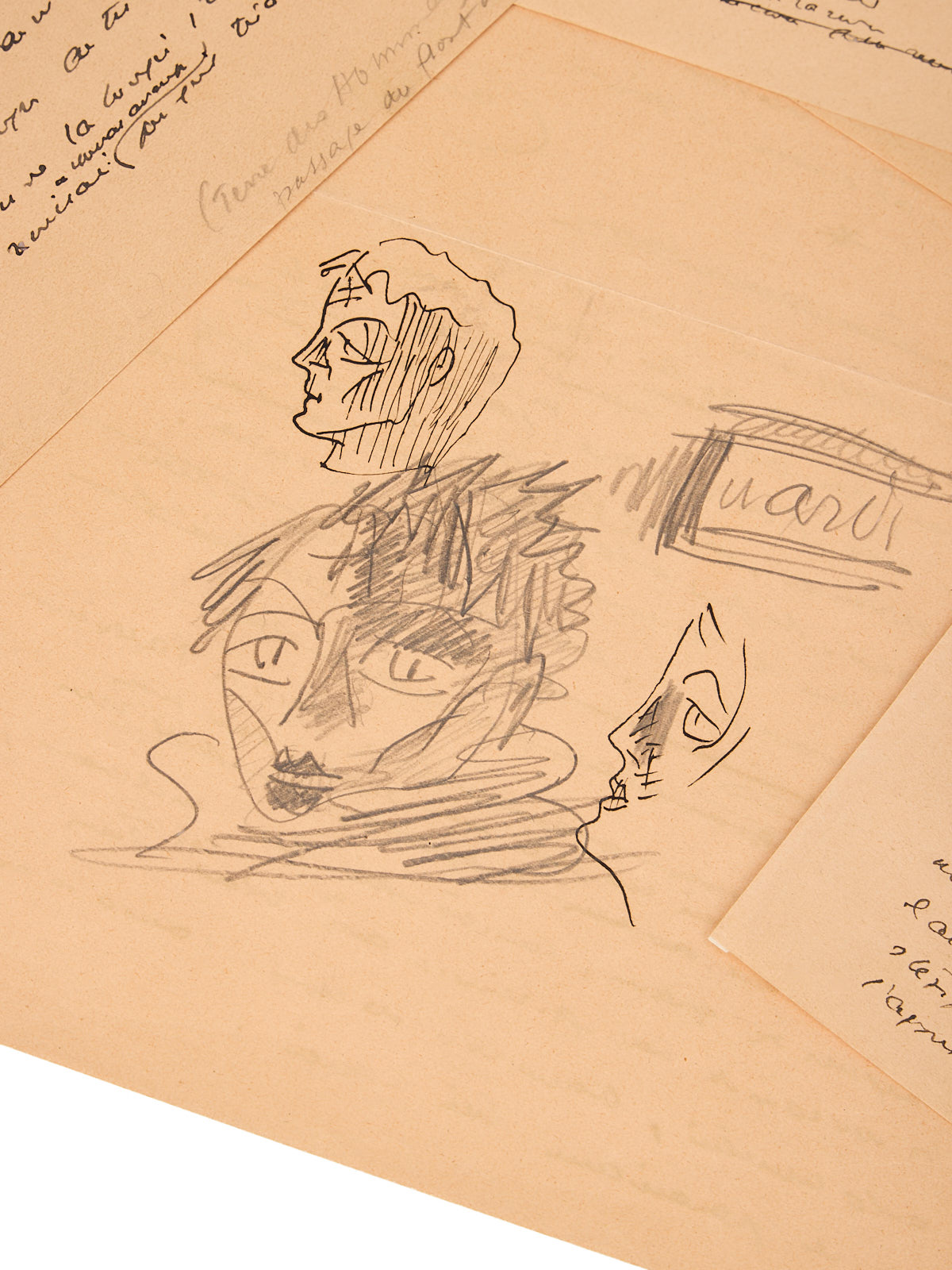
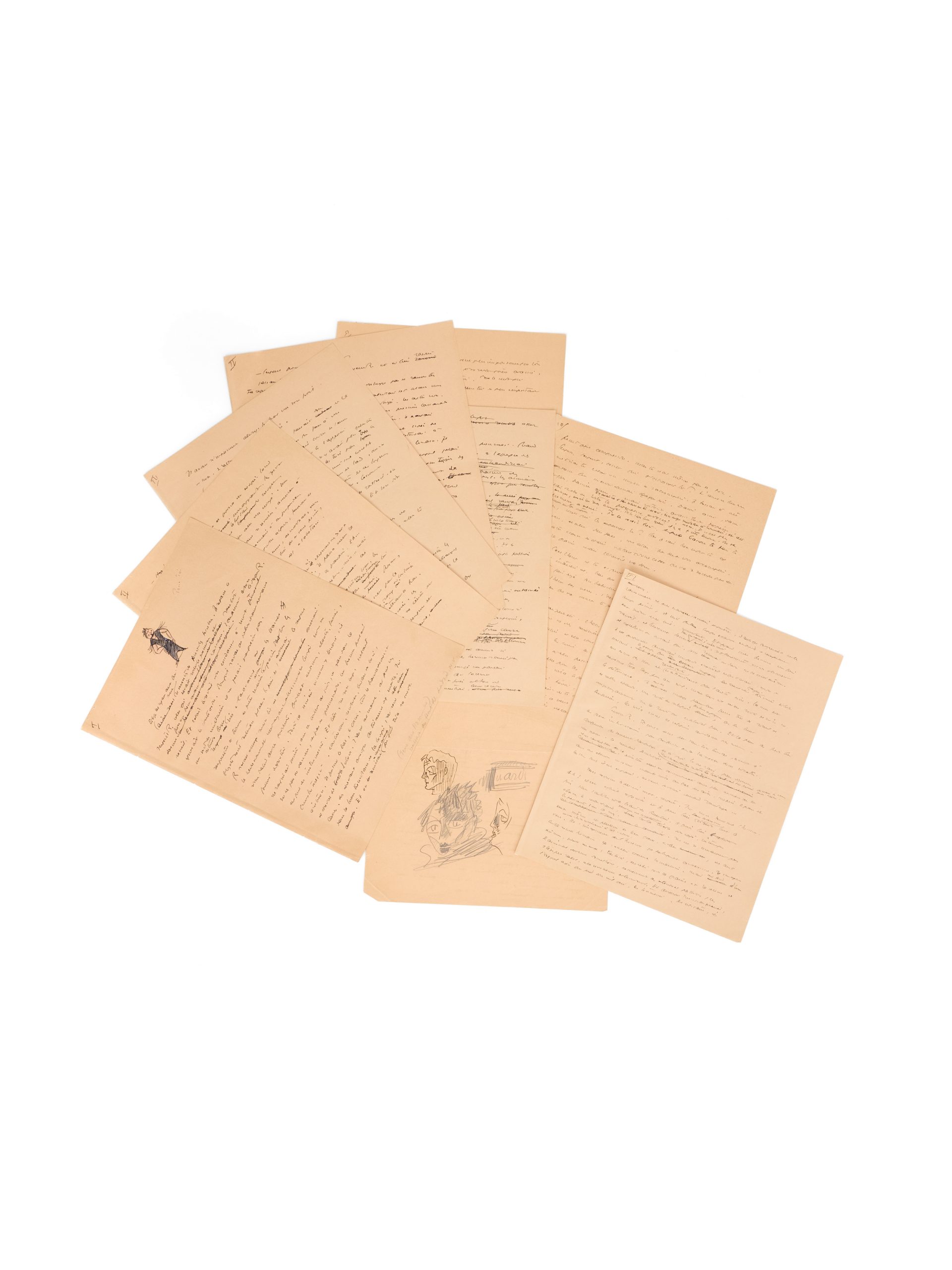
With four original drawings, on the first and last leaves. The first bears this autograph note: “Pour toi” — the provenance of the mention cannot be established.
Terre des hommes is Saint-Exupéry’s great book, the collection in which the writer-pilot first gathered the major themes of his literary humanism. Its publication made him an author of international renown, after his first two narratives, Courrier Sud (Southern Mail, 1929) and Vol de nuit (Night Flight, Prix Femina, 1931), and before the universal fable of Le Petit Prince (The Little Prince, 1943).
A decisive book that was originally only a gathering of scattered texts previously published in the weekly and daily press — a weaving of articles that appeared between 1932 and 1938 in Marianne, La NRF, Air France Revue, Minotaure, L’Intransigeant and Paris-Soir, which the author distributed across eight chapters. The seven first chapters pay homage to his friends (Mermoz and Guillaumet, to whom the book is dedicated) and to all those he had met in the deserts of Africa and South America. To this assemblage, begun in the spring of 1938, he decided to add a final chapter, “Des hommes.” This title was added on proofs, where only the numeral “VIII” had figured before (Pléiade, I, p. 1057), a sign of its distinct status among the earlier chapters, all titled much earlier. The book itself changed title on proofs, a few weeks before publication: Étoiles par grand vent became Terre des hommes.
The eighth chapter is the conclusion of the book, and the one that occupied him longest. It is the fruit of the war and of the fury of men, discovered on two journeys to Spain: first in August 1936, when L’Intransigeant sent him to Barcelona for five articles published under the heading “L’Espagne ensanglantée”; then in April 1937, when Paris-Soir sent him to Madrid and the surrounding villages, where the Nationalist assault had failed. Saint-Exupéry returned to France in early June and set to writing; Paris-Soir published the first article on 27 June 1937, “Défense de Madrid,” illustrated with Robert Capa’s famous photograph “The Falling Soldier.” The second, “Madrid : La guerre sur le front de Carabanchel,” followed on 28 June. The account of the day after, published on 3 July 1937 as “Hep, Sergent ! Pourquoi es-tu parti ?,” is the longest and least journalistic of the three: an attack has been called off, and at daybreak the sergeant who was to go first still sleeps, unaware the order has been cancelled; on waking, he is offered his life, like a reprieve to a condemned man. For the first time at the heart of a front line, Saint-Exupéry asks why this man had agreed to advance toward certain death, and sets the inhumanity of military logic against the heroism of ordinary men revealed by the danger of death.
This exceptional manuscript throws precious light on the complex genesis of the article — the articles were given to Hervé Mille, director of Paris-Soir, between May and June 1937, some three weeks after his return from Spain — and gives access to a first-hand account of one of the intense moments of Saint-Exupéry’s life: the night spent keeping watch among the compañeros, and the waking that followed. The manuscript preserves the scene of the sergeant roused from sleep — “Hep ! Sergent !” — in a fuller state than the newspaper text, and the passage would be reworked two years later for Terre des hommes into a graver, more fraternal and more novelistic form: the tender gesture, one of the man’s companions slipping an arm behind his neck to lift his heavy head, is an addition present in neither the article nor this draft.
The present manuscript — unpublished in this complete form — is the only one known of the original article. It comprises nine autograph leaves and approaches the text as published in the daily, but with still more development. Its existence has been known since its reproduction in the Album Pléiade (1994, no. 27, p. 148); these pages, among the finest of his work, would be taken up in Terre des hommes and form, after important variants and cuts, the central part of chapter VIII. It is entirely unpublished and unknown to the critical apparatus of the Pléiade, where the three articles are reproduced.
The story of the sergeant and the Madrid articles allowed Saint-Exupéry “to bring together the essential theme of the chapter: men become men when they obey a sovereign vocation” (Pléiade, p. 1056). The famous episode of the wild ducks is also present — the migration of wild birds toward sunlit climates, which the Little Prince would use for his escape — here evoked for the first time, in words already close to those of the book. To bear witness in 1937, and, two years later in Terre des hommes, to make heard “the great human voice of pity.”
Literary documents of such scope are rare.
Four drawings illustrate it: a full-length figure on the first leaf (ink and pencil) and three faces on the verso of the last leaf — two profiles in ink and one facing view in pencil, with the word “mardi” framed in pencil.
Saint-Exupéry, Album Pléiade (1994, no. 27, p. 148, reproduced and credited “page de travail, avec dessin de Terre des Hommes; vers 1938. Autographe”); Œuvres, I, Pléiade, pp. 416–423 and notes p. 1087 et seq.