

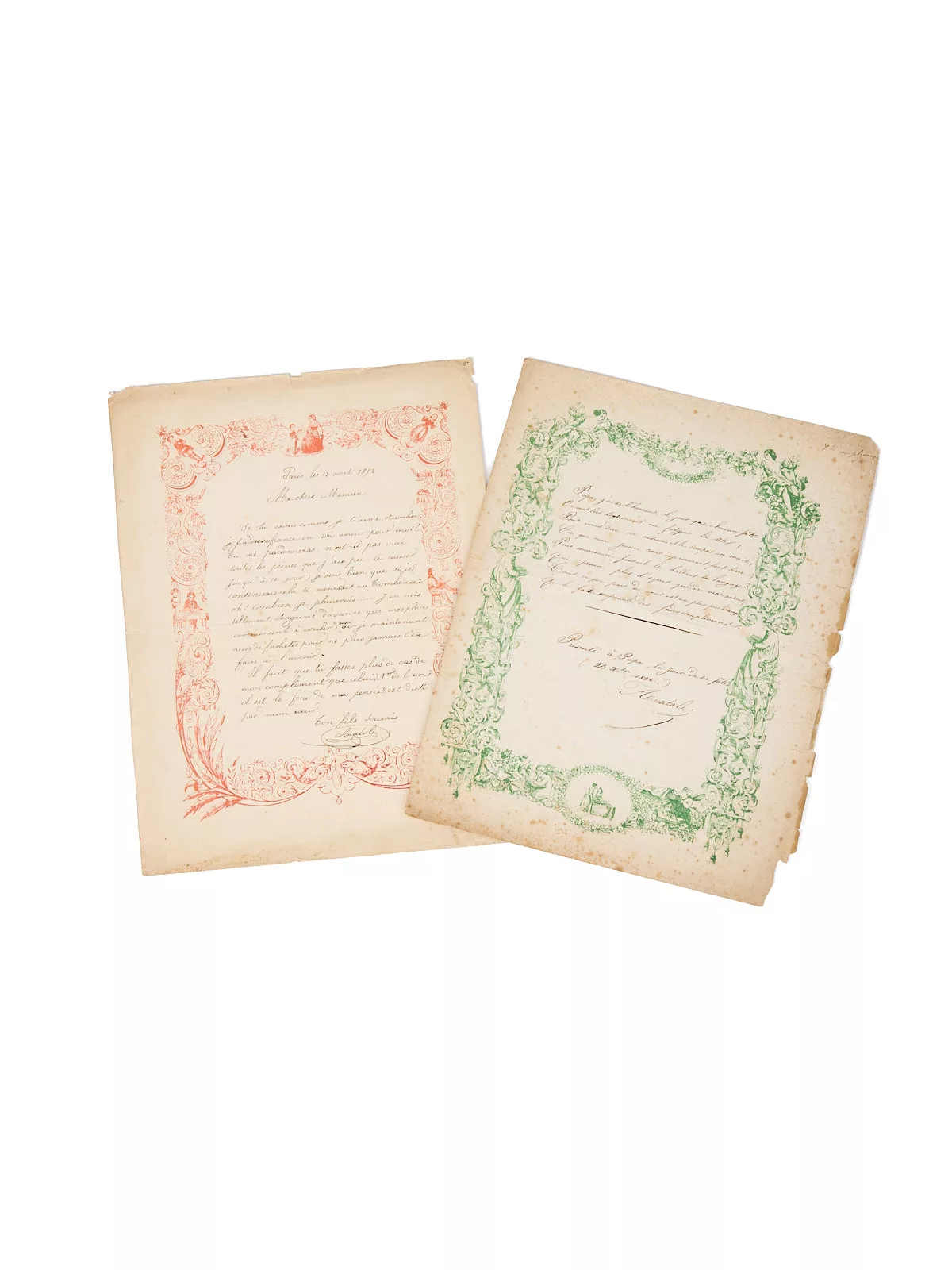
Compliments à chacun de ses parents
Born on 25 December 1795 into a poor family — his father was a shoemaker near Angers — Noël-François Thibault, Anatole France’s father, had a remarkable trajectory: from an uneducated farm boy to a respected Parisian bookseller specializing in documents and books on the Revolution, by way of service as a soldier in the 4th Infantry Regiment of the Royal Guard, where he rose to corporal shortly before the Revolution of 1830.
“Father France had won his reputation through his professional erudition. Among the many men of letters who came to sit at his shop ‘on a straw chair’ and leafed through him ‘like a dictionary’…” were the Goncourt brothers (to whom the phrase is owed), Paul de Saint-Victor, and many others, but above all his patron and friend the Comte de La Bédoyère, whom he had known during his time in the Royal Guard, where the count had been one of his former officers. A collector, La Bédoyère is recorded at 57 rue Saint-Dominique in Paris in 1837, when Anatole France’s father — probably with the count’s help — became a clerk for the bookseller-publisher Jacques Techener: “This peasant, this formerly illiterate soldier, proved an excellent employee in a most delicate trade, and Techener valued him so highly that in 1838 he placed him at the head of a branch of his firm he had just set up at no. 4 of the former place de l’Oratoire-du-Louvre [since destroyed by the opening of the rue de Rivoli], which dealt mainly in books on the Revolution.” Noël-François Thibault, who would soon become known as “père France,” took over the shop himself the following year (January 1839), again probably with the financial help of the bibliophile La Bédoyère, who also had a collection on the revolutionary period.
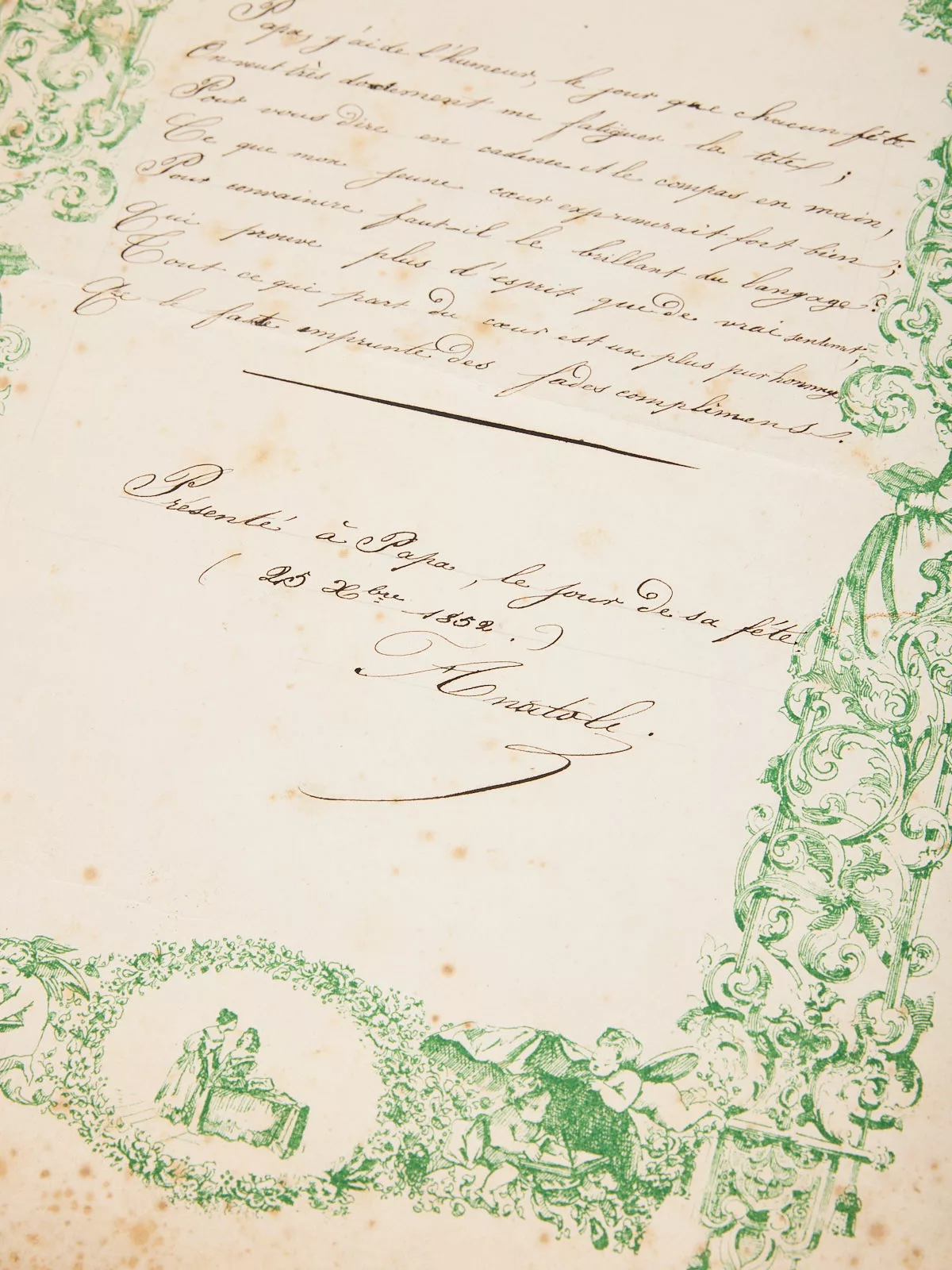
When the young Anatole, then eight years old, addressed this compliment to him, the bookseller France had already been established and recognized for more than ten years among the antiquarian booksellers. He had since set up his shop at 19 quai Malaquais, where his son was born. After some time at no. 15 of the same address, the France bookshop moved again — a year after the little “compliment” offered here by Anatole — settling permanently at 19 quai Voltaire. It was at this address that France spent his childhood and youth; the shop was later bought by the famous Honoré Champion before Édouard moved it to its present location.
The eight lines carefully copied out by Anatole for his father on 25 December 1852, for his father’s feast day, are probably less personal and less original than those he had sent his mother a few months earlier, on 12 August of the same year. To her he wrote tender words, specifying that she should “think more of [his] compliment than of that of New Year’s Day,” which one may suppose was equally conventional, like the one addressed to his father. He adds: “it is my true thought and is dictated by my heart.” We know, moreover, both from France himself and from those who knew him intimately, that he felt equal affection for both his parents. Age, no doubt, accounts for the difference here and shows a certain closeness with one rather than the other.
Once he became a young man, Anatole worked with his father, having acquired by osmosis certain reflexes of the bookseller and publisher’s trade. The last task in which he had a hand was the substantial catalogue that the bookseller France published on the dispersal of the Comte de La Bédoyère’s revolutionary collection, a task entrusted to him by testamentary disposition.
Anatole France’s childhood and youth beside this bookseller father, the last of the “chair booksellers” (another Goncourt phrase), also brought him some solid friendships, foremost among them the precious friendship of Étienne Charavay, whose father, Jacques Charavay — his godfather — had become a friend of the France bookshop through years of business dealings. Their careers took different paths: France became the writer we know, elected to the Académie, while the archivist-paleographer Charavay, forced by his father’s early death to take over a business and support his family, nonetheless remained very close to him. Anatole owed to his friend Étienne his first critical writings, published in L’Amateur d’autographes, the review Étienne had taken over on his father’s death.
As an anecdote: the name France, which some long believed to be a pen name, was, in the author’s own words, “a nickname older than myself… my father’s name was François Noël Thibault. He was known in his native region by the diminutive of his first name, France. It was the name he kept throughout the eighty-five years of his laborious, modest and honorable life. Custom, stronger than law, imposed on me in turn this name of France, which I bear as he bore it.” (letter to a journalist, 17 August 1895).
A moving pair of two “compliments” written by Anatole France, then aged eight, to his parents.