

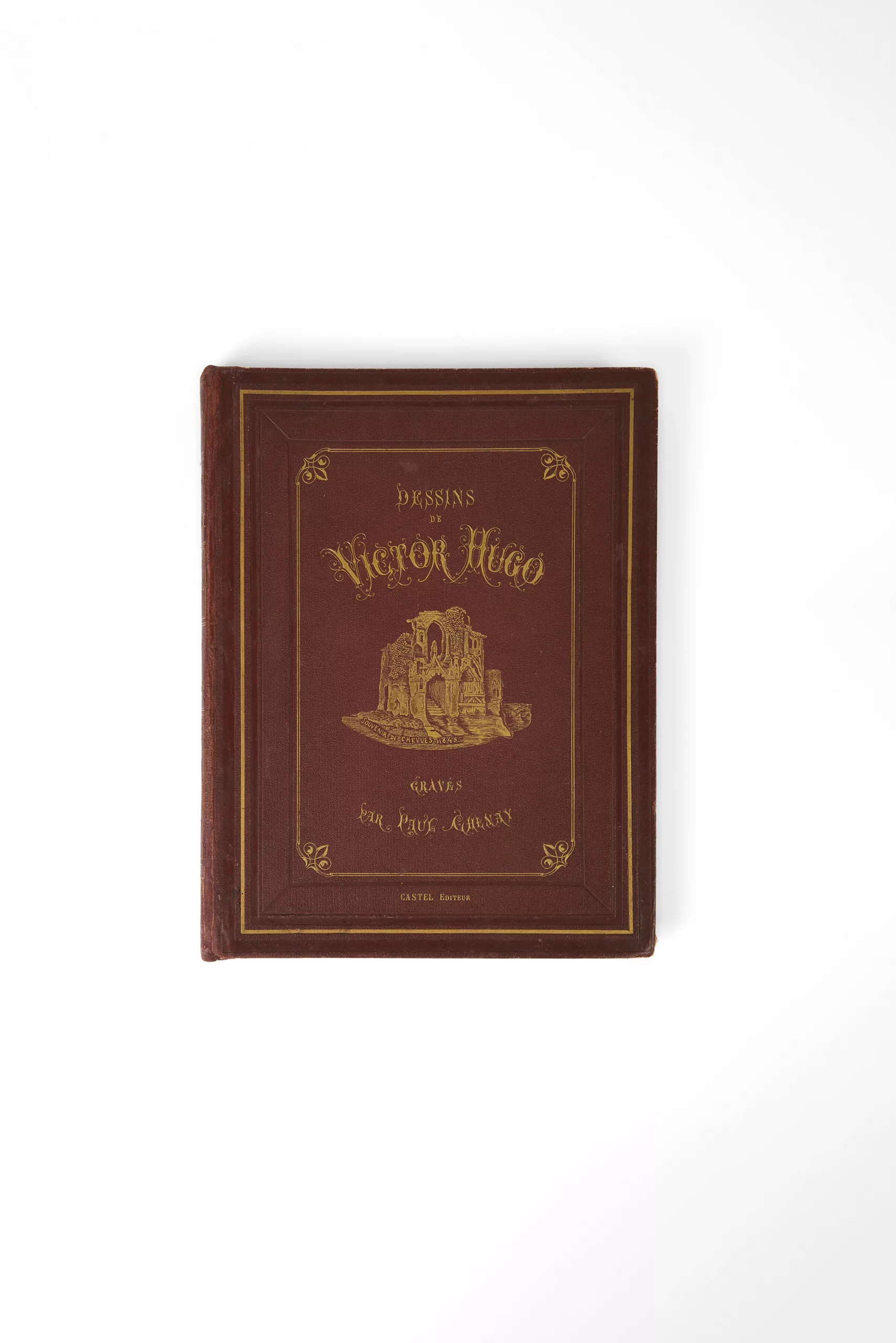
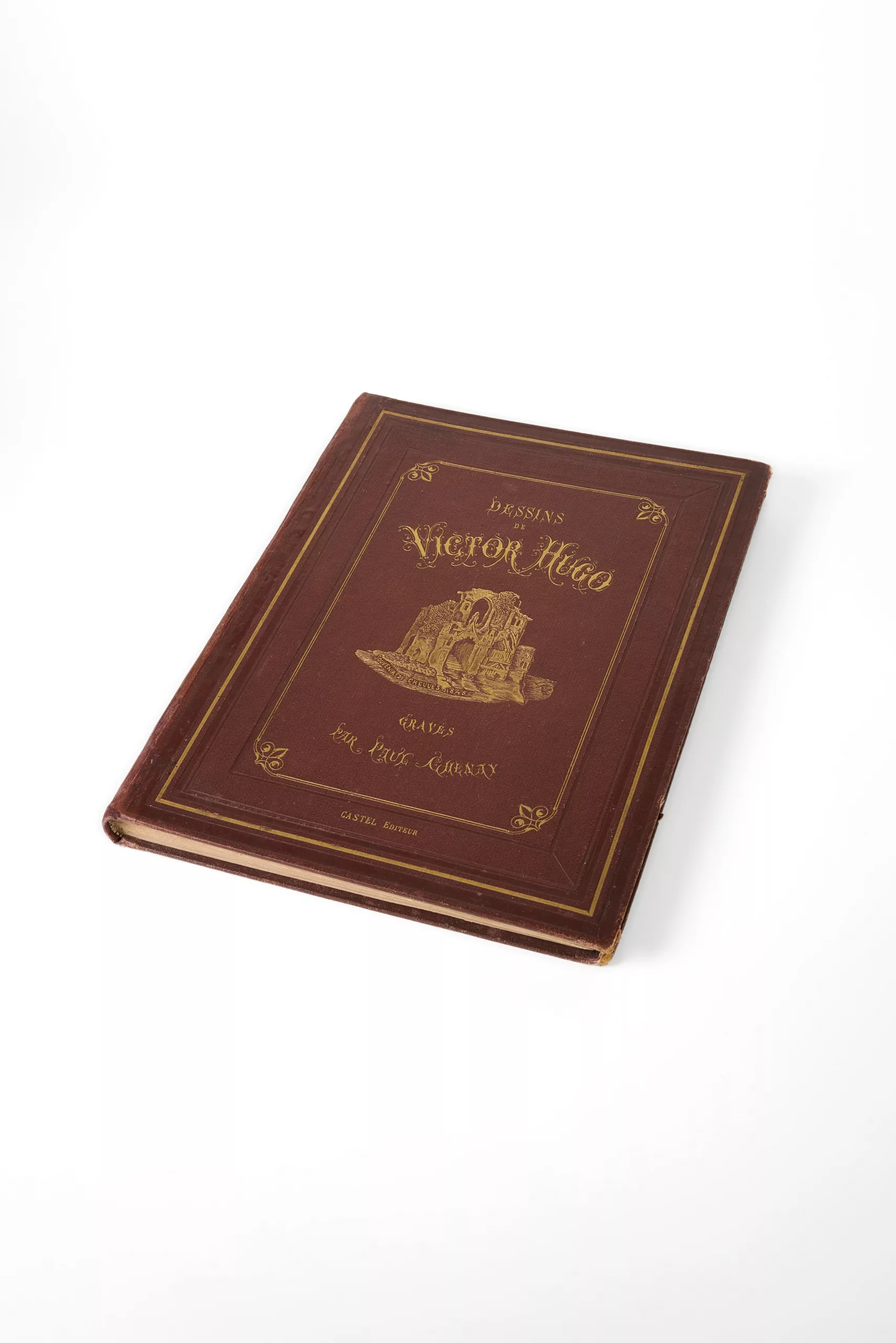
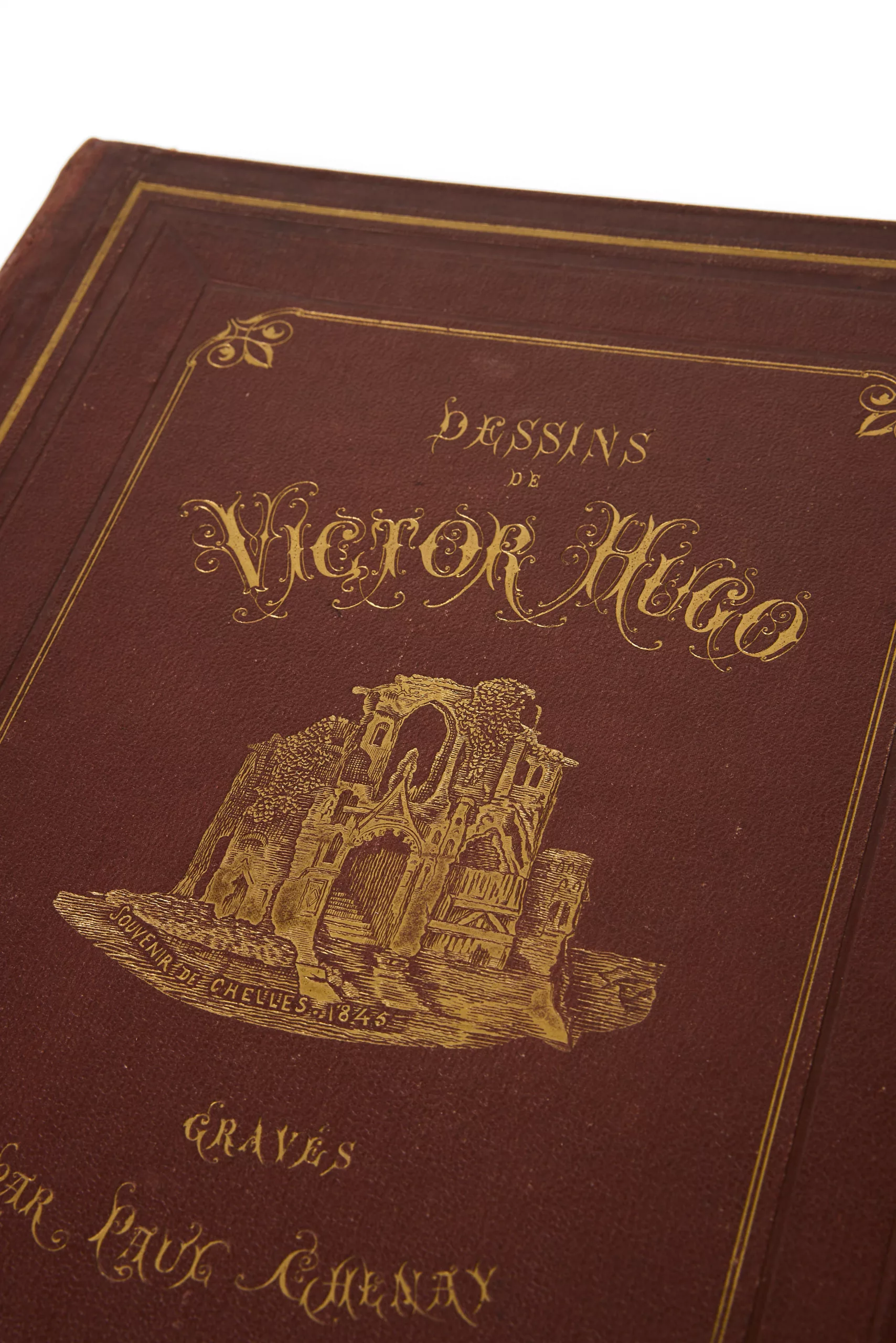
Dessins de Victor Hugo, gravés par Paul Chenay
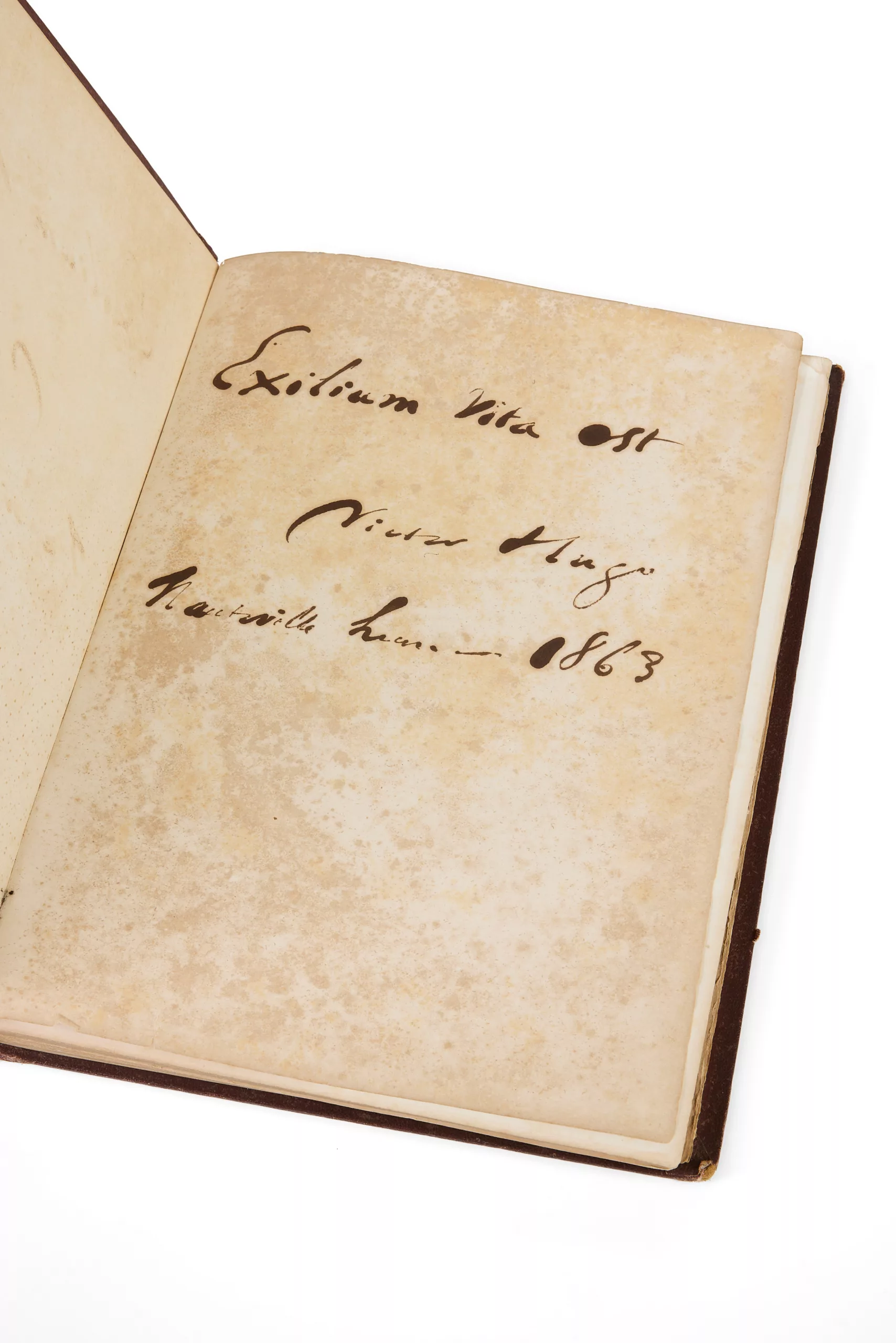
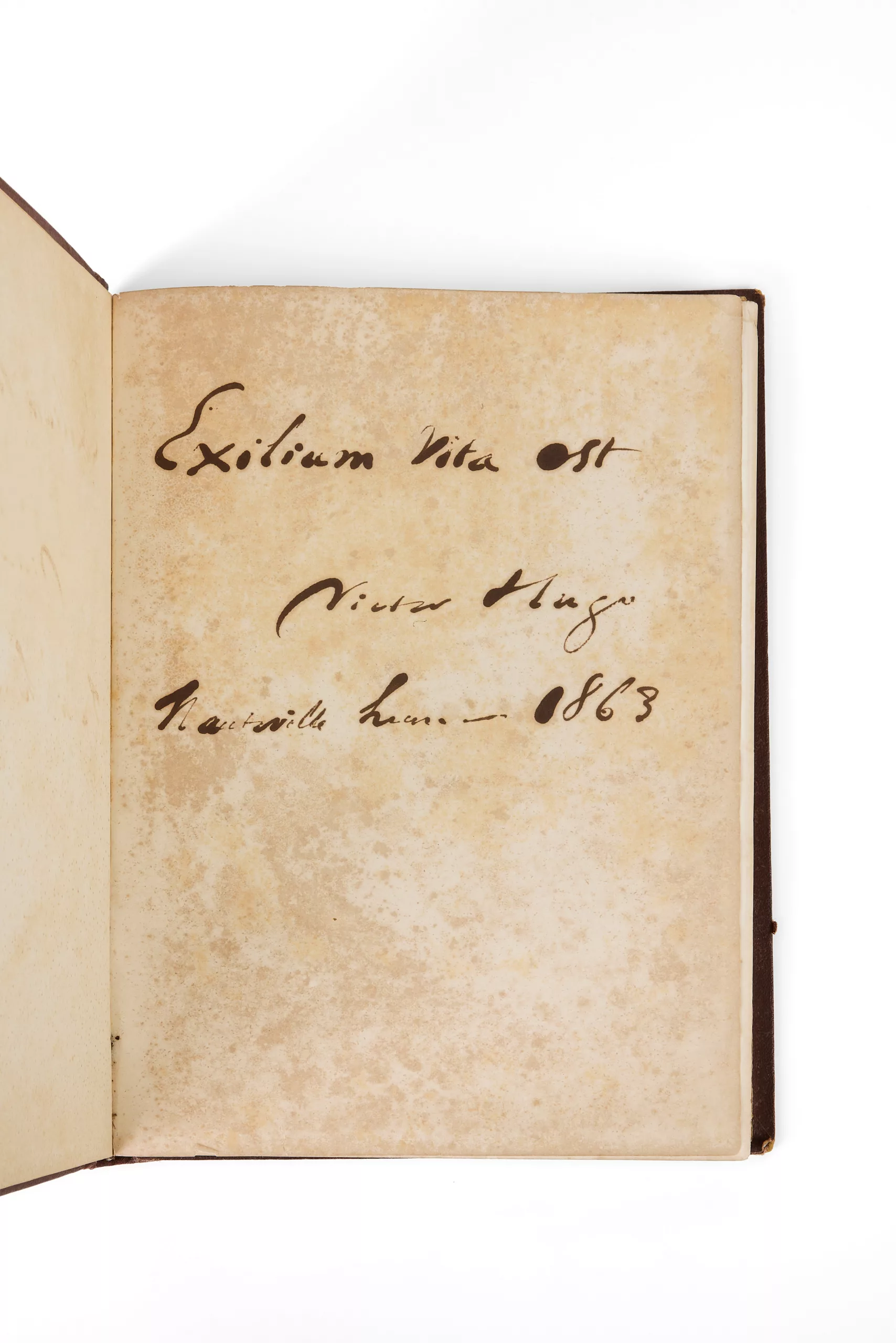
Autograph presentation at the head: “EXILIUM VITA EST / VICTOR HUGO / HAUTEVILLE HOUSE 1863.”
This is one of the rare copies handled by the poet himself and distributed on Guernsey. The Latin inscription transcribed here is the one that adorned the dining-room door at Hauteville House: “life is an exile.”
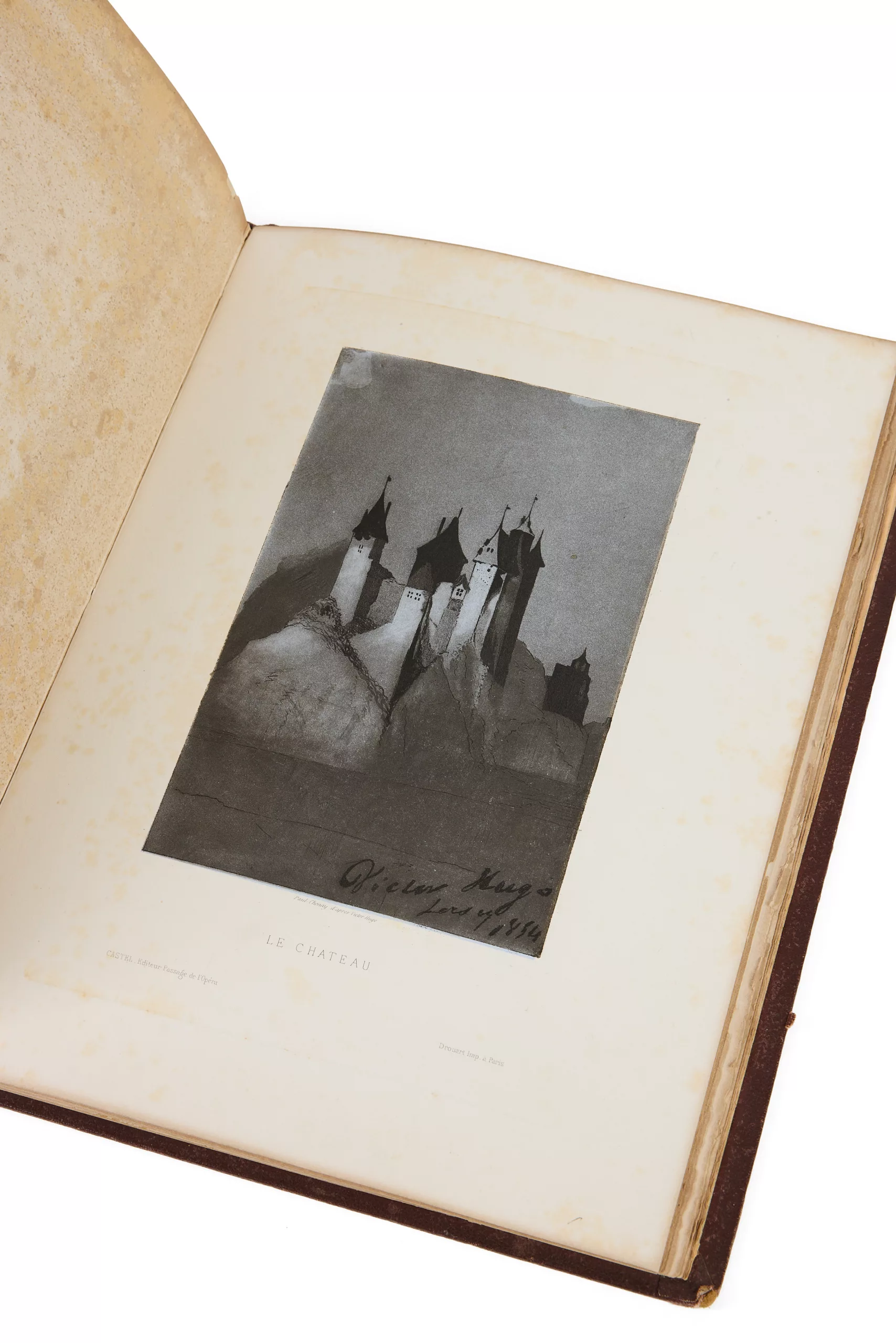
This is the first publication devoted exclusively to Victor Hugo’s drawings: it includes 12 plates of aquatints by Paul Chenay and 10 wood-engraved vignettes by Gérard, reproduced within Théophile Gautier’s text.
Hugo dedicated the book “to the rock of hospitality and freedom, to this corner of old Norman land where the noble little people of the sea live, to the island of Guernsey, stern and gentle, my present refuge, my probable tomb,” having agreed with the publisher Castel to reproduce “his sorts of drawing attempts” on the sole condition that the proceeds go to his fund for poor children’s dinners on Guernsey, “which I would like to increase and above all to spread.”
The typesetting was long and complicated — the project dated from the previous year — but the work, both a book and an album, finally appeared at the end of the year, a few months after Les Misérables: the serial in the Journal de Guernesey announced its release, in advance, at the publisher-printer Castel’s from 10 to 13 December.
Paul Chenay presented three copies of the work to the exiled poet, and this may well be one of the three. One of them is found in the Louis Barthou collection, while ours, after the Latin inscription written at the head by Victor Hugo, was subsequently given to Hennet de Kesler, who in turn presented it, with a manuscript “Hommage” signed at the end, to the Reverend Edmond Curey, minister of the Anglican Church of Guernsey. Mounted opposite is the original review of the work, as it appeared in the Guernsey gazette.
Hennet de Kesler was arrested in Paris in June 1849 for his part in the Affaire du 13, the Conservatoire des Arts et Métiers affair. As director of the newspaper La Révolution in December 1851, he wrote, signed and posted a call to resistance and held the barricade at Petit-Carreau. Kesler had shaken Hugo’s hand for the first time on the morning of 3 December, before being arrested the following day: the “commission de révision de Paris” ordered his immediate expulsion, justified thus: “Fervent socialist. Affiliated with secret societies. Incitement to revolt. Said after his arrest that he was glad of what had happened to him.” He took refuge in London, then settled in Jersey in May 1854 and became close to the Hugo family. He contributed to the journal L’Homme, edited by Ribeyrolles, and was among the thirty-six exiles who signed, on 17 October 1855, the protest — drafted by Victor Hugo — against the expulsion of Colonel Louis Pianciani, Philippe Thomas and Ribeyrolles. This signature earned him, like the others, expulsion from the island. He then followed the Hugo family to Guernsey, and the writer housed him at Hauteville House from 14 December 1866. The bond formed on the barricades continued in exile until Hennet de Kesler’s death on 6 April 1870.
On 7 April, Victor Hugo spoke these words at Kesler’s grave: “The day after the ambush of 1851, 3 December, at dawn, a barricade rose in the Faubourg Saint-Antoine, a memorable barricade where a representative of the people fell. The soldiers believed they had brought it down; the coup d’État believed it had destroyed it; the coup d’État and its soldiers were wrong. Demolished in Paris, it was rebuilt by exile. The Baudin barricade reappeared at once, no longer in France, but outside France; it reappeared, built no longer of paving stones, but of principles (…). It is as high as truth, as solid as honor, as riddled with grapeshot as reason; and men continue to die there. After Baudin — for yes, it is the same barricade! — Pauline Roland died there, Ribeyrolles died there, Charras died there, Xavier Durieu died there, Kesler has just died there. (…) Farewell, my old companion. You are going to join the luminous spirits who have enlightened and who have lived, where the thinkers, the martyrs, the apostles, the prophets, the forerunners, the liberators are (…) and you will tell them all that all is well, and that in France an intrepid legion fights more fiercely than ever, and that, outside France, we, the voluntary sacrifices, we, the handful of surviving exiles, are still holding firm, and that we are here, resolved never to surrender, standing on that great breach called exile, with our convictions and with their ghosts!” (Actes et paroles)
The Paul Chenay copy, preserved at the Maison Victor Hugo (2015.0.31), is enriched with four original drawings and several dozen manuscript documents related to the publication, while the Barthou copy contains the manuscript of Gautier’s preface. The copy held at the Bibliothèque nationale contains the long letter to the publisher Jean-Pierre Stanislas Castel. Several other exchanges with him are known, Hugo reproaching the publisher for his lack of commercial sense: he wrote to him, for instance, on 29 December, that he saw “in the newspapers that the Album appeared only the day before yesterday, eight days after the publication of my letter. If you expected any effect from that letter, it should have been placed in the newspapers only the day before the Album’s appearance. Eight days later, the effect you seemed to be counting on is entirely lost. This, combined with the deplorable delay in publication, will, I fear, greatly harm its immediate success. You will recall that I had recommended (uselessly, unfortunately), for the New Year and holiday sales, that the Album appear before 1 November (…). I hope that all this inexperience which has attended your publication will not work to your disadvantage. Success may still come later, I hope, but the present effect is no less compromised. Please see in my remarks, I beg you, a proof of the keen interest I take in your success, and believe me most cordially yours… Attend to the necessary shipments. Ask Mr. Chenay to give you a letter from me in which I provide him with addresses and useful and important instructions. I will place all the shipments in your capable hands on Tuesday…”
A precious copy of remarkable provenance.
To our knowledge, the only copy bearing an autograph note by Victor Hugo written from his place of exile.
Scattered foxing; some restoration to the boards.
Maurice Clouard, Notes sur les dessins de Victor Hugo accompagnées de lettres inédites, in Revue d’Histoire littéraire de la France, 5th Year, no. 3 (1898), pp. 341–364.