

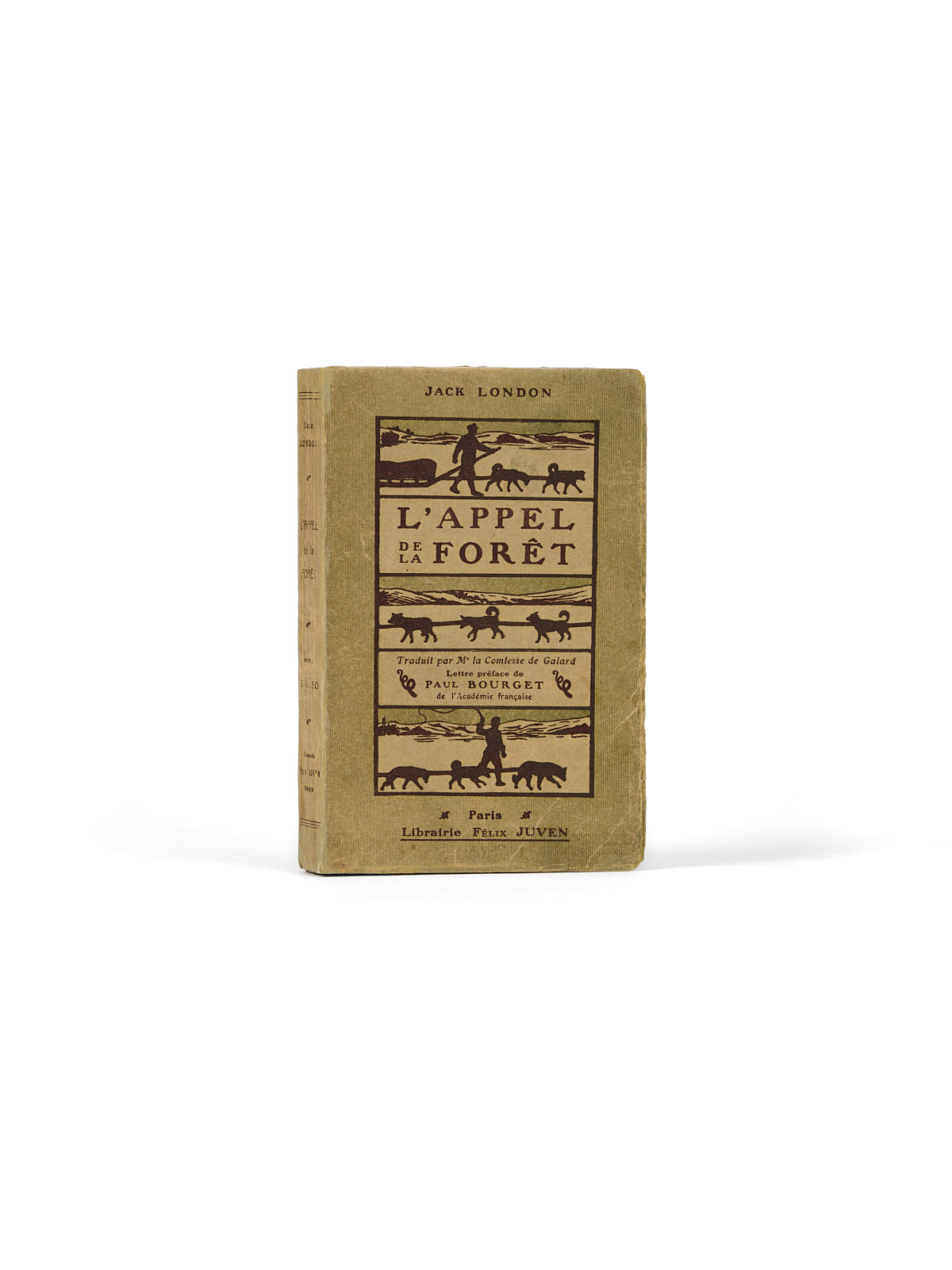
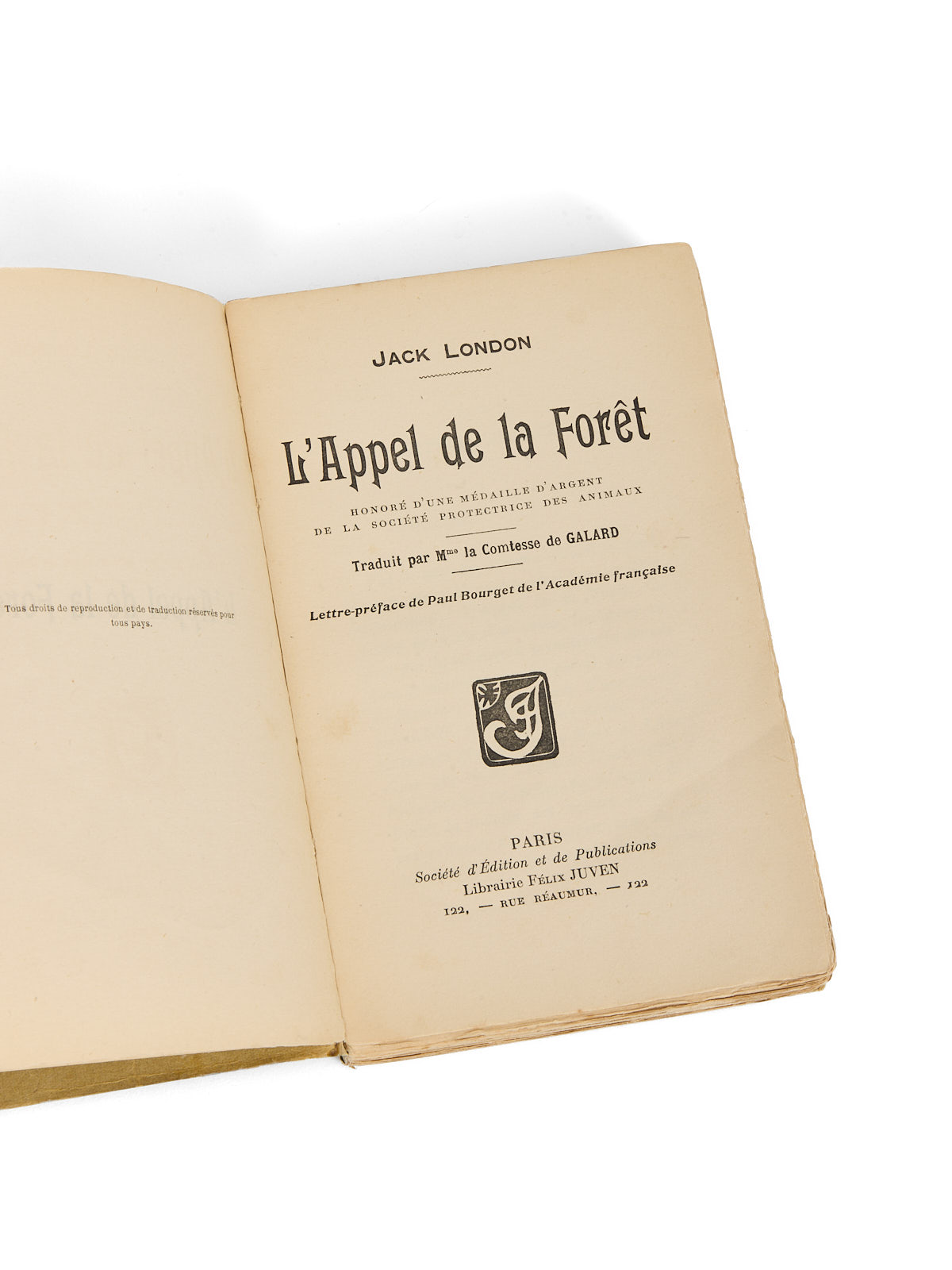
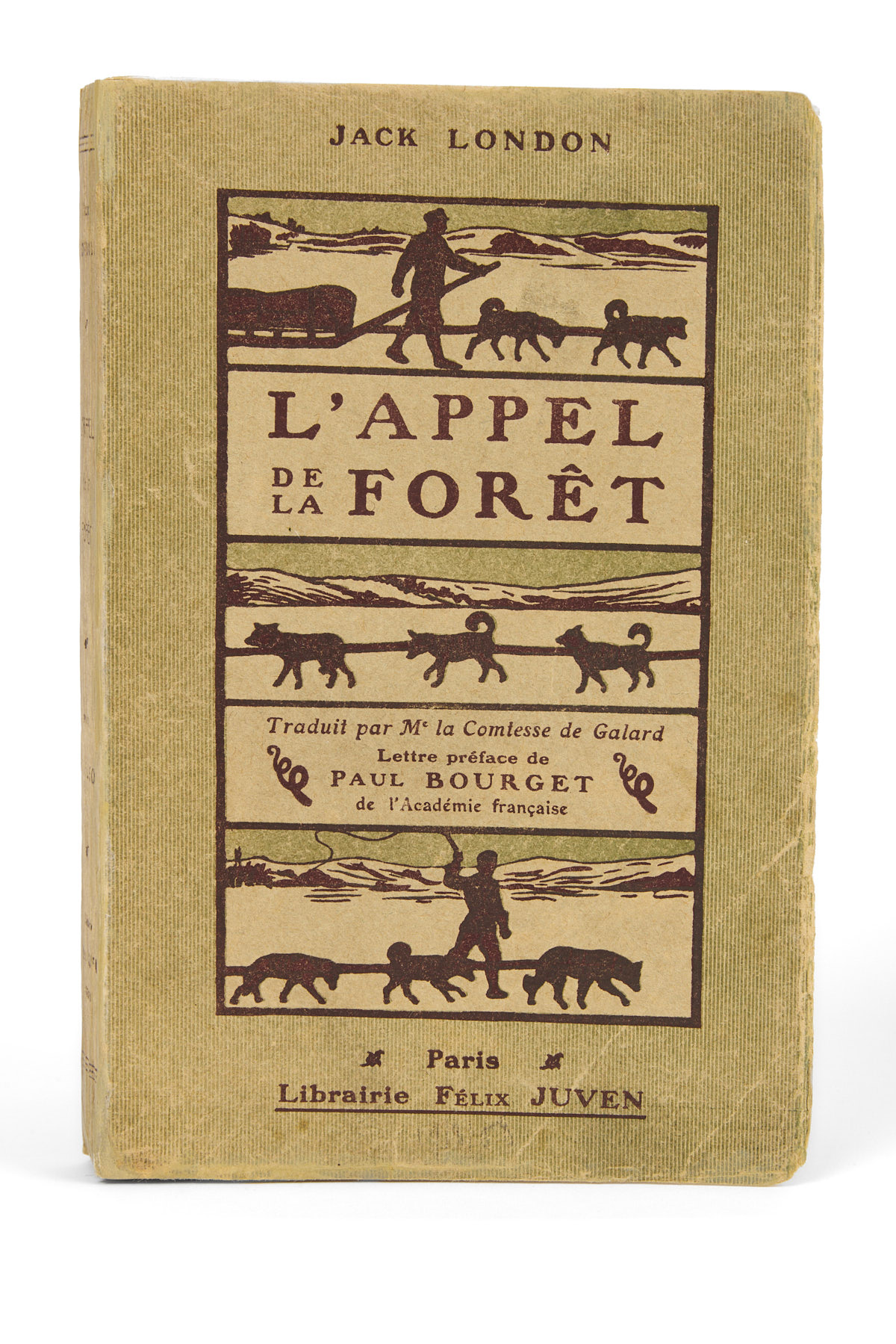
L’Appel de la forêt
Preface letter by Paul Bourget.
In 1896, rich gold deposits were discovered in the Yukon, a territory of the Canadian far north, sparking the Klondike gold rush, named after the river that runs through the region. The frenzy was significant enough to inspire and provide the setting for works by Jules Verne (Le Volcan d’or), Charlie Chaplin (his famous The Gold Rush), and Jack London, with this novel, The Call of the Wild, which tells the story of Buck, a dog torn from a comfortable and peaceful life in California and thrust into the harshness and cruelty of daily life as a sled dog amid the gold rush.
London himself had taken part in this world as early as 1897: at twenty-one, having already led an eventful life (a factory worker at fourteen, a sailor at seventeen, a union activist at twenty), and nicknamed “The Prince of the Oyster Pirates” or “Sailor Jack,” he set off to seek his fortune in Alaska. Struck down by scurvy, he was repatriated to San Francisco the following year, bringing back only a meager pinch of gold dust from his journey. The true riches of this experience came through writing, when he began his first stories drawing on this brief adventure. He achieved initial recognition with The Son of the Wolf, but true success came with The Call of the Wild in 1903.
A tale of initiation and a quest for freedom, The Call of the Wild is above all the story of a return to origins, inspired by the theory of evolution that marked the end of the nineteenth century: a novel of “unlearning,” a rediscovery of the wild instinct that the domesticated dog Buck gradually recovers.
Jack London was then entirely unknown in France, but the work caught the attention of the publisher Félix Juven, who had recently specialized in adventure literature for young readers: London, nicknamed the “Kipling of the cold,” could be admired as much for his exploits and travels as for his books. The translation was entrusted to Raymonde de Galard: a member of the highly aristocratic Société des bibliophiles français since 1903, she translated five of London’s titles between 1905 and 1906; Paul Bourget, of the Académie française, wrote the preface, which could only help the successful introduction of a still-unknown writer. Raymonde de Galard appears there as “Madame la Comtesse de Galard,” the mention of her noble title no doubt lending credibility to her work at the time. Furthermore, on the same title page, the following phrase appears, intended to single out the work itself: “honored with a silver medal from the society for the protection of animals,” a mention that likely contributed to a persistent misunderstanding about the book’s content.
The work first appeared in installments, in the newspaper Le Temps (December 3 to 16, 1905), then in Le Journal des voyages (July 1 to September 9, 1906, with illustrations by Joseph Beuzon). The cover of the Juven edition that followed largely reproduces that of the original 1903 American edition.
A remarkable copy of London’s first title translated and published in French.
White Fang, also published in English in 1906, would not be translated until fifteen years later, in 1923.