

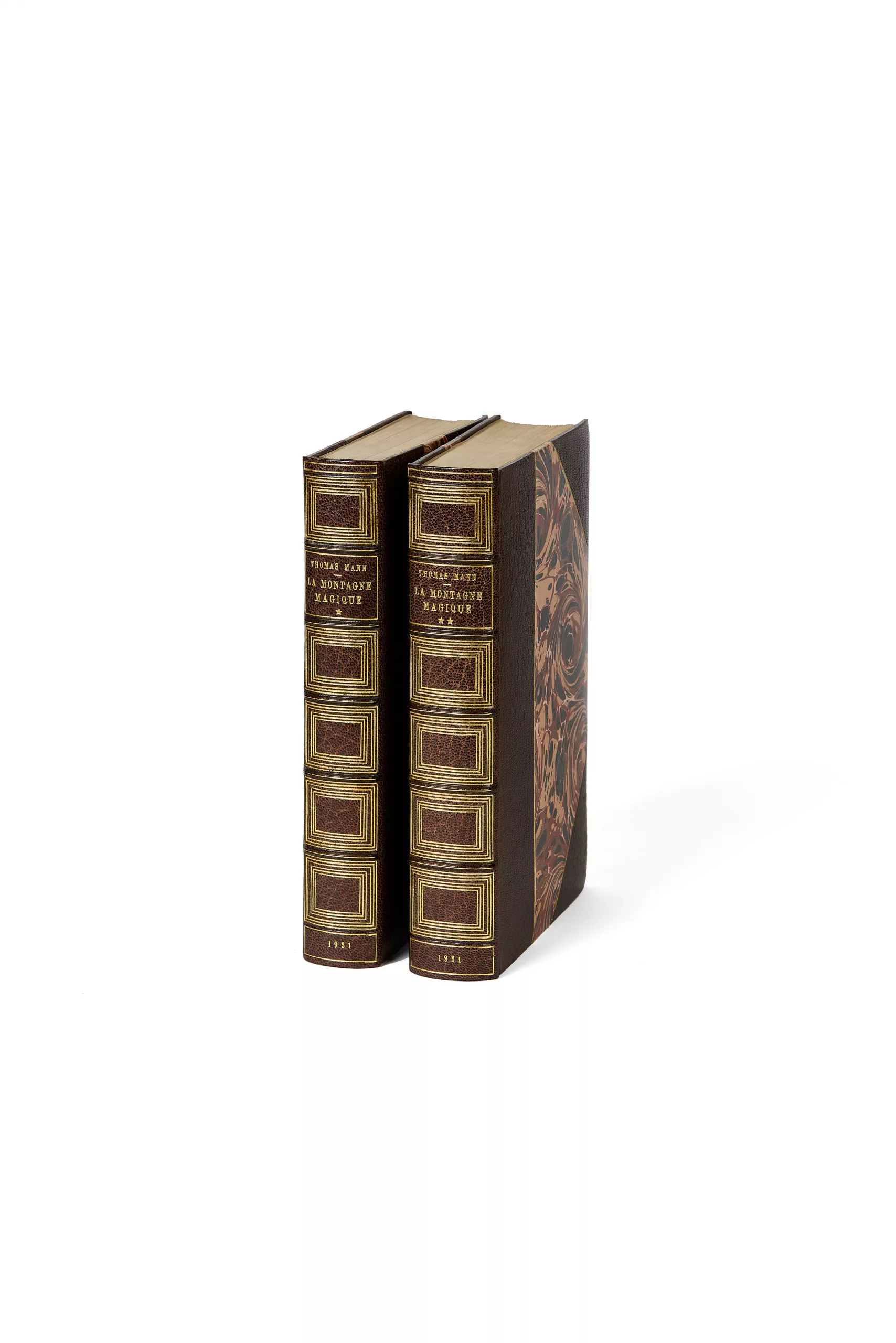
La Montagne magique
One of 125 copies on vélin pur fil (no. 26).
A magnificent copy, superbly bound by Duhayon.
The story of Hans Castorp, whose three-week visit to his tuberculous cousin at a sanatorium in the Swiss Alps turns into a seven-year stay — before he is violently thrust into the Great War.
The novel, begun in 1912, was published twelve years later. Mann’s original intention had been to write “a satirical counterpart to Death in Venice, whose theme would be the seduction of death and illness.” But in the meantime the Great War had taken place, and Thomas Mann incorporated “all the problems that the war had made more acute and more topical.” This powerful analysis of the spiritual condition of the West is perhaps Thomas Mann’s masterpiece, published in February 1924 by his usual publisher, S. Fischer.
More than 100,000 copies were sold in the first four years, with 27 translations by 1933. The French version was published by Fayard in 1931, translated by Maurice Betz — a friend of Rilke and his translator (as well as translator of Zweig and Nietzsche) — after Mann had received the Nobel Prize in Literature in 1929. A Maurice Betz Prize, established at the initiative of his widow, awarded by the Académie d’Alsace and revived in 2017, has honored a literary translation since 1958. The 2017 laureate was particularly symbolic, honoring Claire de Oliveira for her new translation, again published by Fayard… of La Montagne magique!
A very rare printing, seldom encountered: only seven other occurrences are known to us: the François Mitterrand sale (copy 48), one copy handled by our colleagues at Le Feu Follet (copy 49, in 2018), three other copies at public sales (copies 1, 31 and 34) and two copies in private collections.
A magnificent copy, superbly bound by Duhayon.