

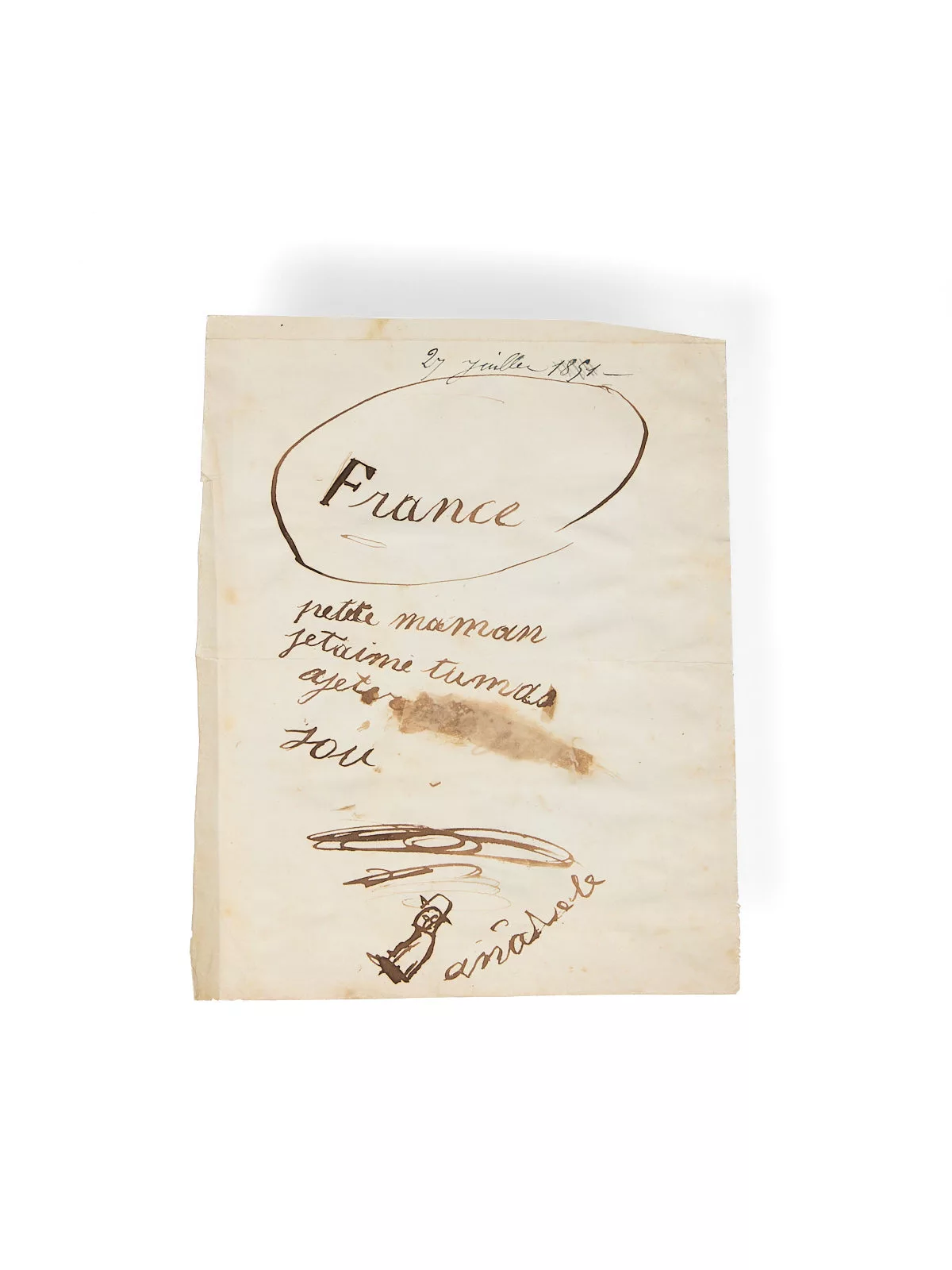
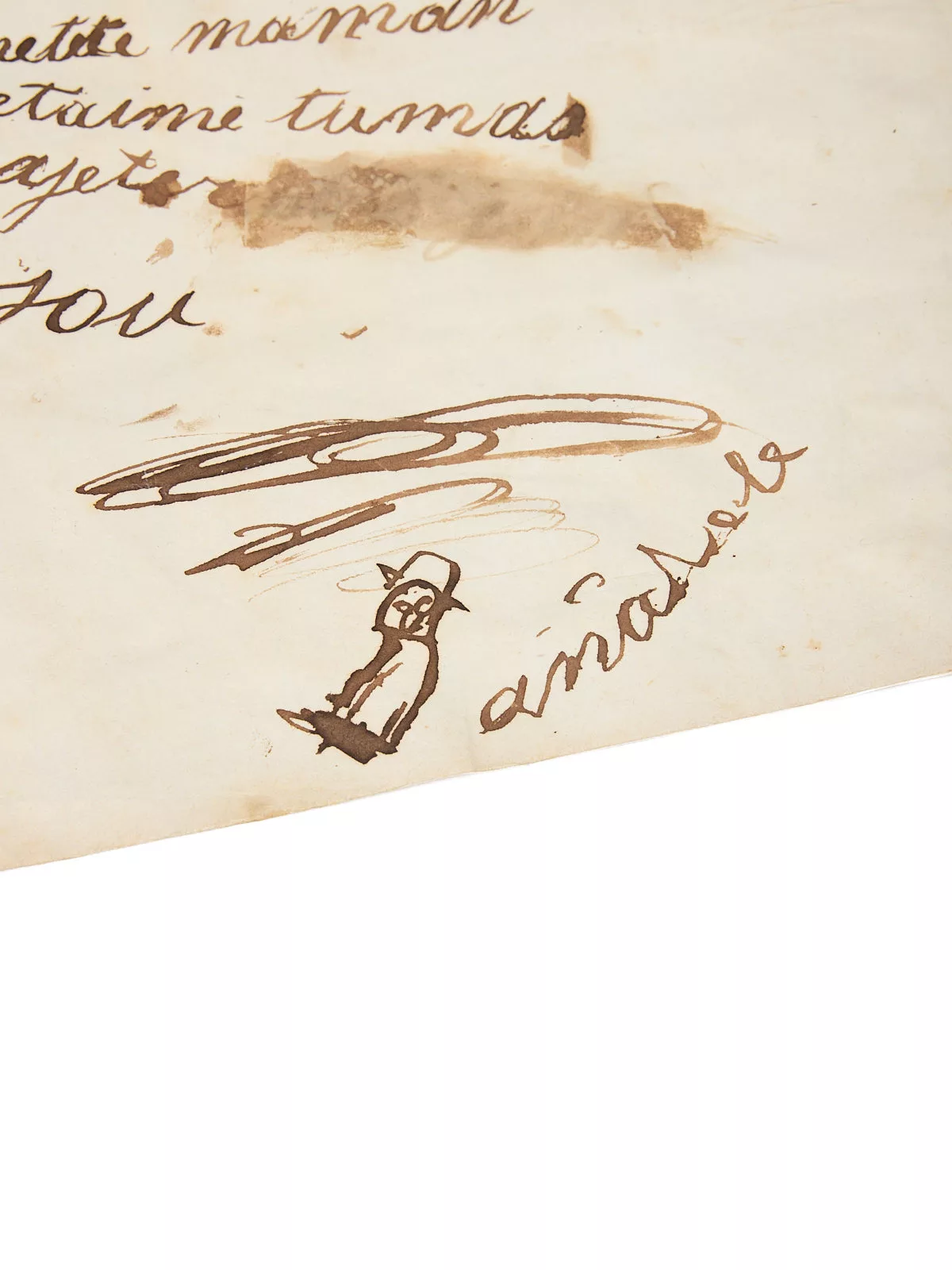
Billet autographe à sa mère
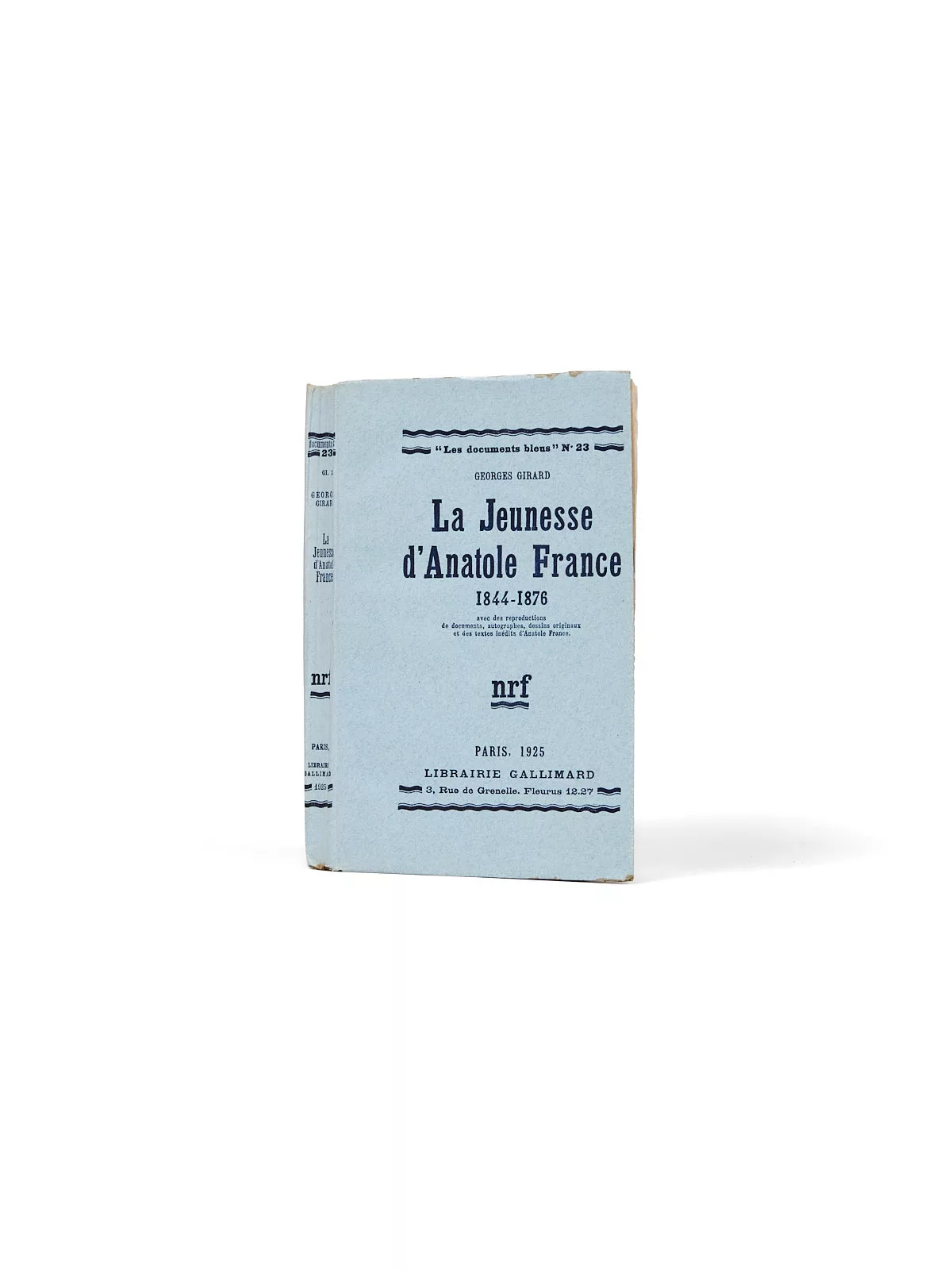
Accompanied by: Georges Girard's study, La Jeunesse d’Anatole France (Paris, Gallimard, 1925), in which this note is reproduced.
A small number of surviving childhood manuscripts, carefully preserved, attest to Anatole France’s affection for his parents, and to his particular bond of tenderness with his mother. This manuscript — a draft, in appearance — belongs to those spontaneous, urgent words that a child’s heart suddenly cannot hold back, and which parents, knowing their worth, keep as a treasure. Madame France evidently did just that: she noted on the slip the date “27 July 1851,” as if to better remember, later, this fleeting and fragile outburst of love. She did the same with another of these childhood productions that has come down to us, in which her small son wrote her a longer note — he was a year older — on “Sunday, 5 September 1852,” which likewise expressed his love and his joy at having such a mother: “tu seras toujours la plus heureuse mère et moi le plus heureux enfant.” Nothing about this would change over the course of France’s long life; it is said that he spoke his mother’s name even in his final agony.
In La Jeunesse d’Anatole France, where this note is reproduced (pp. 35–36), the young Anatole’s attachment to his parents appears otherwise evenly shared, and France had equal affection for his father. Yet a particular closeness must have bound him to the recipient of this note, in whom he had such confidence and whom he never feared: notably, when he entered the Collège Stanislas — whose register, kept by his teacher M. Allain, covers the first term of the 1856–1857 school year (France was then twelve) — he never had his bad marks or punishment exercises signed by his father, only by his mother. The shrewd young boy no doubt also judged that his father would be immune to the wit concealed in remarks such as “insouciance,” “légèreté,” “négligence,” or “devoir généralement fait avec un sans-gêne merveilleux.” Years later, this same M. Allain did not hesitate to send a letter of congratulations to his former pupil upon his election to the Académie française…
Born in 1811 in Chartres to an unknown father, Amable-Antoinette Gallas, the future Antoinette France, was raised by a “picturesque” figure, a certain Dufour, of whom France retained a vivid memory that would serve several of his novels: he became Captain Victor in Le Crime de Sylvestre Bonnard, Mathias in Pierre Nozière, and uncle Hyacinthe in Le Petit Pierre. Antoinette France had a joyless and precarious childhood, marked by the family’s lack of money and repeated moves. It is said that she found happiness only on the day of her marriage to Noël-François Thibault, known as France, a bookseller by trade when he married her in 1840. Settled first at no. 16, rue de Seine, the couple soon moved to no. 19, Quai Malaquais, where Anatole France was born on 16 April 1844, on the first floor above his father’s bookshop. One must picture the pampered child, at home or in the shop, with easy access to paper and ink — his godfather was none other than the prince of autographs, Jacques Charavay — as he scribbled this note to his mother. Of her, he would later say that she had “un esprit charmant, l’âme belle et généreuse et le caractère difficile.” He would recall the complicity the two of them shared when he “stole” from his father’s bookshop as bundles of books were unpacked, a task often entrusted to him: “si son père n’y veillait, il mettrait la boutique au pillage, écrémant avec la complicité de sa mère les nouvelles acquisitions, faisant disparaître les plus belles pièces d’un lot, quitte à les restituer à regret.” (G. Girard, La Jeunesse d’Anatole France, p. 104).
It was also for his mother, in the very year he wrote this note, that he began keeping a notebook of reflections for his own use: the little boy already showed something of the future man of books and of the printed word, noting in this endearing preface: “Anatole a fait un livre qui est intitulé Pensées Chrétiennes. Il est trop jeune pour le faire imprimer, il est âgé de sept ans, il attend qu’il ait vingt ans.”