

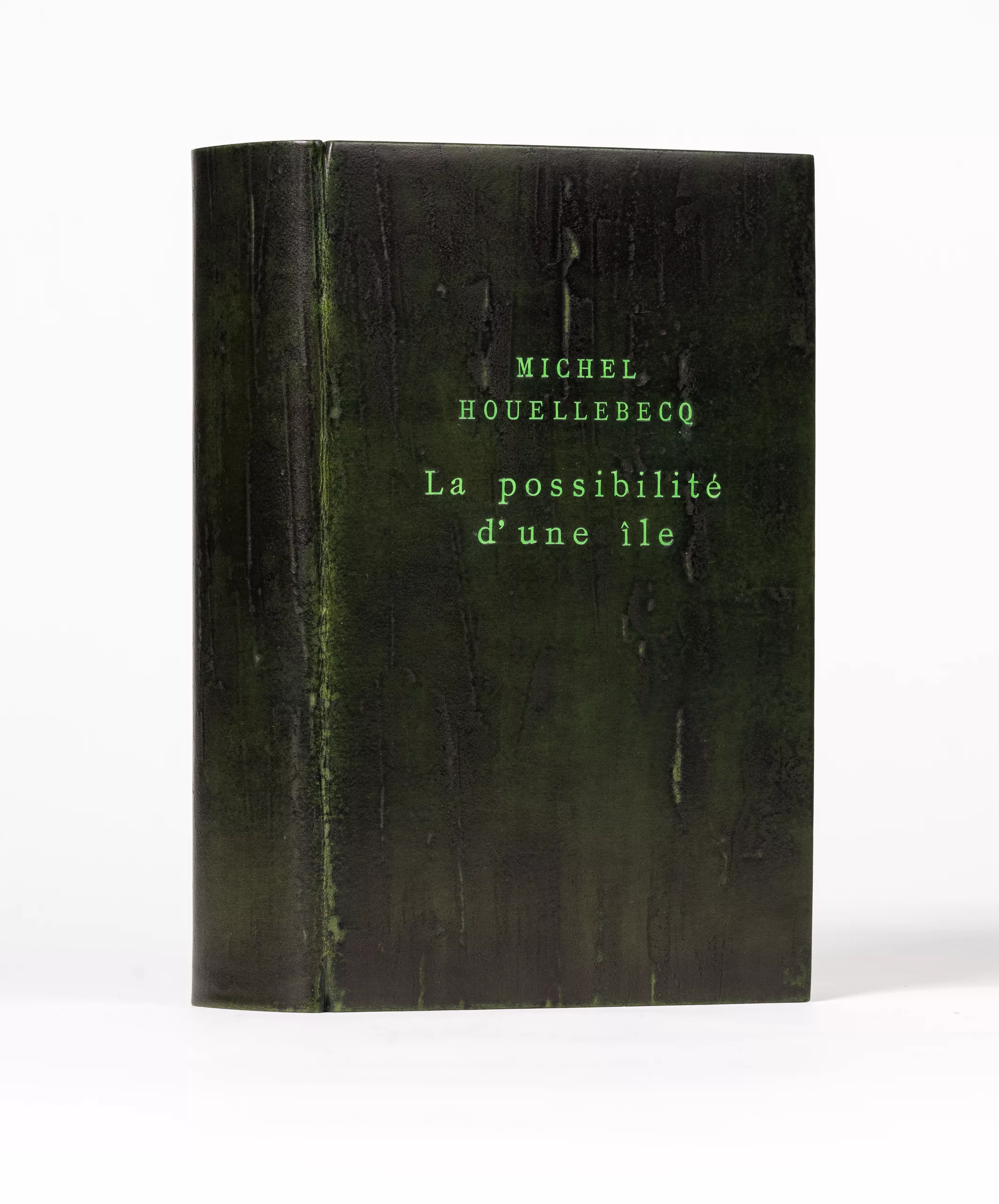
La Possibilité d’une île
One of 179 copies on Ingres d'Arches paper (no. XXXII), this copy hors commerce.
Signed presentation inscription: “pour Jean-Luc [Marchant], en espérant qu'il trouvera justifié l'effort de découper les pages une à une. Michel Houellebecq.”
A social and moral satire of the contemporary world as much as a philosophical-religious tale, La Possibilité d’une île explores cloning in a future where humanity has been decimated. Houellebecq and his two clones (or clowns), Daniel1 and Daniel2, offer a self-portrait of the artist as an old man, a hyperrealist scout convinced that everything science makes possible — including the least desirable outcomes for mankind — will eventually be realized.
Both a novel of anticipation and a warning, La Possibilité d’une île is also a bleak meditation on relations between generations in a world in decline, drowning in its own mediocrity: “the physical body of the young, the only desirable good the world had been able to produce, was reserved for the exclusive use of the young, and the lot of the old was to work and suffer. Such was the true meaning of solidarity between generations: it consisted of a pure and simple holocaust of each generation for the benefit of the one destined to replace it, a cruel, prolonged holocaust unaccompanied by any consolation, any comfort, any material or emotional compensation.” This grim assessment recalls Arthur Schopenhauer, frequently quoted in the novel, who used a similar metaphor: “Human existence resembles a theatrical performance that, begun by living actors, would be finished by automatons dressed in the same costumes.”
La Possibilité d’une île narrowly lost the Prix Goncourt (by four votes to six, to Weyergans’s Trois jours chez ma mère), and Houellebecq himself considers it his best book. It was praised, among others, by the late Philippe Muray, who saw Houellebecq as a true visionary of a world adrift, redeemed only by “this millenarian expectation of a new humanity freed from the misfortune of loving, the suffering of aging, and the tragedy of dying.”
Houellebecq immersed himself personally in the writing of this fourth novel, going so far as to mix with the Raëlian sect, drinking with Claude Vorilhon, alias Raël — guru and rogue, embodied here by a mad scientist specializing in genetics and molecular biology named Miskiewicz, leader of a sect worshipping the Elohim, extraterrestrials supposedly responsible for the creation of humanity. Houellebecq closely followed the elaborate speculations orchestrated from Geneva by this private enterprise, investigating the possibility of a continent from which his distant clones — Daniel25, Daniel26… — would one day emerge.
A delightful field of investigation for Houellebecq, who was even named “honorary priest” by Raël himself at the International Raëlian Congress in Sierre in October 2005, in recognition of “his integrity and exemplary honesty in having spoken only respectfully of us, despite journalistic pressure to say otherwise.” Dieudonné received the same honor in 2015, as did Michel Onfray, who learned of his own nomination in 2006 through the press and retorted that he had asked nothing of this “tribe of morons.” The club is a distinguished one: Houellebecq joins some 79 other non-Raëlians honored for their actions in favor of a “more just and beautiful Humanity,” a list that includes Madonna, Sinéad O’Connor, Bill Gates, Michael Moore, Hugh Hefner, Hugo Chávez, Eminem, Noam Chomsky, Julian Assange, Stephen Fry and Elon Musk. Such is fame.