

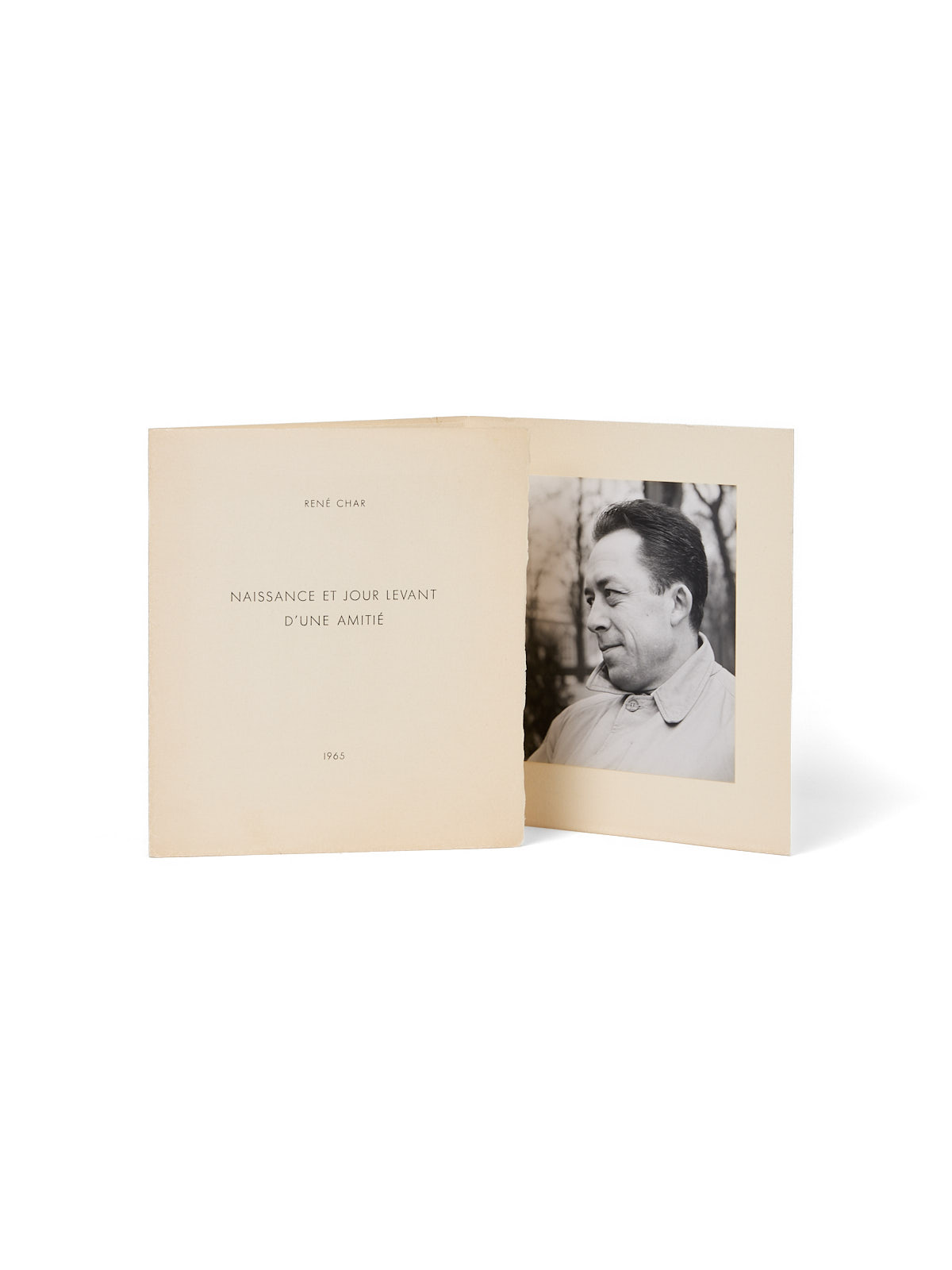
Naissance et jour levant d’une amitié
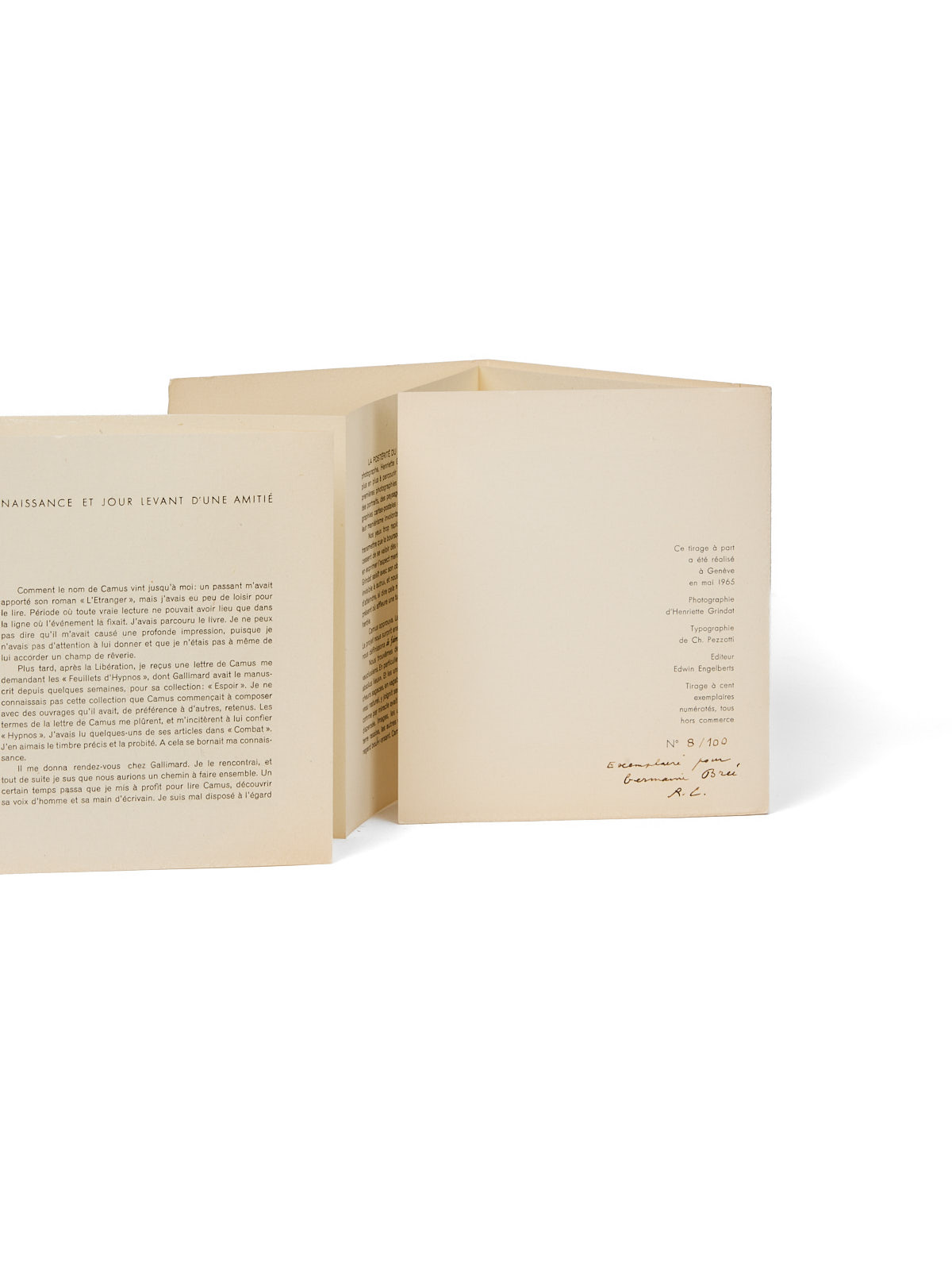
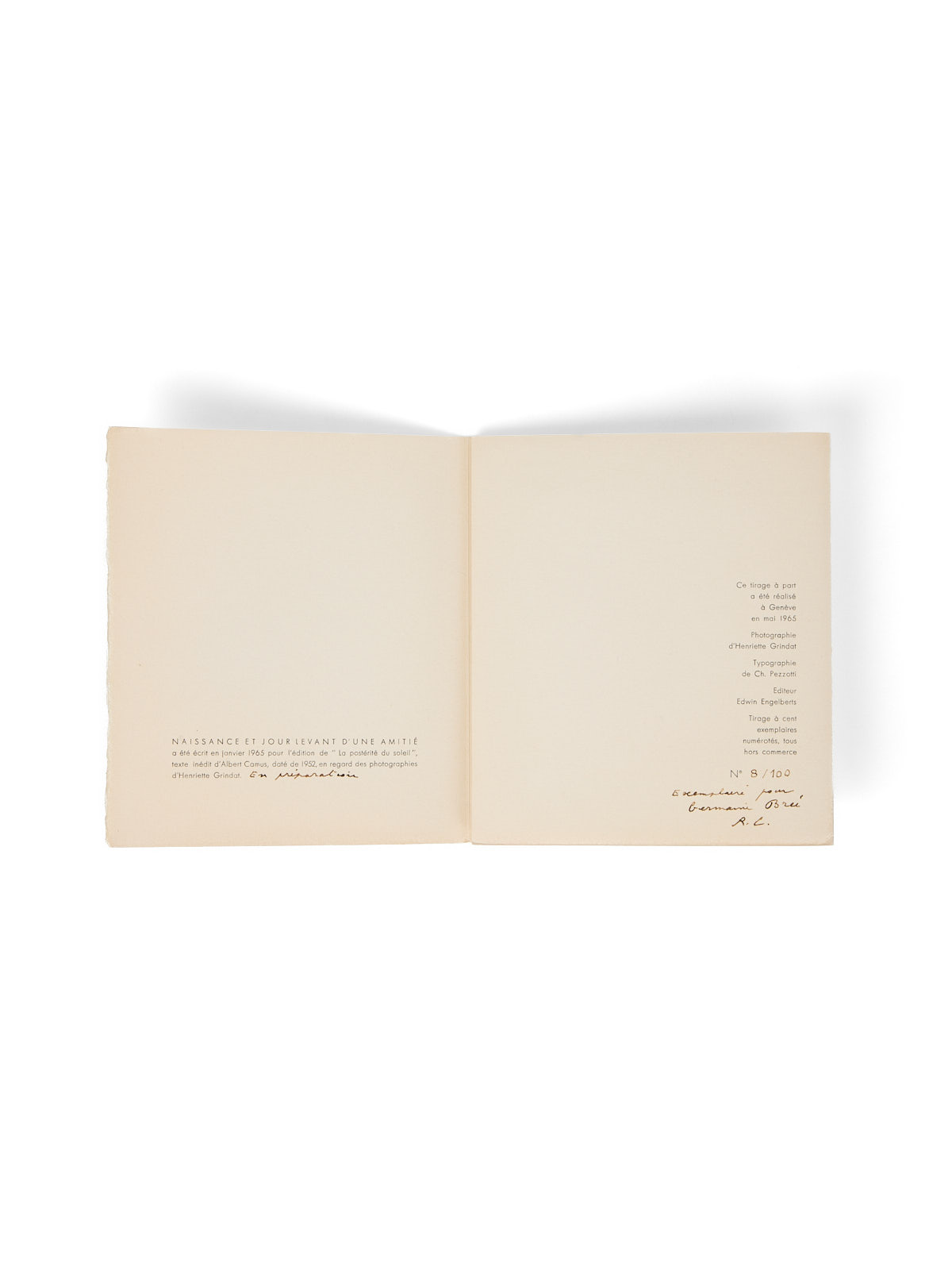
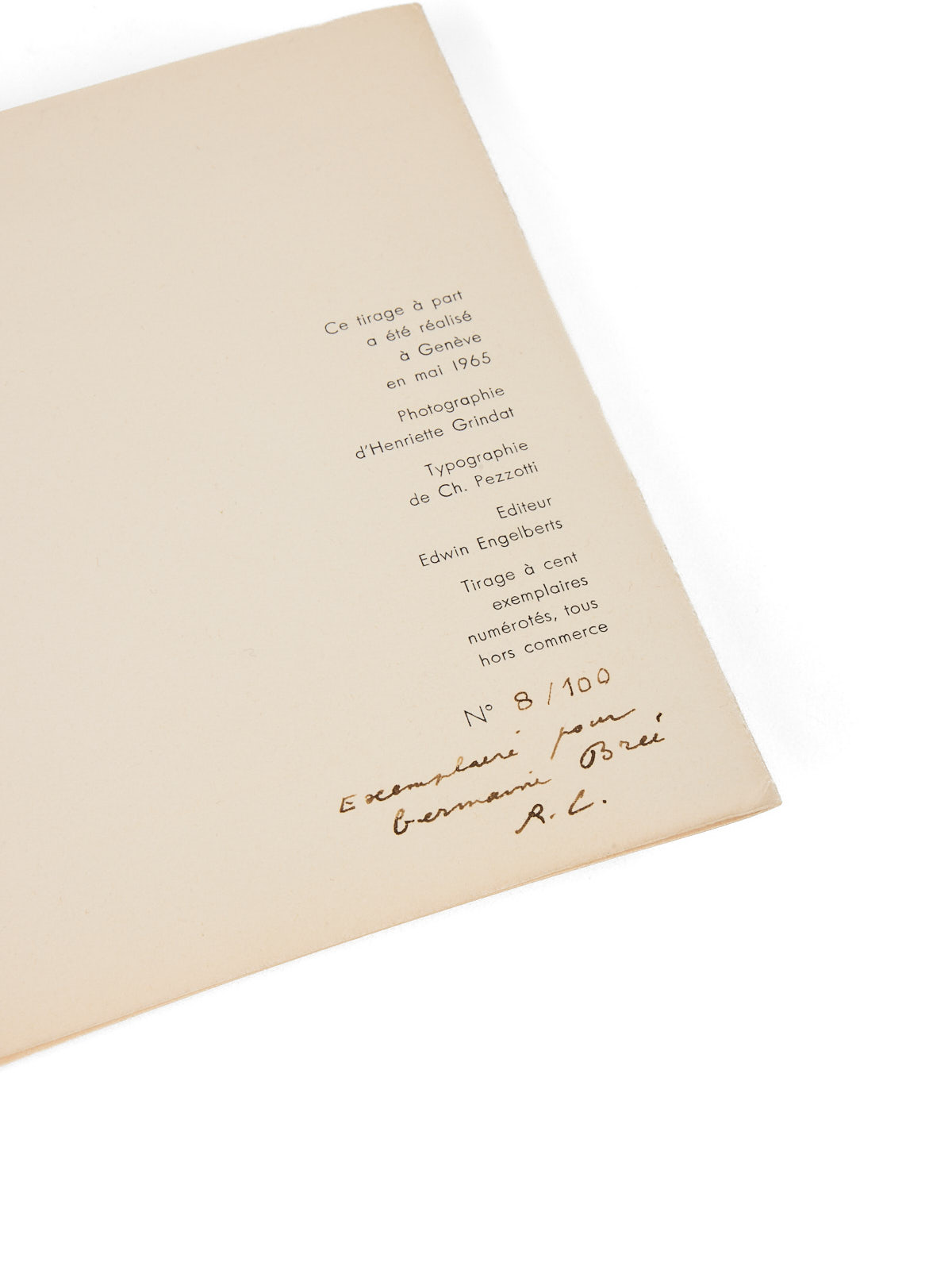
Signed presentation inscription: “Exemplaire pour Germaine Brée. R.C.”
The project of La Postérité du soleil was repeatedly postponed, then halted by Camus’s sudden death in January 1960. Four years later, the first edition of Camus’s works in the “Bibliothèque de la Pléiade” — undertaken by Roger Quilliot, in which Char, because of his close friendship with Camus, declined to take part — gave Char the occasion to revive, in Camus’s memory, the publication of La Postérité du soleil.
He decided to add this luminous text, which had first been recorded in January 1965 at Edwin Engelberts’s, in Geneva. This booklet was then set in May, while Char and the publisher were working on the main volume, itself to be limited to 100 copies, to accompany this “advance separate printing” at the end of the year.
These 100 copies, published as early as May, constitute the true first edition of the text and were, before publication, given only to a few close friends (copies are known to have been given to Erwin Engelberts, Francine Camus, Henriette Grindat, Roger Quilliot, Claude Gallimard, José Corti and Maryse Lafont), before the remaining copies were added to the volumes published in December.
Few copies encountered contain it.
This copy was presented by René Char to Germaine Brée: a major figure of the French-American intellectual world, this exacting and committed critic, born in France, pursued brilliant studies at the Sorbonne and then at the University of Oxford, before teaching at the Lycée Fénelon and then in Algiers. During the Second World War, she joined the Forces françaises libres, attached first to intelligence services and then to cultural affairs. From London to Algiers, she played a discreet but decisive role in transmitting the voice of Free France through the media, the press, schools and intellectual circles. She was one of the first women to hold positions of responsibility within the Gaullist intellectual services.
After the war, she settled in the United States, where she became a professor at several major universities (New York University, Bryn Mawr, Yale, Columbia, then Wake Forest). She was among the very first to teach modern French literature and maintained an ongoing relationship with Albert Camus and René Char from the postwar years onward. In 1964 she published the first monograph devoted to Camus in the United States, and from the 1950s onward published numerous articles and studies on the poetry of René Char.
Fine condition and a distinguished provenance.