

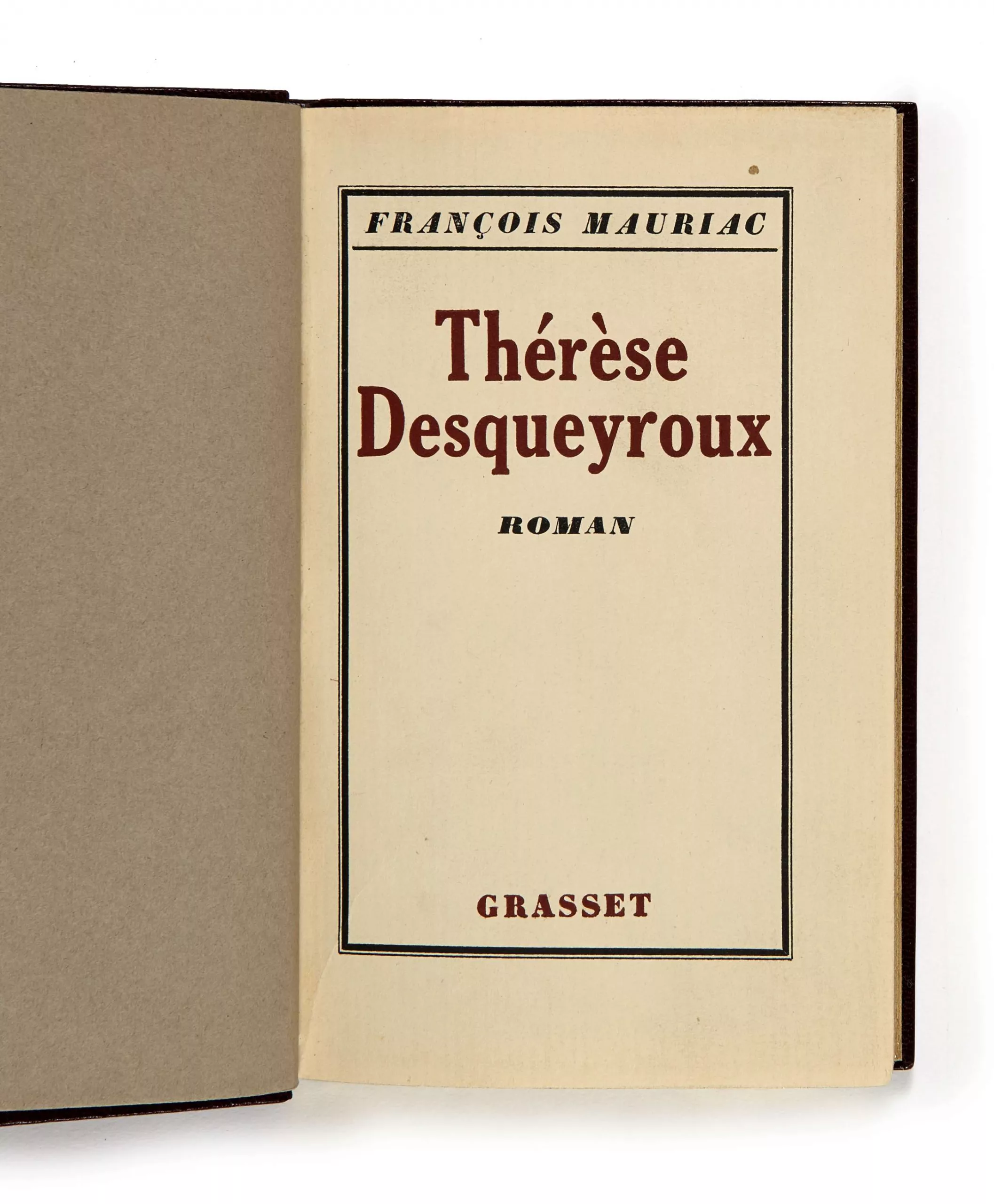
Thérèse Desqueyroux
One of 7 copies on Ronsard Muller paper, this copy no. 3.
This was the trial of 1905. François Mauriac, then a young writer of twenty-one, followed the case day by day in Bordeaux, an affair that gripped the whole of France. Fascinated by the young woman at its center, Henriette-Blanche Canaby, he drew from it three short stories, and then this novel, which translates the recurring Jansenist conflict between freedom and grace. But why on earth did she try to poison her husband? Did she hate him enough to want him dead?
Mauriac’s first great novel, it became his masterpiece and the work that led to his Nobel Prize in 1952, two years after Thérèse Desqueyroux was included on the list for the Grand Prix des meilleurs romans du demi-siècle, honoring the twelve finest novels published between 1900 and 1950.
Placed under the patronage of Baudelaire, with an epigraph drawn from Le Spleen de Paris (Mademoiselle Bistouri), Mauriac in turn tracks Satan through the depths of human psychology and the structures of society: this is his ambition as a novelist. Thérèse Desqueyroux is not Emma Bovary; she does not escape into fusional dreams, but remains possessed by a malaise, a romantic dissatisfaction, ill-suited to the coarse rural world to which she is condemned. A complex, uncompromising novel, it also condemns a self-righteous landed bourgeoisie, guilty of a lack of openness, generosity and any thirst for the absolute. How, then, can Thérèse and her grace find a way through the guilty thickness of proud and contemptuous Christians?
Provenance: Charles Hayoit (bookplate; sale, Paris, November 30–December 1, 2001, no. 1091).