

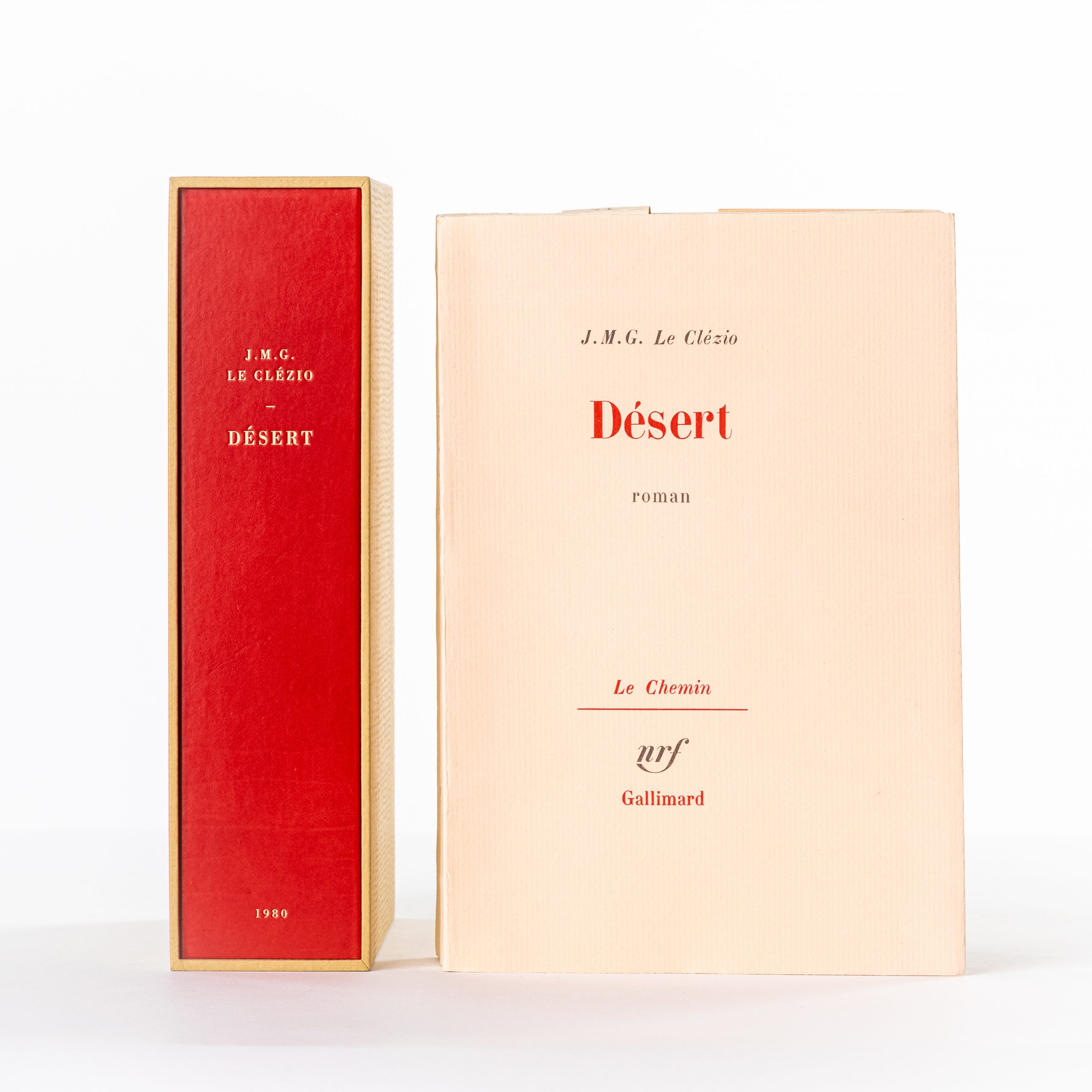
Désert
One of 31 copies from the deluxe issue on vergé de Hollande paper (no. 21).
“Saguiet el Hamra, winter 1909–1910. They appeared, as in a dream, at the top of the dune, half hidden by the haze of sand raised by their feet. Slowly they descended into the valley, following the almost invisible track.” These are the Tuareg, the “blue men,” so called because “their dark skin had taken on the reflection of the indigo” dye of their clothing. These nomadic people, so alien to modernity that they did not survive it, were also warriors, driven from south to north across the Rio de Oro by French conquest. Such is the epic of the people from whom Lalla descends, a young girl raised in a shantytown who will one day take the road of her ancestors. “They were born of the desert, no other path could lead them. They said nothing. They wanted nothing. The wind passed over them, through them, as though no one stood on the dunes. They had been walking since first light, without stopping, fatigue and thirst enveloping them like a shell.”
For this book, Le Clézio was awarded the Grand Prix Paul Morand, given for the first time by the Académie française.